Opinion · Oct 16, 2026
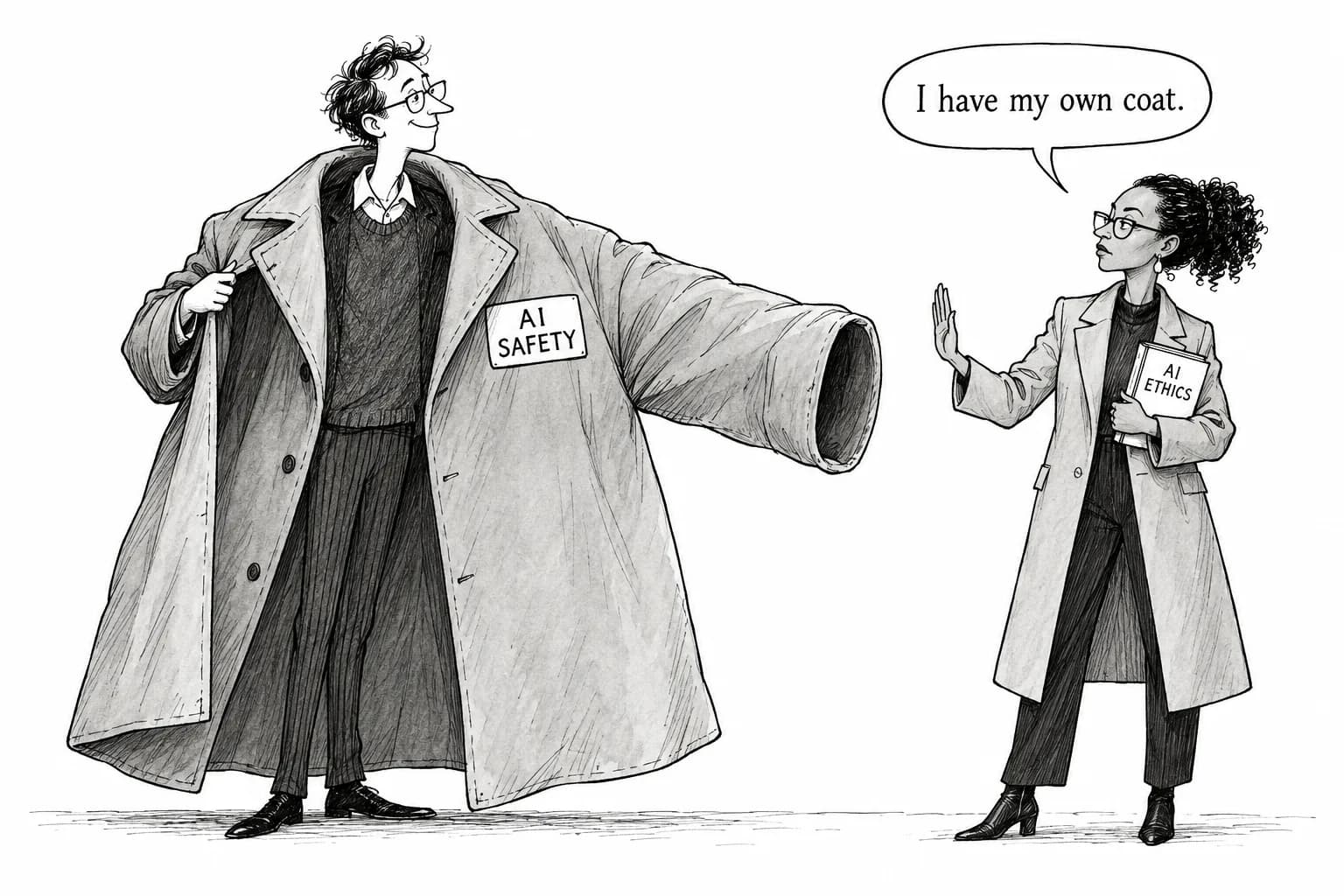
Scott Alexander's "AI Safety Is Not A Corporate Plot" calls for a safety–ethics "coalition," but on the ethics side, Birhane rejected that framing the same night
Alexander sorted the "corporate plot" argument into three types, rejected each one, and wrote that safety and ethics are allies fighting the same enemy. But a researcher on the ethics side, one of the people he counted as an ally, refused to have her work called AI safety at all
Koji Yamamoto · Economics Analyst

Key points
- Alexander sorted the view that AI safety is a corporate plot into three types and answered each one. He wrote that the safety camp and the ethics camp are a coalition fighting the same opponent (primary source)
- The same night, Abeba Birhane, from the ethics side, refused to have her work called "AI safety" at all (primary source, Bluesky)
- One side cannot form a coalition by announcing it. This week's Reuters report on "editorial control" and OpenAI's firing of safety researchers give the ethics side more reasons to keep its distance, not fewer
Scott Alexander has published "AI Safety Is Not A Corporate Plot" on his blog, Astral Codex Ten. Some critics say AI safety is a story that frontier labs built to benefit themselves. Alexander sorts this view into three types and rejects them one at a time. He then argues that the AI safety camp and the AI ethics camp are not rival factions but a coalition fighting the same enemy.
But the same night, Abeba Birhane, from the ethics side that Alexander had named as a coalition partner, put up a post on Bluesky. In it, she refused to have her work called AI safety at all. On the same night, the side making the invitation and the side being invited published texts that did not line up.
Alexander's argument: not a plot, but a coalition against the same enemy
Alexander's essay has two parts. The first sorts the claim that "AI safety is a corporate plot" into three types and answers each one. The second goes a step further and argues that the safety and ethics camps share interests. Both want to check the power of companies that dislike regulation and want to ship fast. So, in his view, they should be able to stand on the same side.
The "plot" argument has long come from the ethics side. The critique has several familiar lines. Talking about catastrophic risk makes models look more powerful than they are (so-called "criti-hype"). It builds regulatory moats that suit the incumbents. And it pulls attention away from harms happening now. Alexander's rebuttal can be read as aimed, broadly, at this tradition. Many people who talk about safety work outside the labs, he argues, and they also push for regulation the labs would rather avoid. So it is wrong to treat them as corporate publicists.
Birhane's refusal: not accepting the coalition's label
Birhane, known for her work on AI audits and training data, is one of the leading voices on the ethics side. What she offered that same night was not a rebuttal but a refusal. Her work is not AI safety, so she does not accept being grouped under that name.
The difference matters. Alexander's coalition argument assumes that the two camps keep their separate names while pointing in the same direction. That assumption is exactly what Birhane rejected. Put work on present-day harms under the big umbrella of "safety," and whoever holds the umbrella sets the agenda. From the ethics side, even a well-meant invitation turns the word "coalition" itself into a form of absorption.
Which reading does this week's news support?
Alexander's argument depends on whether the safety camp can be separated from the companies. This week's news makes that separation harder.
Reuters reported on October 13 that Anthropic and OpenAI had sought strong editorial control in contracts over what third-party evaluators embedded inside the companies could publish (secondary source). Anthropic called the report inaccurate, and OpenAI said it does not seek approval of full texts. Even so, the report conflicts with September's pledges of "without editorial control" and "editorial independence." Separately, OpenAI fired three safety researchers. One of them has written that the way they handled communications with METR was given as a reason. They countered that talking with outside evaluators was their job.
From the ethics side, both stories show the same thing. At the center of the organizations that speak the language of safety sit companies that want to decide for themselves how far evaluation and oversight are opened up to outsiders. Even without a plot, interests tilt toward the companies. Many individuals who talk about safety may be sincere, as Alexander says. But "AI safety" as an institution is built by the labs' safety frameworks and by the external evaluation systems shaped to fit them. Birhane's refusal reads less as a question about individual sincerity than as a question of whether to lend her name to that institution.
A coalition cannot be made by invitation
As a rebuttal to the plot theory, Alexander's essay holds together. But the coalition argument in its second half needs the other side to agree. Birhane's post the same night made clear that this agreement does not yet exist.
On calls for regulation, the two camps do sometimes line up. On October 14, on stage in Dublin, Microsoft's Brad Smith said the industry should get over its allergy to regulation. On the 13th, 406 scientists from 34 countries issued a letter calling for models with cyber capabilities to be air-gapped by default. The signers include voices from the safety side as well as other researchers. The two camps can line up behind specific demands. What they have not managed is to march under a single flag.
Alexander called it "the same enemy," but Birhane's side sees the safety camp as part of that enemy. An essay arguing for a coalition has failed to cross exactly this gap. That is the conclusion to draw from the two texts published on the same night.
Editorial cartoon