Rules & Policy · Nov 14, 2026
Cabinet members trade blame over chip sales to China as commerce secretary heads to hearing
The administration has said nothing more advanced than the A100 would go to China. Yet Megaspeed reportedly bought more than $4.8 billion of NVIDIA chips over two years, and the Treasury secretary, asked about the delay in blacklisting it, said "Commerce has the pen"
Koji Yamamoto · Economics Analyst
Key points
- The administration's stated policy is to keep AI chips more advanced than the A100 out of China. Yet Megaspeed reportedly bought more than $4.8 billion of NVIDIA chips over two years, and lawmakers are examining how Commerce approved chip sales
- Treasury Secretary Bessent, asked about the delay in blacklisting Megaspeed, said "Commerce has the pen," adding that Treasury and other agencies had favored it for months
- Commerce Secretary Lutnick has agreed to appear voluntarily before the Senate Banking Committee, whose chair has requested a public hearing on Dec. 10. The Commerce Department has also reportedly delayed adding Megaspeed to the Entity List (the list of parties subject to export restrictions)
[Update Nov. 14, 2026, 4:44] Jensen Huang, who has already stepped down, is now referred to as "former CEO" instead of "CEO." Details of the hearing that we had described as unconfirmed — the committee and the requested date — have been revised, based on reports, to "the Senate Banking Committee, which is seeking Dec. 10."
[Update Nov. 14, 2026, 9:25 JST] After rereading the sources, we corrected three points. (1) We had presented the claim that the Commerce Department approved about $4 billion in sales to Megaspeed as reported fact. It is a remark by Sen. John Kennedy, quoted by MS NOW, that Commerce "apparently" greenlit the sale, and it has not been verified (this explanation was corrected at 9:45 JST; at 9:25 we had wrongly said the claim was not in the sources); CNBC reported that Megaspeed bought more than $4.8 billion of NVIDIA chips over two years and that lawmakers are examining how Commerce approved chip sales. (2) We had quoted Treasury Secretary Bessent as saying Commerce issues the export licenses. He actually said "Commerce has the pen" about the delay in blacklisting Megaspeed, and said Treasury, Defense and State had favored blacklisting it for months. (3) Commerce Secretary Lutnick agreed to appear voluntarily before the Senate Banking Committee; the chair has requested a public hearing, but the format has not been set.
The U.S. administration has said it will not allow AI chips more powerful than NVIDIA's A100 to go to China. Yet Singapore-based Megaspeed reportedly bought more than $4.8 billion (about ¥770 billion) of NVIDIA chips over two years, raising questions about how the Commerce Department enforced its rules. Treasury Secretary Bessent, asked about the delay in blacklisting Megaspeed, said publicly that "Commerce has the pen." With cabinet members shifting blame onto one another, Commerce Secretary Lutnick has agreed to appear voluntarily before a Senate committee.
For Japanese companies: Most companies will see no immediate impact. Those affected are trading houses and manufacturers that sell GPU servers or semiconductor manufacturing equipment to Southeast Asia or China, and companies that rent data center capacity overseas. Export control officers should review this month whether they have complete records verifying their customers' end users. U.S. regulations can tighten suddenly, without warning.
Chips were not supposed to go to China, but Commerce reportedly approved the sales
At the heart of the issue is a gap between what the administration said and what it actually did. Under the administration's policy, the AI chips China can obtain are capped at the A100 level. But according to CNBC (Nov. 13), Megaspeed bought more than $4.8 billion of advanced NVIDIA chips over the past two years, and lawmakers are investigating how Commerce approved chip sales to companies linked to the Chinese government and military. Sen. John Kennedy said Commerce had "apparently" greenlit the sale of $4 billion in advanced chips to the company (MS NOW). If the chips ultimately ended up being used on the Chinese side, it would mean there was a hole in the policy.
The details of how the sales were approved — when, by which office, and for which chip models — remain unclear even in the reports. No primary documents have emerged showing that the Commerce Department formally approved anything.
Treasury secretary: "Commerce has the pen"
The blame-shifting within the administration came into the open with remarks by Treasury Secretary Bessent. According to MS NOW, Bessent, asked on Nov. 13 about the delay in blacklisting Megaspeed, said "Commerce has the pen," adding that Treasury, Defense and State had been in favor of blacklisting the company for months.
Export licensing is indeed the job of the Commerce Department's Bureau of Industry and Security (BIS). Still, a cabinet member saying so publicly is being seen as an effort to shift responsibility toward Lutnick. Reports say there have been calls for Lutnick to be removed, as well as talk of summoning NVIDIA's former CEO Jensen Huang to Congress.
Commerce secretary heads to a public hearing
Against this backdrop, Commerce Secretary Lutnick has agreed to appear voluntarily before the Senate Banking Committee, NBC News reported. Chair Tim Scott has asked him to testify at a public hearing on Dec. 10; the date and format have not been set. The key question is whether he will personally explain what was approved, when, and on whose authority.
Separately, the Commerce Department has delayed adding Megaspeed to the Entity List (a list of parties to which U.S. companies cannot sell without a license), AI Weekly reported. Being placed on the list would, in principle, halt sales to Megaspeed. The reason for the delay is unknown.
What to watch next
The following four developments will determine whether regulations move toward tightening.
First is the hearing: its date, and whether the testimony will be given under oath. Second is whether Megaspeed is added to the Entity List. Third is whether the Commerce Department issues a new rule barring Chinese companies from renting and using chips in data centers in other countries. Fourth is how NVIDIA explains its China sales in its earnings report scheduled for Nov. 17. In Congress, there is also a push to include a bill tightening export controls in the defense spending legislation (NDAA).
What we could not verify
This article is based on media reports; we were unable to consult primary announcements from the government or NVIDIA. None of the following has been verified: whether the Commerce Department specifically approved sales to Megaspeed, the official hearing schedule and format (the Senate Banking Committee chair has requested a public hearing on Dec. 10, but nothing has been decided), and who ultimately used the chips. The $4.8 billion figure comes from CNBC's reporting and may differ from actual documents. Dollar figures have in the past differed significantly between media reports and actual documents. The numbers may change in follow-up reports.
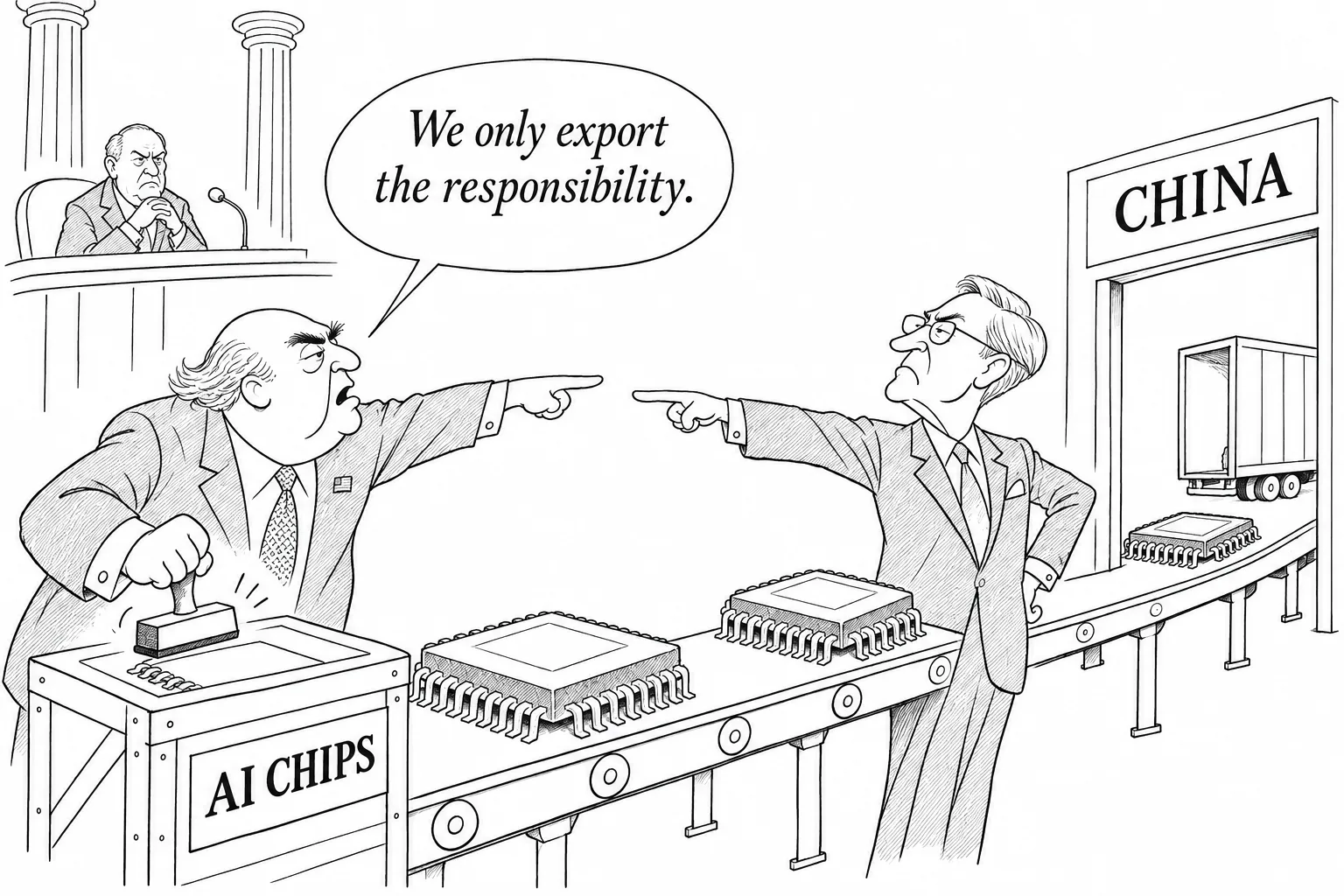
Editorial cartoon
Sources
- https://www.ms.now/news/bessent-lutnick-nvidia-trump-huang-chips
- https://www.nbcnews.com/politics/congress/commerce-secretary-howard-lutnick-testify-pressure-nvidia-scandal-rcna609093
- https://www.cnbc.com/2026/11/13/nvidia-scandal-lutnick-chip-sales.html
- https://aiweekly.co/alerts/commerce-delays-entity-list-additions-megaspeed-stays-off