Work & Society · Oct 29, 2026
PayPal says AI agents resolved 24 million inquiries
The agents answer customers in 190 countries and six languages, and credit decisions take about half as long in Canada, Italy and Spain. Still, the company does not credit AI with all of its $1.5 billion in cost cuts
Koji Yamamoto · Economics Analyst

Key points
- PayPal's conversational AI agents have resolved more than 24 million inquiries so far this year, across 190 countries and six languages
- In Canada, Italy and Spain, credit decisions now take about half as long
- The company does not credit AI with all of its $1.5 billion in cost cuts, and it gave no figure for AI's share
On October 27, PayPal used its third-quarter 2026 earnings call to put numbers on what happened after it brought AI agents into customer service and credit decisions (Earnings call transcript). Its conversational AI agents have resolved more than 24 million customer inquiries since the start of the year, across 190 countries and six languages. In Canada, Italy and Spain, credit decisions now take about half as long.
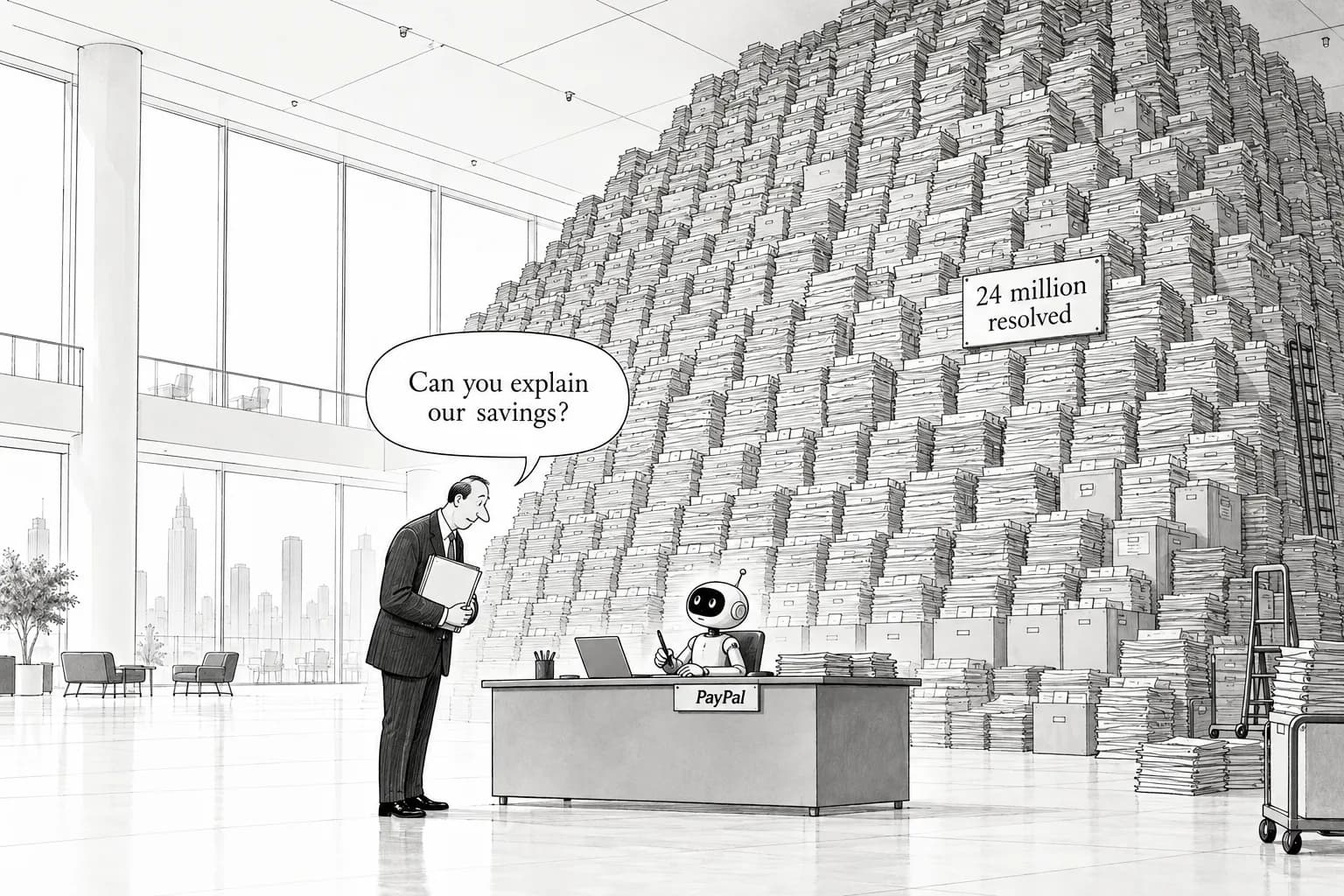
On the same call, the company said it is carrying out $1.5 billion in cost reductions. It did not say that all of those savings come from AI, and that is the most important point in this story. PayPal gave clear numbers for what the agents did, but it did not separate out how much of the savings the agents produced.
The scale of 24 million
The 24 million figure covers roughly 10 months since the start of the year. Reaching 190 countries and six languages means that at a payments company, customer service in almost every market now goes through an AI agent first.
The figure counts inquiries the agents resolved, not inquiries they answered. That suggests it counts conversations that ended without a handoff to a person. The transcript does not say how PayPal defines a resolution, what share of inquiries went on to human staff, or how customer satisfaction changed.
Credit decisions in half the time
The second number concerns work that goes further than customer service. In Canada, Italy and Spain, credit decisions now take about half as long. That means agents are now part of deciding whether to lend money.
In lending, every delay and every mistake costs money directly. Cutting decision time in half is a gain, but the quality of those decisions is a separate question. Research Anthropic published on October 27 found that 86% of the choices made by experts analyzing data with Claude Code matched the agent's leanings, and that serious errors fell from 55% to 6%. Agents can make work faster and more accurate, but they can also shift human judgment without people noticing. PayPal did not say whether approval rates or default rates changed. It also did not say why the change is limited to three countries, or when it might reach other markets.
Not giving AI credit for the $1.5 billion
What stands out in these results is what the company did not say. On the same call where it highlighted big numbers for its AI agents, PayPal did not say that all of the $1.5 billion in savings comes from AI.
Companies now routinely point to AI when they announce cost cuts on earnings calls. Even so, the transcript gives no breakdown of PayPal's savings: no split between AI-driven automation and other measures, such as reorganization or cutting back on outsourcing. Nor did we find any figures tying past or planned job cuts to AI.
This could be read as honesty, or as caution. Playing up AI's effect could lift the stock, but it would also invite criticism over jobs and attention from regulators. Playing it down would raise questions about whether the money spent on agents is paying off. PayPal chose a middle path: it gave numbers for case volumes and decision times, but did not say how much money the agents saved.
How to measure what agents deliver
So far, the numbers companies give after adopting agents are mostly about how many cases the agents handled and how much time they saved. PayPal's 24 million inquiries and its halved credit decision times fit that pattern. What is missing is how those results affected costs and revenue.
In October, Anthropic gave figures showing that inside the company, agents now put in six times as many working hours as humans, and that it is hiring fewer junior engineers. The next question is whether large corporate customers will likewise measure the impact of agents in headcount and dollars. A key thing to watch in PayPal's coming earnings reports is whether it says how much of the $1.5 billion comes from AI.
Editorial cartoon