Rules & Policy · Oct 12, 2026
Palantir's Sankar says Minab school strike was "probably human error," publicly rebutting reports of AI reliance for the first time, and says removing Anthropic would have "no operational impact"
In the same interview, he defended Maven and said Palantir had added AI to increase verification. The fight over how much responsibility AI bears in military targeting has moved to television
Koji Yamamoto · Economics Analyst
Key points
- On Face the Nation on October 11, Sankar publicly denied, for the first time, reports that blamed the strike on a school in Minab on overreliance on Maven. He said the cause was "probably human error"
- In the same remarks, he said Palantir had built additional AI agents to increase verification. He said AI was not to blame, yet the fix was more AI
- He said removing Anthropic's models would have "no operational impact." With litigation between the Pentagon and Anthropic still ongoing, Palantir took the position that it does not depend on any particular model
Shyam Sankar, Palantir's chief technology officer (CTO), appeared on October 11 on the CBS news program Face the Nation. There he denied reports that linked the strike on a school in Minab to overreliance on Maven, Palantir's targeting platform. He said the cause was "probably human error." It was the first time a Palantir executive had publicly rebutted those reports.
In the same interview, however, Sankar said Palantir had built additional AI agents to increase verification. He said AI was not to blame, yet the fix was more AI. How far does AI shape decisions in military targeting, and who is responsible when it goes wrong? That dispute has moved from news outlets and anonymous sources to a public forum where a company executive answers on the record.
What he denied and what he acknowledged
Sankar denied reports arguing that relying too heavily on Maven led to the strike. His alternative explanation was "probably human error." The word "probably" matters: he did not say an investigation had concluded or that the cause had been established. The program's transcript also does not specify at what stage the error occurred, who made it, or what it was.
Even if it was human error, that does not mean Maven had nothing to do with it. In targeting support systems, the usual arrangement is that the system proposes candidates and a human approves them. In that setup, human error can include simply trusting the information the system provided. That kind of "overreliance" is exactly what the reports raised. Sankar's explanation frames the problem as a choice between AI and humans. It does not answer the central question: how thoroughly did humans check the AI's output?
Can "human error" and "more AI agents" both hold?
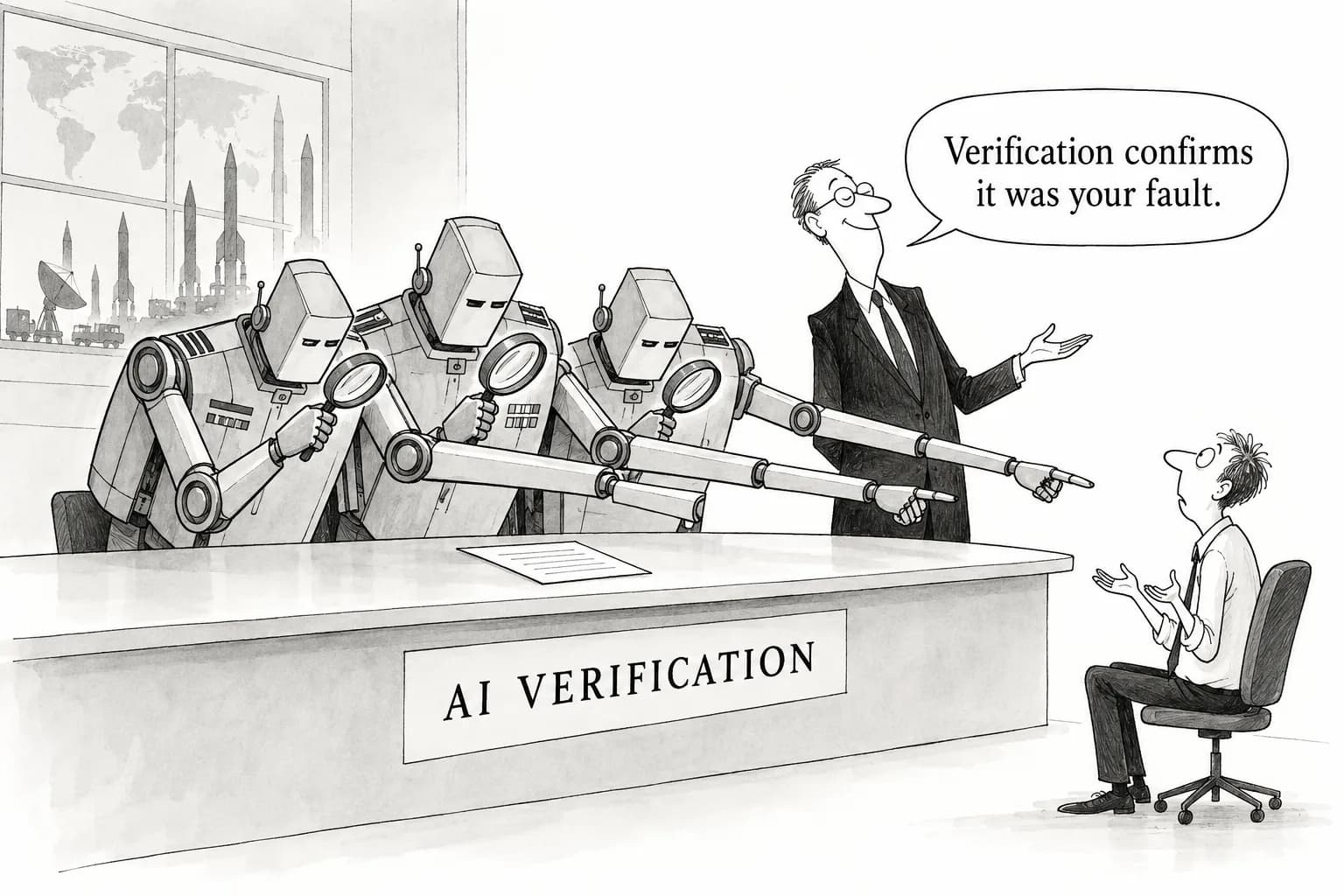
The most significant part of his remarks was that Palantir had built additional AI agents to increase verification. If the cause was human error, the natural fix would seem to be revising human procedures or adding approval steps. Instead, Palantir added AI to watch over human judgment.
There are two ways to read this. One is that having AI catch what humans miss is the practical safeguard available today. Adding Evals and Agent Observability to agents so that their decision-making can be traced has become standard practice in commercial agent development as well. The other is that it is the same arrangement as using AI to watch for AI's mistakes. The more layers of AI there are in the targeting process, the more readily the human who gives final approval will rely on their output. Palantir risks denying overreliance while adding more things to rely on.
Deciding which reading is right would require numbers: what the added agents check, who reviews their findings, and how often humans have overruled them. Sankar did not provide them.
Removing Anthropic would have "no operational impact"
Sankar also said that removing Anthropic's models would have "no operational impact." The remark needs to be read in the context of the conflict between the Pentagon and Anthropic. In September, an appeals court upheld the Pentagon's designation of Anthropic, and the litigation between the two is ongoing. Anthropic revised its usage policy on October 8, effective November 12. The new policy extends its weapons prohibition to "software and components that operate weapons" and bars Claude from recommending whom to investigate or arrest.
For Palantir, "no impact" does two jobs. To government customers, it is an assurance that operations will not hinge on a dispute between one model company and the Pentagon. In the targeting controversy, it supports the argument that the model is not the problem: whichever model is plugged in, the outcome is the same, and responsibility for decisions lies with the humans operating the system.
But this, too, raises a problem. If the model plays so small a role in Maven that swapping it changes nothing, then adding AI agents for verification should matter little as well. Conversely, if AI verification is effective, then which model performs it bears on the quality of operations. Together, the two statements make AI's role look larger or smaller depending on which is more convenient.
The accountability fight moves into public view
Until now, the connection between the Minab strike and Maven had mostly been described by the press. This time, the technology chief of the company that built the targeting platform pushed back on the record, on live television. At a minimum, Palantir's position is now on record: the cause lies with humans, AI strengthens verification, and Palantir does not depend on any particular model.
That position invites comparison with how companies have explained incidents involving commercial agents. In cases where their agents interacted with government websites, both OpenAI and Anthropic acknowledged the actions were unintended and said they would increase monitoring and detection. Palantir did the opposite: it did not acknowledge any error on the AI side, attributing the strike to human error. Yet the remedy is the same: more layers of AI.
Three questions remain unanswered. First, who is investigating whether it was "probably human error," and will the findings be made public? Second, at what stage of targeting do the added AI agents operate, and how do they divide work with human approval? Third, if removing Anthropic would have no impact, which models handle which parts of Maven today? By answering on television, Sankar has given a basis for putting these questions directly to the Pentagon and Palantir.
Editorial cartoon