Infrastructure & Security · Oct 11, 2026
Oracle trucks natural gas to power data centers at about 4 times pipeline cost; pipeline delays put Project Jupiter's schedule at risk ahead of Oct. 19 hearing
Unable to wait for a grid connection, operators generate their own power — and then the fuel can't arrive in time either. Gas supply is reportedly emerging as a new bottleneck in AI data center construction schedules
Seiichi Tanaka · Editor-in-Chief

Key points
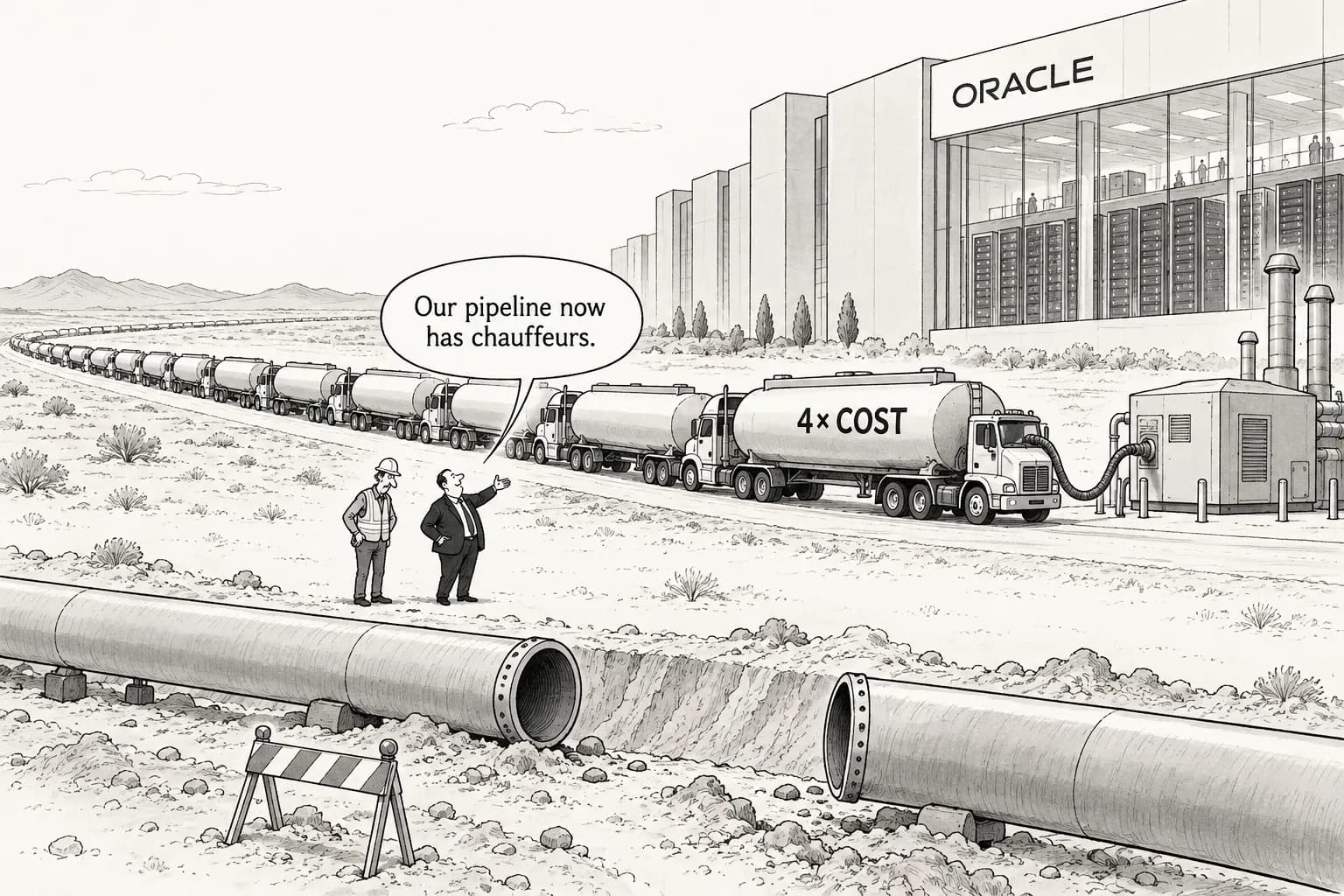
- Oracle is reportedly trucking compressed natural gas to generate power for its data centers, at a cost said to be about 4 times that of pipeline delivery
- On-site generation avoids the wait for a grid connection, but the pipelines needed to deliver fuel have become a new constraint on construction schedules
- Project Jupiter faces schedule risk from reported pipeline delays ahead of an October 19 public hearing and a November 23 deadline
Oracle is reportedly transporting natural gas in compressed form by truck to power its data centers (SupplyChainBrain). According to the report, the cost is about 4 times that of delivery by pipeline. This article is based on media reports, and we have not been able to verify the details against primary sources such as Oracle announcements or regulatory filings. Both the figures and the details should be read as reported, not confirmed.
Even so, the picture the report paints is clear. Waiting in line for a grid connection is not the only thing holding back AI data center schedules. Operators that sidestep the grid by generating power on-site then run into a different problem: how to get the gas there. Oracle's willingness to pay 4 times the cost to move fuel by truck suggests the company has concluded that waiting for a pipeline would leave its computing capacity unable to come online in time.
Bypassing the grid leads to a fuel problem
Over the past year, the multi-year wait to connect to a utility's grid has been seen as the biggest constraint on large AI data centers. The response has been a shift toward self-generation, with gas turbines and similar equipment placed on or near the site. Skipping the grid queue makes it easier to bring power online at the same time the buildings are finished.
Self-generation, however, requires a way to receive large volumes of fuel without interruption. That is normally the job of a pipeline, but pipelines also need land acquisition, permits and construction. The trucking reported at Oracle appears to be a stopgap to fill that gap in the construction timeline. Put another way, the bottleneck has not disappeared; it has simply moved one step upstream, from transmission lines to gas lines.
What the roughly 4x cost means
According to the report, trucking costs about 4 times as much as pipeline delivery. Fuel is the core of generation costs, so the difference feeds directly into the unit price of power. If Oracle has nonetheless chosen this approach, it implies that timing matters more than the price of fuel. The calculation is that leaving billions of dollars' worth of GPUs idle without power costs more than expensive fuel.
Trucking is not a method that can go on indefinitely, however. Each truck carries a limited volume, and running a large campus requires ever more trucks and trips. Road congestion, noise and the safety of handling compressed gas could cause friction with local communities, and any disruption from weather or logistics would translate directly into a risk of generation stopping. The longer the reliance on a stopgap lasts, the heavier the cost and operational burden of pipeline delays becomes.
Project Jupiter: pipeline delays and the Oct. 19 hearing
The problem is most concrete at Project Jupiter, a large AI data center project involving Oracle, where pipeline delays are reported to be unsettling the schedule. The project faces a public hearing on October 19, and the deadline we are tracking is November 23. Both could bring scrutiny of how the project will secure its fuel.
For projects that generate power on-site, fuel delivery is tied to air permits, local approval and the construction schedule alike. If the pipeline is not ready in time, the options are to fill the gap with trucking, delay the start of generation, or scale the project down. The key question at the hearing is how much will be disclosed about the fuel supply outlook and the scale of transport during the interim period. However, it has not been confirmed, even in media reports, whether there are actual plans to truck gas to Jupiter or how far the pipeline has slipped.
The race for compute becomes a race for fuel logistics
The computing capacity behind training and inference of frontier models only runs when chips, buildings and power are all in place. If the reports are accurate, Oracle's case shows that the power constraint has worked its way down to the logistics of gas supply. For Oracle, which holds massive compute contracts with OpenAI, schedule delays directly affect when it can book revenue. That gives it a strong incentive to rush capacity online, even with expensive fuel.
There are three things to watch. First, whether Oracle itself acknowledges the trucking and its cost in disclosures or earnings commentary. Second, how the pipeline completion outlook and interim fuel arrangements are presented at Project Jupiter's October 19 hearing and by the November 23 deadline. Third, whether other operators emerge with fuel supply similarly constraining their schedules. Beyond the grid queue lies another line. Reading an AI data center's construction schedule now means looking not only at transmission lines but at gas lines too.
Editorial cartoon