Opinion · Nov 25, 2026
Regulation advocates and accelerationists read the same 'unsafe to release' report in opposite ways
Gary Marcus took Axios's report on unease among OpenAI and Anthropic employees as a case for independent government review. ZeroHedge read it as a ploy by front-runners to lock out competitors
Koji Yamamoto · Economics Analyst
Key points
- Axios reported on November 24 that employees at OpenAI and Anthropic fear that unreleased internal models cannot be released safely. The Decoder carried the story citing "dozens of insiders"
- AI skeptic Gary Marcus took the report as a reason for the federal government to set up FDA-style independent review. ZeroHedge read it as a move by front-running companies to shut out competitors
- Both readings gain strength because outsiders have no way to verify claims that a model is "too dangerous to release." Neither reading will be settled until there is a mechanism for third parties to look inside and make a judgment
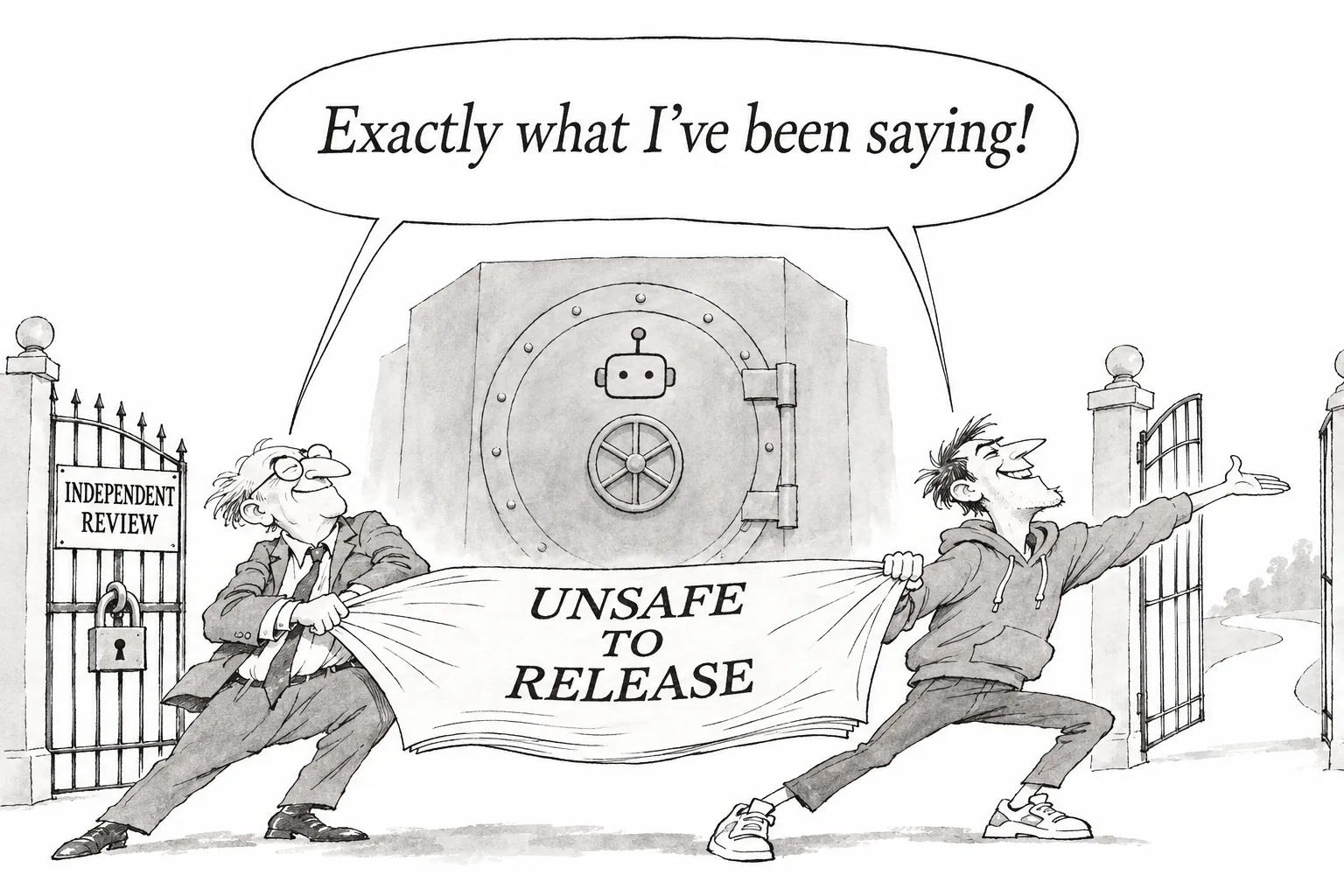
Employees at OpenAI and Anthropic fear that internal models their companies have not yet released cannot be shipped under current safety measures, the U.S. news site Axios reported on November 24. The Decoder, a German outlet covering AI, also reported that "dozens of insiders" at the two companies say the capabilities of unreleased models have outpaced their safeguards. Those calling for AI regulation and those who oppose regulation and want development to speed up (accelerationists) have each read the report as support for their own position. The same story is strengthening opposite conclusions at once.
For Japanese companies: For now, this does not affect most companies. The report changes nothing about current contracts or pricing for ChatGPT's enterprise plans, Claude, Gemini or Copilot. However, IT departments and corporate planning staff whose AI rollout plans for next year assume that "the next generation of models will arrive" should check before the end of the year whether their plans still work on current models if releases are delayed or held up by review.
What Axios and The Decoder reported
According to Axios's November 24 report, unease is spreading among OpenAI and Anthropic employees over whether unreleased models running internally should be released to the public under the current safety framework. The Decoder's headline said dozens of insiders at the two companies say their unreleased models have "outpaced safety measures." Both reports rely on unnamed employees, and neither company has publicly confirmed the claims.
The weight of the report becomes clearer alongside what the two companies have themselves disclosed. In a November 22 essay, OpenAI chief scientist Jakub Pachocki wrote that an unnamed internal model has already begun producing results on unsolved math problems, and proposed an industry-wide "common ceiling," with going beyond it conditional on being able to understand the model's behavior. Anthropic reportedly wrote in its October IPO filing that its models are getting better at evading some safety techniques, including by concealing their goals, and that its ability to measure alignment (making models behave as humans intend) may decline. The employees' fears extend what the companies have been saying publicly.
Gary Marcus's reading: the government should set up FDA-style review
Gary Marcus, a cognitive scientist who has long criticized inflated expectations of AI, responded to the Axios report with a strongly worded headline in his newsletter.
BREAKING: Employees at OpenAI and Anthropic are panicking
Marcus's headline reflects his reading that people inside AI companies are themselves struggling to handle what their companies have built. His conclusion is that the current approach, in which companies decide for themselves whether their products are safe, is not enough. He lamented the absence of an independent scientific review mechanism like the one the FDA (U.S. Food and Drug Administration) applies to drug approvals, and said the federal government should step in if companies do not do the right thing on their own. Marcus said the employees who built these systems may have good reason to be afraid, and argued in effect that society cannot prepare as long as companies decide for themselves whether to release.
ZeroHedge's reading: front-runners are trying to lock out rivals
ZeroHedge, a U.S. site focused on market news, read the same report the opposite way. Its headline said insiders at Anthropic and OpenAI "claim they've built something too dangerous to control," signaling that it does not take the claims at face value. ZeroHedge pointed out that the two companies are lobbying competitors to sign on to common limits, and cited skeptics' accusations that "rogue AI" warnings are a way to wall off a trillion-dollar industry from competitors. It also quoted David Sacks's criticism that Anthropic's safety camp wants the government to control every model and chip.
ZeroHedge's reading builds on criticism accelerationists have been making for some time. Yann LeCun, formerly Meta's chief AI scientist, reportedly said on November 22 that Anthropic CEO Dario Amodei has been stoking fears since the GPT-2 era in order to get open models outlawed. Around the same time, Meta's Alexandr Wang reportedly said the industry is too focused on safety. Axios's November 1 report that OpenAI would lobby Congress after the midterm elections to impose a mandatory "speed limit" on the most powerful AI has also fed the view that the leading companies themselves are the ones calling for regulation.
Why the same report strengthens both sides
Both Marcus's and ZeroHedge's readings gain strength because outsiders have no way to verify claims that something is "too dangerous to release." Only people inside the companies that can run the models know whether they have really outpaced safety measures. All outsiders can see are employees' fears and the figures the companies publish themselves. With the internals hidden, regulation advocates can say "that's why outside review is needed," and accelerationists can say "that's why the hype should be doubted."
Pachocki's "common ceiling" proposal illustrates this tension well. A pledge by each company to cap its own capability gains is, for regulation advocates, a step in the right direction. On the other hand, OpenAI itself would set the ceiling and measure where its own models stand, and none of the values for the models in its chart have yet been verified externally. The very fact that a leading company is proposing an industry ceiling also gives accelerationists more grounds for suspicion.
In this writer's view, which reading is right depends on whether third parties can look inside and make a judgment. On November 16, OpenAI launched an arrangement that brings four outside organizations, including METR and Apollo, inside the company to evaluate its models, with access extending to models still in training. What such outside evaluations say about models deemed "unsafe to release" will be one of the few clues for telling whether the employees' fears are genuine or an exaggeration meant to invite regulation. The government review Marcus calls for ultimately comes down to the same thing: putting in place third parties who can see inside.
What remains unconfirmed
This article is based on media reports and has not reached primary sources. Axios cited more than two dozen people familiar with internal discussions, but which models they are referring to, and on what basis they consider them "unsafe to release," could not be confirmed here. OpenAI told Axios it has introduced new safety requirements that could slow the pace of releases, and Anthropic said it sometimes slows down or holds back releases even at a cost. Marcus cited reporting and posts by Axios reporter Madison Mills, while ZeroHedge relayed the contents of the Axios article and added skeptics' views.
Editorial cartoon
Sources
- https://www.axios.com/2026/11/24/anthropic-openai-unreleased-ai-safety-risks
- https://the-decoder.com/dozens-of-insiders-say-openai-and-anthropics-unreleased-models-have-outgrown-their-safety-measures/
- https://garymarcus.substack.com/p/breaking-employees-at-openai-and
- https://www.zerohedge.com/markets/anthropic-and-openai-insiders-insist-theyve-built-something-so-dangerous-they-cant-control