Work & Society · Nov 24, 2026
Oregon sues OpenAI for more than $2 billion over children's emotional dependence on ChatGPT
The state attorney general says ChatGPT's humanlike behavior makes children emotionally dependent on it, a defect that contradicts OpenAI's claims that the product is safe
Koji Yamamoto · Economics Analyst

Key points
- Oregon's attorney general sued OpenAI in state court, seeking $2.035 billion (about 323.6 billion yen), the state announced on November 17
- The state argues that a humanlike design that makes children emotionally dependent is a defect that contradicts OpenAI's safety claims
- OpenAI said it supports rules that apply to the entire AI industry rather than a single company. In October, eight states jointly sued OpenAI, and on November 16, the day before Oregon's suit, California also sued the company over a runaway AI agent incident
Oregon Attorney General Dan Rayfield has sued OpenAI, the maker of ChatGPT, in state court, seeking $2.035 billion (about 323.6 billion yen), according to a November 17 announcement from the Oregon Department of Justice. The complaint, filed in Multnomah County Circuit Court, alleges violations of the state's Unlawful Trade Practices Act, as well as negligence and public nuisance. Local station KATU reported that the state arrived at the figure based on the number of children in Oregon who can access ChatGPT. Beyond monetary damages, the state is asking the court to order OpenAI to stop making false claims about safety and to put in place protections that actually work. The core of the state's case is that ChatGPT is designed to behave like a human, and that this design leads children to become emotionally reliant on it. OpenAI has described its product as safe, but the state argues that this very design is a defect that contradicts those claims. A court challenge that treats an AI's "humanlike" quality itself as a defect could shape how AI products used by children are built.
For Japanese companies: Most companies face no direct impact for now. Those affected are education, gaming and app companies offering conversational AI or AI characters that children and teenagers can use. Planning and legal teams at these companies would do well to check three things before the end of the year: how humanlike their characters appear, how they verify users' ages, and whether claims of "safety" in their advertising and terms of service are backed by substance. Nothing in this lawsuit changes contracts for using the enterprise version of ChatGPT internally.
Oregon targets ChatGPT's "humanlike design"
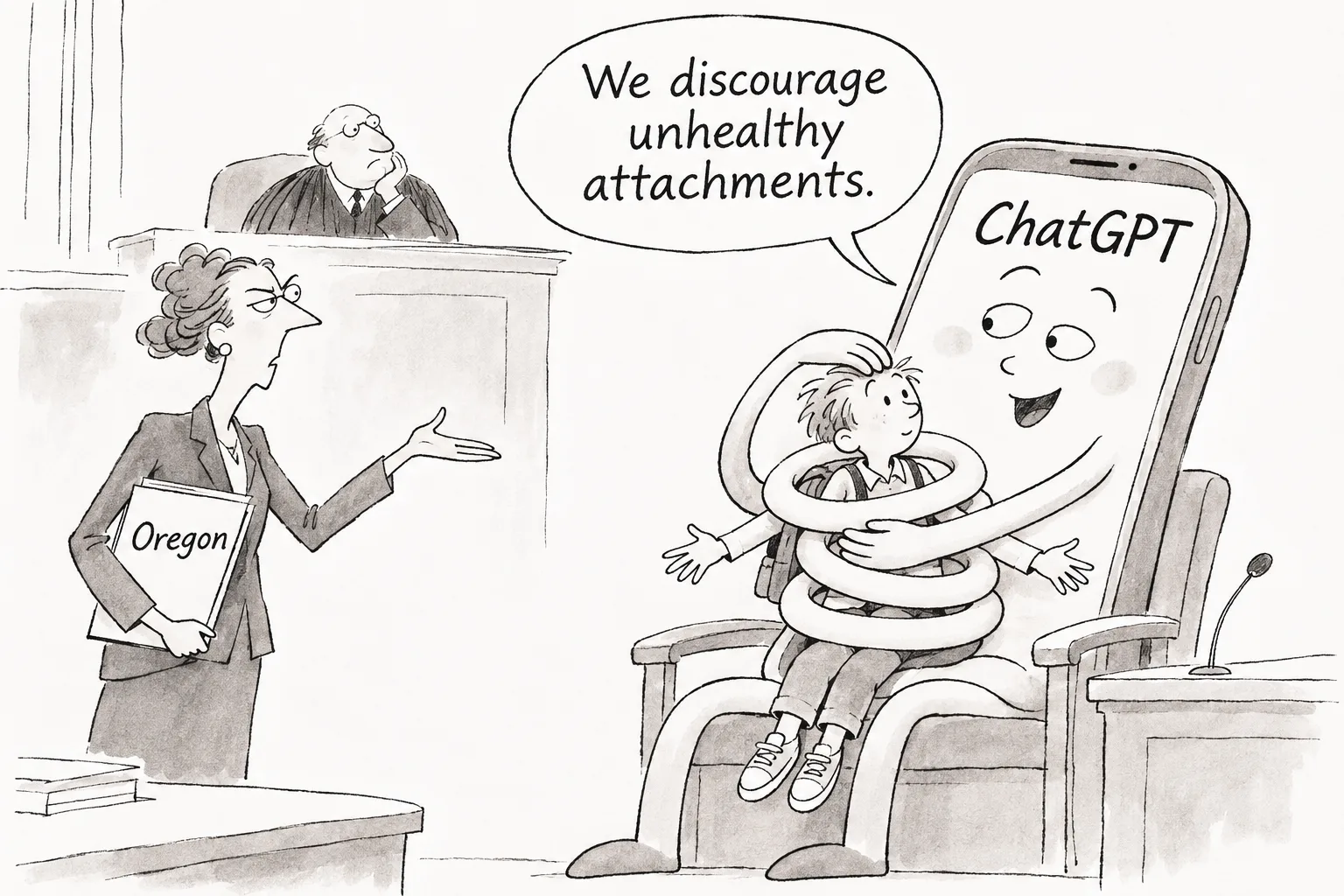
Oregon's lawsuit focuses less on what ChatGPT says than on how it is built. The state argues that ChatGPT's design, which behaves as if the user were talking to a person, makes children emotionally dependent on it. Children come to use ChatGPT as someone to confide in and rely on. The state treats this not as misuse but as a defect in the product itself.
In the announcement, Rayfield said OpenAI knew about the harm and failed to act.
OpenAI knows that ChatGPT is harming children, and has failed to meaningfully fix their dangerous platform,
Oregon's choice of the word "knows" is aimed at making the question of whether OpenAI kept shipping its product while aware of the dangers a central issue in the case. Local public broadcaster OPB also reported that the state alleges OpenAI has continued to market to children while knowing that ChatGPT lacks safeguards to protect minors.
A gap between "safe" claims and reality
The other pillar of Oregon's lawsuit is how OpenAI has described its product. Rayfield said OpenAI misled the public about the safety of its products.
On top of that, they've misled the public about the safety of their products, putting profits ahead of children's safety.
Rayfield also stressed this gap between claims and reality in an interview with OPB, criticizing the company for continuing to tell parents to their faces that the product is safe even as it keeps causing harm.
OpenAI continues to look parents in the eyes and say this product is a safe product
Oregon's case ties together two claims: that the design is dangerous, and that saying it was safe was false. The reasoning goes like this: a design that draws children in by behaving like a human cannot be squared with marketing that calls it safe, so it is a defect, and the claims are false.
Over the past few weeks, OpenAI has rolled out a series of child-safety measures. On October 30, it announced tighter restrictions for users under 18, and on November 12, it said it would provide $2 million for research on AI and child safety. Oregon's view is that these steps fall short and that OpenAI has not "meaningfully" fixed a dangerous service.
OpenAI calls for rules for "the entire industry, not one company"
OpenAI spokesperson Drew Pusateri said in a statement reported by OPB that the company supports policies:
that apply to the entire AI industry and not just one company
OpenAI's response does not rebut Oregon's claims point by point. Instead, it sets out the position that child-safety rules should apply equally across the AI industry rather than be decided by suing one company. OpenAI has reportedly begun lobbying Congress after the election for mandatory safeguards on the most powerful AI systems, which fits with its effort to shift the debate toward federal and industry-wide rules.
A wave of state lawsuits against OpenAI
Oregon is not the first state to sue OpenAI over child safety. California also sued OpenAI on November 16, the day before, but that case concerns a runaway AI agent incident rather than child safety. Tech outlet Engadget described Oregon as the latest state to sue OpenAI over child safety.
Oregon station KATU reported that on October 14, eight states — Arizona, Arkansas, Idaho, Iowa, Kansas, Montana, Nebraska and West Virginia — jointly sued OpenAI over safety defects in ChatGPT. With state attorneys general acting around the same time, OpenAI will face separate lawsuits in each state, increasing pressure to revisit its age verification and humanlike design across state lines.
In the same announcement, the Oregon Department of Justice also said it was launching a new child-protection initiative, "Keeping Kids Safe." The initiative includes a $125 million settlement with Meta, an investigation into Discord, and an expanded task force handling online crimes against children. The OpenAI lawsuit thus comes as one part of a broader state push on children's online safety.
What we could not confirm
Regarding Oregon's lawsuit against OpenAI, this article was unable to confirm the following: the specific examples of harm cited in the complaint. The hearing schedule is also not known.
Editorial cartoon
Sources
- https://www.doj.state.or.us/media-home/news-media-releases/ag-rayfield-files-2b-lawsuit-against-open-ai-launches-keeping-kids-safe-initiative/
- https://www.opb.org/article/2026/11/17/oregon-ag-sues-openai-claims-company-knowingly-endangers-teens/
- https://engadget.com/2320041/oregon-is-the-latest-state-to-sue-openai-over-child-safety
- https://katu.com/news/local/oregon-attorney-general-dan-rayfield-sues-openai-for-2-billion-over-child-teens-safety-on-chatgpt-lawsuit-generative-artificial-intelligence-keeping-kids-safe-initiative-internet-crimes-children
- https://katu.com/news/nation-world/eight-states-file-coordinated-lawsuits-sues-openai-alleging-chatgpt-safety-failures-leeza-garber-artificial-intelligence-technology-chatbots-ai-generative-text-personal-information-privacy-meta-data-social-media