Products & Models · Nov 7, 2026
Murati's Thinking Machines Lab releases new model, promises Apache 2.0 weights next week
Inkling 2 Small has 594B total and 17B active parameters. Once its weights ship, it would be the strongest open model built outside China, but for now it is only a promise
Rie Suzuki · Technology Editor

Key points
- Thinking Machines Lab released Inkling 2 Small, with 594B total and 17B active parameters, and promised to publish the weights under Apache 2.0 next week
- Most large open models from the US and Europe carry terms that require a separate agreement once revenue passes a threshold. Apache 2.0 has no such conditions
- Once the weights are released, it would be the strongest open model outside China. For now it remains a promise, and other labs have a mixed record: some released on schedule, others still haven't
Thinking Machines Lab, the US AI company led by former OpenAI chief technology officer (CTO) Mira Murati, has released a new model, Inkling 2 Small. According to the company's announcement, the model has 594B (594 billion) parameters in total, and only 17B (17 billion) of them are active on any single computation. The company has promised to publish the model's weights next week under the Apache 2.0 license. Once released, it would be the strongest open model built outside China. For now, though, it is still only a promise.
For Japanese companies: Apache 2.0 allows commercial use regardless of revenue size, and lets companies host the model on their own servers and modify it. If the weights ship as promised, companies would gain another way to run a near-frontier model without sending internal documents outside the company. Running it, however, requires a server with multiple GPUs. For small and midsize businesses, the practical route will be cloud services that host the model.
A large model with only part of it active
Despite the "Small" in its name, Inkling 2 Small is not small at 594B total parameters. Still, only 17B are active on any single computation. Holding the full model in memory carries a cost, but the computation needed for each generated token is roughly that of a 17B model. The design makes it easier to keep per-response electricity costs and latency down.
Memory estimate (our calculation): storing the weights at 2 bytes per parameter takes about 1.2TB; compressing them to 1 byte brings that to about 600GB. The latter would fit on a single server with eight data-center GPUs. It is not yet known what format the company will release the weights in.
Why Apache 2.0 matters
Large open models from the US and Europe usually come with conditions.
Meta's Muse Spark Open (816B total, 42B active) requires companies with more than $20 million in trailing 12-month revenue to sign a separate agreement with Meta if they sell it as a service. French company Mistral's Large 4 (1T total, 52B active) uses a modified MIT license that requires separate permission for businesses selling the model via an API. Kimi K3.1 Pro (about 2.8T total, 104B active), released by China's Moonshot on November 4, also has a $20 million revenue threshold. It also requires products with large user bases to display the model's name on screen.
Apache 2.0 has no revenue thresholds and no name-display requirement. If Thinking Machines Lab keeps its promise, Inkling 2 Small would stand out among US and European open models for both its size and how freely it can be used. Another large US model released under Apache 2.0 is Reflection AI's Beam (501B total, 23B active), whose weights came out in October.
What "strongest outside China" means
Over the past year, the top spot among open models has been contested by Chinese labs. Labs outside China have been catching up, but the gap has not fully closed. If the company's reported scores hold, Inkling 2 Small would take the top spot outside China. Even so, compared with China's largest, Kimi K3.1 Pro, it is about one-fifth the size in total parameters and about one-sixth in active parameters.
Importantly, the model's strength has yet to be verified. The current figures were measured by the company itself. Third-party evaluators will be able to test it, and outside developers to run it themselves, only after the weights are released.
Will the promise be kept?
Labs differ in how well they keep promises to release weights. Moonshot released Kimi K3.1 Pro by November 4, as promised. Mistral released Large 4 two days ahead of schedule. China's StepFun and the US's Reflection AI also met their stated timelines.
On the other hand, China's Tencent said the weights for Hy4, released on November 4, would come "within a few days," but has not yet released them. Meituan's LongCat-2.5 only said the weights were "planned," without giving a date or a license. For Alibaba's Qwen4, the "next week" deadline an executive gave is approaching.
Will Inkling 2 Small ship next week under Apache 2.0 as promised? And when it does, will third-party scores back up the strength the company claims? Its standing as the strongest model outside China will only be settled once both are confirmed.
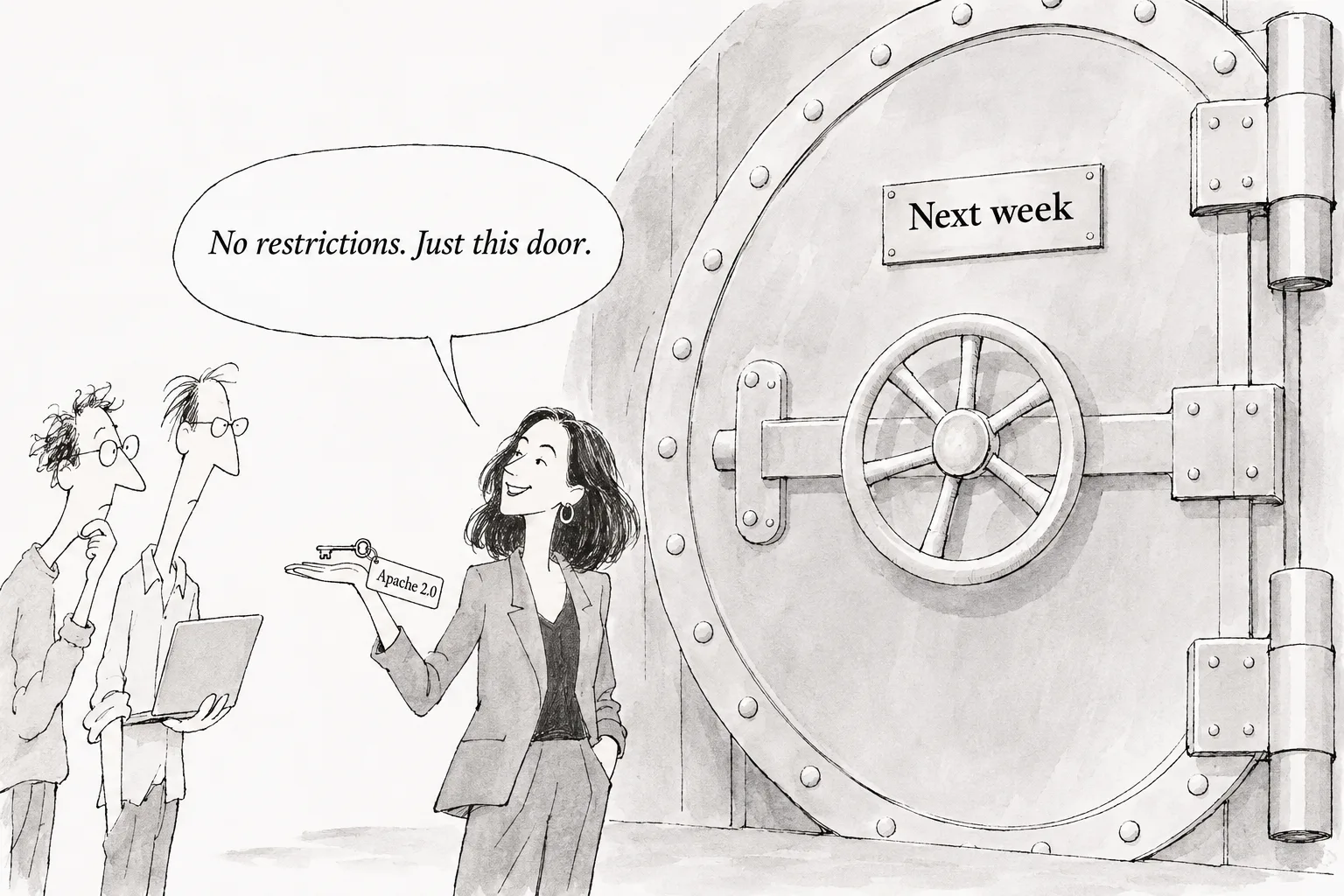
Editorial cartoon