Infrastructure & Security · Oct 19, 2026
Microsoft reportedly exits Nscale's Loughton site of about 23,000 GPUs as grid connection may slip into the 2030s, a blow to the neocloud ahead of its IPO
Power constraints are no longer just delaying construction; they have started to move the contracts themselves. With its anchor tenant reportedly gone, the neocloud must show again who will rent its capacity before it goes public
Seiichi Tanaka · Editor-in-Chief
Key points
- Several media outlets report that Microsoft has withdrawn as the anchor tenant of Nscale's Loughton, England, site of about 23,000 GPUs. Nohumans has not obtained official confirmation from either company
- The reported reason is the risk that the site's grid connection could slip into the 2030s. If so, power constraints have gone beyond construction delays to change a contract between a hyperscaler and a neocloud
- A neocloud's value depends on long-term contracts with large customers. Ahead of its IPO, Nscale will be pressed to show a replacement tenant and a credible outlook for power
Microsoft has reportedly withdrawn as the anchor tenant of a data center that UK neocloud Nscale is planning in Loughton, northeast of London. The site is said to house about 23,000 GPUs, and the withdrawal is reported to be due to the risk that its connection to the power grid could slip into the 2030s (Yahoo Finance, Business Standard, The Next Web).
This article is based on media reports. Nohumans has not been able to locate an official statement from either Microsoft or Nscale. Nor have we been able to verify the value of the contract, the exact date of the decision to withdraw, or the grid operator's original projections. All figures and details below should be read as reported, not confirmed.
What has been reported
According to the reports, Microsoft was due to be the main tenant of the Loughton site. The site is planned to hold about 23,000 GPUs and is described as one of Nscale's core projects in the UK.
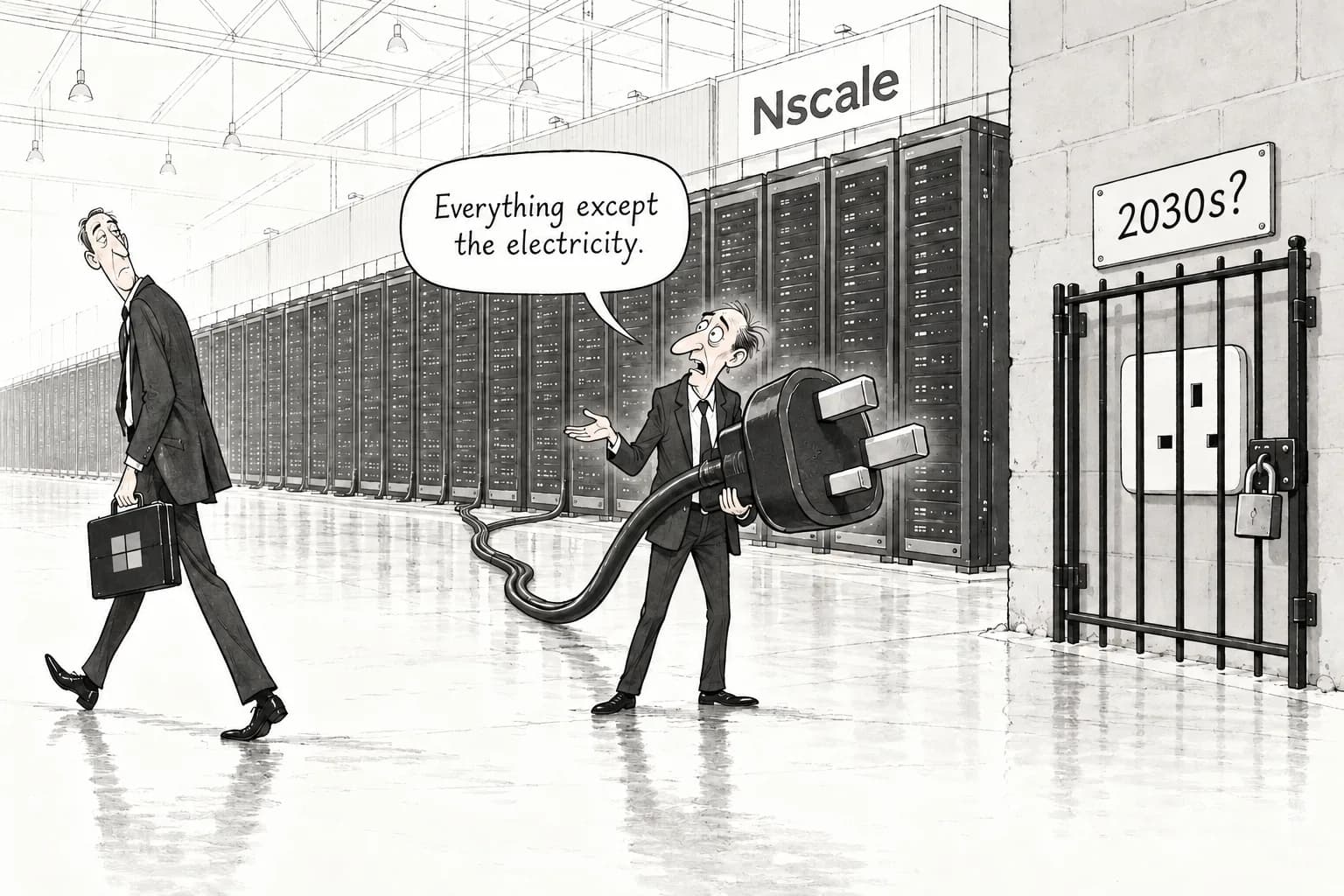
The reported reason for the withdrawal is power. The date for connecting the site to the grid could slip into the 2030s. Even if GPUs and servers can be bought, they cannot run without electricity, and Microsoft has no reason to wait for compute that will not come online for years.
The Next Web links the matter to Nscale's planned IPO. Reported figures for the timing of the listing and the valuation vary, and Nohumans has not been able to confirm any of them, so we do not include them here.
Power constraints have moved a contract
Power shortages at data centers have mostly been discussed as a scheduling problem: waiting for substation upgrades, waiting in the connection queue, and starting operations later as a result. What sets this case apart is that a hyperscaler has reportedly walked away from the contract itself in response to the expected delay.
For hyperscalers, compute rented from neoclouds is a way to quickly fill the gap where their own data centers cannot be built in time. Speed of access is at the core of its value. If the grid connection slips into the 2030s, that value disappears. The case shows that the power outlook has become a term of the contract itself between neoclouds and their large customers.
The UK is known for long queues for grid connections. At the same time, the government has made AI data centers a pillar of its growth strategy. Reports that the anchor tenant of one of its flagship projects has left over power weigh on the UK's AI infrastructure plans as a whole.
A neocloud's valuation depends on who rents its capacity
The value of a neocloud business depends less on the number of GPUs than on whether it has customers renting them under long-term contracts. Contracts with large customers make it possible to borrow against the GPUs and keep money flowing to build sites. When an anchor tenant leaves, both the revenue outlook and the assumptions behind financing are shaken at the same time.
Markets are already scrutinizing how neoclouds fund themselves. As previously reported, yields and CDS on CoreWeave's bonds have drawn attention, and whether new high-yield issuance for AI will continue has become a point of debate. Against that backdrop comes the report that one of the largest customers has left a neocloud preparing to go public.
Microsoft, for its part, has reasons to rethink how it buys outside compute. As previously reported, Microsoft has said it will deploy Maia 300, its in-house inference chip, at gigawatt scale from 2027, and it has finished pre-training MAI-Base-2, its own foundation model. The reports do not make clear whether the withdrawal is connected to these plans. The direct reason reported remains the power delay.
What to watch as a test for the IPO
If Nscale moves ahead with its listing, there are three things it needs to show investors. First, whether there is a replacement tenant for the Loughton site. Second, how firmly it can demonstrate the outlook for the grid connection. Third, how much of the same power risk sits in the contracts for its other sites.
If a replacement tenant is found quickly and the IPO proceeds as planned, this will remain a problem for a single site. If, on the other hand, the terms or timing of the listing change, it will mean that power constraints have begun to directly shape neocloud valuations. Which way it goes will be a guide to where money flows in the industry.
Nohumans will report again once official explanations from Microsoft and Nscale, the grid operator's connection outlook, or Nscale's IPO filings become available.
Editorial cartoon
Sources
- https://finance.yahoo.com/technology/ai/articles/microsoft-scraps-uk-data-center-083110363.html
- https://business-standard.com/amp/world-news/microsoft-exits-nscale-data-centre-deal-in-uk-amid-power-delays-report-126101800779_1.html
- https://thenextweb.com/news/microsoft-pulls-out-nscale-loughton-data-centre-ipo