Rules & Policy · Nov 6, 2026
METR says AI is speeding Anthropic's R&D by about 1.9x, disputing the company's "less than 2x"
An outside evaluator estimated that AI speeds up Anthropic's research by 1.5x to 2.8x. It agreed that the risk of catastrophe from models through July is low. But most of the evidence it weighed most heavily was redacted
Koji Yamamoto · Economics Analyst

Key points
- METR estimates that AI is speeding up Anthropic's R&D by about 1.9x (95% range: 1.5x to 2.8x). It says Anthropic's "less than 2x" claim is stated with too much confidence
- METR agreed with Anthropic's conclusion that the risk of catastrophe from models through July is "low"
- Anthropic redacted most of the evidence METR considered most important, so outsiders cannot check what the figure is based on
METR, a U.S. AI evaluation organization, said on its blog on November 5 that it estimates AI is already speeding up Anthropic's research and development by about 1.9x. Its 95% confidence range runs from 1.5x to 2.8x. METR also published its review of the R&D section of Anthropic's risk report (August 2026). It said Anthropic's public statement that the speedup was "less than 2x" claimed more certainty than the evidence supports. At the same time, METR agreed with Anthropic's conclusion that the risk of catastrophe from models through July is "low." However, Anthropic redacted most of the evidence that METR considered most important. Figures in this article come from METR's page, not from AP's reporting.
What it means for companies in Japan: For companies that use Claude at work, this suggests the gap before the next model arrives could be shorter than past experience implies. Internal processes and the cycle for re-evaluating tools should be planned with that in mind. The fact that even an outside evaluator cannot publish most of its evidence also bears directly on how far buyers of AI can trust safety claims.
The gap between "less than 2x" and "about 1.9x" matters
On the numbers alone, 1.9x is less than 2x. METR objected anyway because the top of its range reaches 2.8x. Saying flatly "less than 2x" suggests that a speedup above 2x is unlikely. In METR's view, the chance that the speedup exceeds 2x is too large to dismiss. It concluded that Anthropic's wording made the company look more confident than the evidence justifies.
The difference matters because Anthropic's own safety rules, its Responsible Scaling Policy (RSP), include a threshold for "dramatic acceleration of research by AI." Crossing that line requires stronger safeguards. In an amended IPO filing on November 2, Anthropic wrote that future models "could soon meet" this definition. No current model has been found to meet it. METR's estimate puts an outside number on the possibility that "soon" may be closer than expected.
Figures on internal use point the same way. According to the IPO filing, Anthropic's internal use of Claude, measured at list prices, grew 250-fold from January to September. By September, Claude was writing more than 90% of new code.
Agreement that the risk of catastrophe is "low"
METR did not reject all of Anthropic's conclusions. For models through July, it agreed with the assessment that the risk of catastrophe is "low." It estimated a larger speedup than Anthropic did, but reached the same conclusion about current risk.
That shifts the question from "is it dangerous now?" to "how fast could it become dangerous?" If research is moving about twice as fast, the time before the next generation of models arrives shrinks by the same factor, and so does the time available to prepare safeguards.
Blogger Zvi Mowshowitz used this line in the subtitle of his November 5 newsletter, "AI #193":
Anthropic is warning us
The company wrote in its own filing that dramatic acceleration is near, and an outside evaluator then produced a stronger number than the company had. Mowshowitz argues that this should be read as a warning to the outside world.
The most important evidence was redacted
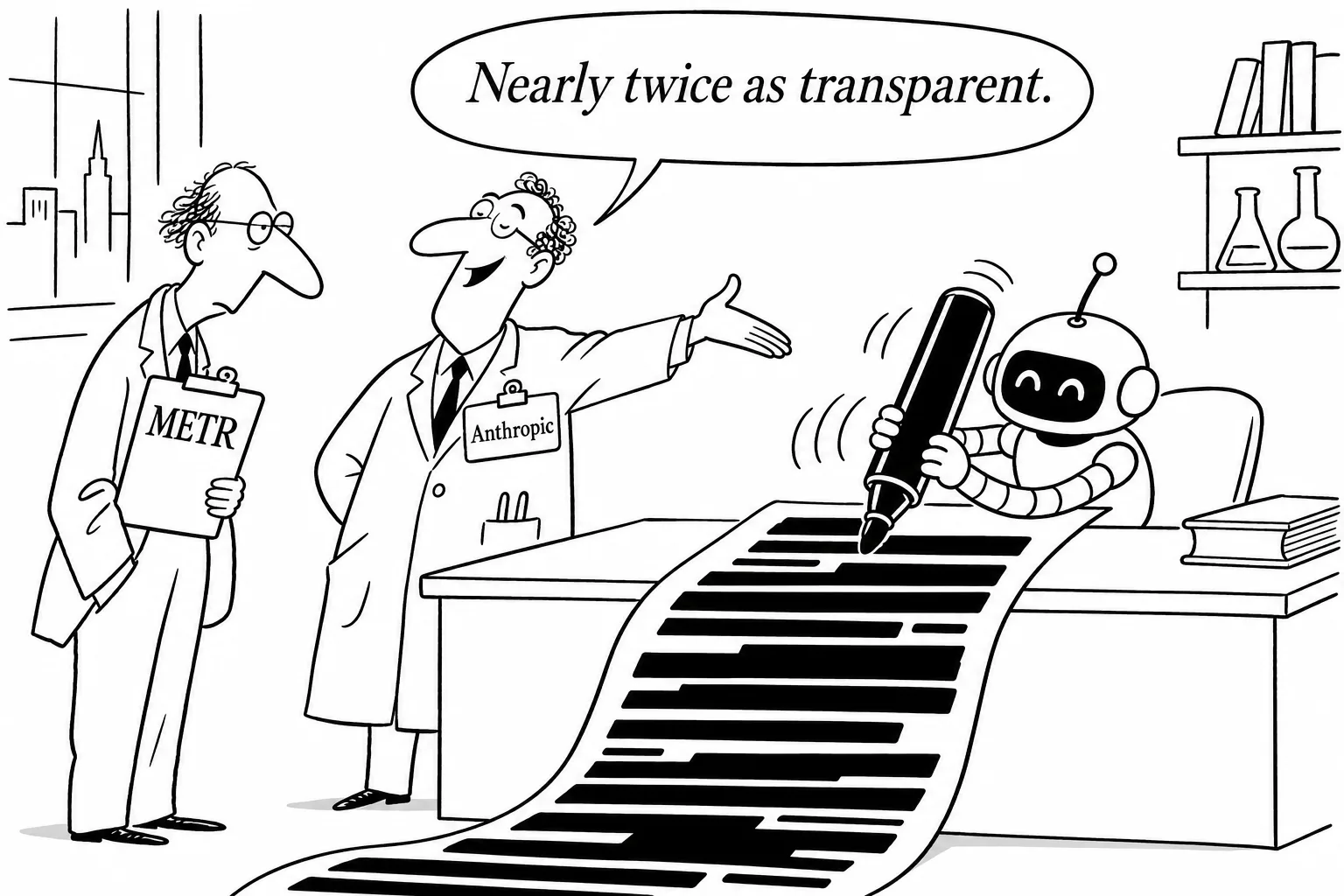
The weakness of the estimate is that Anthropic withheld most of the evidence METR considered most important. As a result, outsiders cannot check what material the 1.9x figure was based on.
The redactions themselves are allowed under the arrangement between the two. On October 15, Anthropic announced that it would give six METR staff "nearly equivalent" access to that of its internal risk assessment team. It said then that it would have no veto over what METR publishes. It also wrote that METR would be asked to withhold certain narrow categories of information agreed in advance. In return, METR may say publicly whether the redactions were appropriate. This release is the first visible case of METR addressing R&D acceleration under that arrangement. On October 20, METR had also reviewed the misalignment section (on AI diverging from human intentions) of the same August risk report.
So an evaluator was able to work inside the company and publish a dissenting view. But outsiders still cannot check the evidence behind that view. In October, Reuters reported that Anthropic and OpenAI had sought strong editorial control over their embedded evaluators. Whether the heavy redaction here bears out those concerns, and whether Anthropic will release any of the withheld material ahead of its IPO, are the next questions to watch.
Editorial cartoon
Sources
- https://metr.org/blog/2026-11-05-rd-section-anthropic-risk-report-august-2026-review/
- https://metr.org/blog/2026-11-05-anthropic-ai-rd-acceleration-assessment/
- https://www.news4jax.com/business/2026/11/05/anthropic-is-rapidly-accelerating-ai-development-amid-slowdown-calls-outside-research-group-says/
- https://thezvi.substack.com/p/ai-193-progress-may-dramatically
- https://www.lesswrong.com/posts/diKDKhQZtfpQ7PPu9/linkpost-to-metr-s-anthropic-speedup-assessment