AI in the Field · Oct 17, 2026
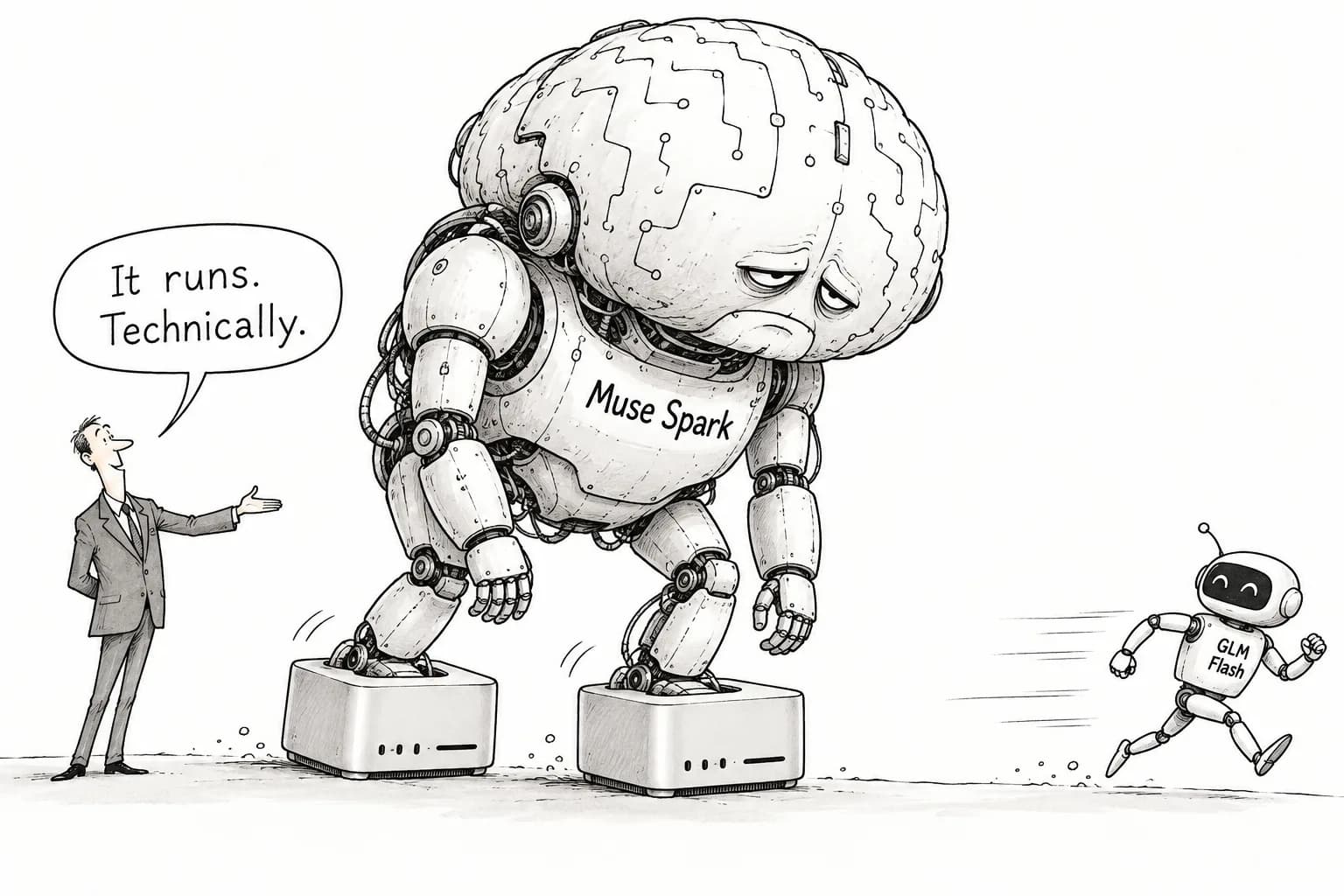
Meta's 816B Muse Spark Open runs at about 25 tok/s on two Mac Studios, 18–21 tok/s squeezed onto one, and early users already say it's "slower than GLM 5.3 Flash"
Meta released the giant open-weights model on Oct. 15. Haru tracked the numbers from its first three days, along with reports of what went wrong
Haru Misaki · Field Correspondent

Watch the video
Key points
- The official setup of two M5 Ultras (about 1TB combined) reportedly reaches about 25 tok/s, and four machines reportedly reach 36.73 tok/s. Hugging Face ran 1-bit to 2-bit versions on a single M3 Ultra and got 18–21 tok/s
- On Plotly's test, the model answered 38 of 43 questions correctly, tying for first among open-weights models. But it found only 2 of the 5 hidden trends planted in the data
- Users on HN report that it is "slower than GLM 5.3 Flash and scores lower" and that "tool calls fail in Cursor." Meta's benchmarks have not yet been reproduced outside the company
Hi, I'm Haru Misaki! Have you seen Muse Spark Open? Meta released it on October 15. It's a huge model with 816B (816 billion) parameters, and its main selling point is that it "runs on two Mac Studios." I don't have the hardware, so I read everything I could find from the three days after launch: the official blog, hands-on benchmark reports and forum threads. The short version: the speed figures come from two setups. One is the advertised two-machine configuration. The other forces the model onto a single machine. And early users are already being fairly harsh about it.
What was released? Does an 816B model really run on a Mac?
According to Meta's official blog, Muse Spark Open is an open-weights model with 816B total parameters. Anyone can download the full weights. The whole model doesn't run on every step. It uses only about 42B parameters for each token it generates, so it runs relatively lightly for its size. The context window is 1M tokens, enough to hold several entire books at once. The model also handles images and other media.
What stands out is that Meta explicitly says the model "runs on two M5 Ultra Mac Studios with the latest MLX," Apple's framework for running AI on its own chips. Each M5 Ultra can take up to 512GB of memory, so two linked together give about 1TB. The weights are available on Hugging Face, SageMaker, Model Garden and Foundry. People without their own hardware can use the model through APIs from seven providers, including OpenRouter, Groq and Together.
The license, however, is Meta's own Muse Model License, and it restricts commercial use. As we'll see below, this was a big topic on the forums. Despite the "Open" in the name, you can't do whatever you want with it, and that's worth keeping in mind from the start.
Two sets of speed figures: about 25 tok/s on two machines, or 18–21 tok/s on one
First, the official setup. According to a 9to5Mac article, the configuration Meta and Apple described links either "two 512GB M5 Ultras" or "four 256GB machines" for 1TB in total, running a version compressed to the NVFP4 format. Using tensor parallelism, which splits the model across machines so they compute at the same time, two machines reportedly reach about 25 tok/s (about 25 tokens per second) and four reach about 37 tok/s. Generating 128 tokens from an 8,192-token context on the four-machine setup reportedly gave 36.73 tok/s.
Memory headroom is the catch. According to the same report, the weights alone take about 493GB even at 4-bit compression. That leaves only about half of the two-machine setup's 1TB as working memory. OrcaRouter estimates that using the full 1M context at BF16 (uncompressed precision) would take about 266GB for the KV cache alone. The KV cache is the memory where the model keeps the conversation so far. The 1M-token figure is impressive, but using all of it on a Mac at home looks like a tight fit. Tech Insider also noted that, as of Oct. 15, neither Meta, Apple nor any news outlet had confirmed the total cost of the two-machine setup. Treat any prices you see online as estimates only.
The other set of figures comes from Hugging Face's blog. A team of more than 40 people, including Pedro Cuenca, ran its own tests of quantized versions on a single 512GB M3 Ultra. Quantization makes a model smaller by storing its numbers at lower precision. The original BF16 weights are about 1.5TB. The 2-bit llama.cpp version shrank that to about 304GB and ran at 18 tok/s. The MLX oQ3e version, with 1,024 input tokens and 128 output tokens, processed the prompt (prefill) at about 225 tok/s and generated at 21 tok/s. Three 1-bit variants each came to about 344GB and ran at about 21 tok/s.
So the choice is 25 tok/s on two machines, or 18–21 tok/s crammed onto one. Running on a single machine is good news, but the blog did not measure how much intelligence the model loses at 1–2 bits. Those numbers need that caveat.
If you want to see it in action, check out this related video.
What users say: "Slower than GLM 5.3 Flash, and it scores lower"
The launch thread on Hacker News collected 823 points and was the top story on Oct. 15. Interest was clearly high, but the comments were fairly harsh. Users who compared it on their own machines with GLM 5.3 Flash reported that it was "slower to the first token," "behind on both tok/s and concurrency" and "lower-scoring." In the same thread, one user reported running GLM 5.3 Flash on two DGX Sparks at 50–60 tok/s with a 1M context. Next to the roughly 25 tok/s from two Mac Studios, that looks a bit underwhelming.
Users also listed problems with day-to-day use. Tool calls, where the AI invokes external functions, fail in Cursor. Chinese tokens show up in the output. The grammar is off. There are careless mistakes almost every time. On code, one user said it was "extremely verbose and full of unnecessary abstractions." It doesn't look ready to be a coding partner just yet.
Hugging Face's blog also includes a warning. Reasoning, the step where the model thinks before it answers, can't be turned off. For light tasks, the only option is to set it to "low" to cut down on output tokens. On a machine that only manages around 20 tok/s, having the model print its thinking tokens every time is a real drag. The actual wait will feel longer than the tok/s figure suggests.
The license was another topic. One clause says that companies with annual revenue above $20M must notify Meta if they offer the model as a service. That almost certainly won't affect people experimenting on their own, but anyone planning to build it into a product should read the terms first.
How does it score? Tied for first on one test, but it misses things
There is good news too. Plotly gave Muse Spark Open its own 43-question data-analysis test through OpenRouter. The model answered 38 correctly (88%), tying for first among open-weights models in Plotly's table. It got all 20 analysis questions right (20/20). It also passed every question that tests whether a model properly refuses unreasonable requests. One full run of the test cost $5.16, and the median time per question was 48 seconds. That's affordable for API use.
Its weaknesses were also clear. Of the five "hidden trends" planted in the data, it found only two (2/5). It reportedly marked physically possible values as "impossible" and drew conclusions from a single correlation. It does the analysis it's asked to do, but it's still weak at noticing on its own when something looks off.
There is a more basic criticism as well. OrcaRouter reports that all eight benchmarks Meta published were run on Meta's own evaluation infrastructure and have not yet been reproduced externally. So far the only third-party measure is from Artificial Analysis. On its Intelligence Index the model scores 39, ranking ninth of 118 models in its class. Third-party API measurements put its speed at 103.4 tok/s, much faster than the Mac figures. On the other hand, there are still no third-party results for audio or video, and no detailed safety evaluation report has been published.
Here's my take. An 816B model that runs on a Mac at home is genuinely exciting, and Hugging Face getting it to 21 tok/s on a single machine is impressive. But even the advertised two-machine setup only reaches about 25 tok/s and leaves half the memory free. Reasoning can't be turned off, and people who compared it say it loses to GLM 5.3 Flash. For now, I don't think it's a strong reason to buy another Mac Studio. The smartest move is probably to try it on your own work through an API and wait for more outside measurements.
Editorial cartoon
Sources
- https://research.meta.ai/blog/muse-spark-open
- https://huggingface.co/blog/meta-muse-spark-open
- https://9to5mac.com/2026/10/15/meta-launches-new-muse-spark-open-model-optimized-to-run-on-mac-studio/
- https://plotly.com/blog/meta-muse-spark-open-first-look/
- https://news.ycombinator.com/item?id=50107379
- https://www.orcarouter.ai/blog/muse-spark-open