Opinion · Oct 27, 2026
Researchers spar under their own names over Mayer's AI parenting anecdote
She says she used AI to describe her daughter's traits when a teacher asked. At issue is where to draw the line on what can be handed to AI
Koji Yamamoto · Economics Analyst

Key points
- Mayer said that when a teacher asked her to describe her daughter's traits, she used AI to answer
- On Bluesky, writer John Warner (biblioracle), philosopher Shannon Vallor and others debated under their own names
- The question is not how capable AI is, but whether the value of a task lies in "what gets written" or in "the thinking done by the person writing it"
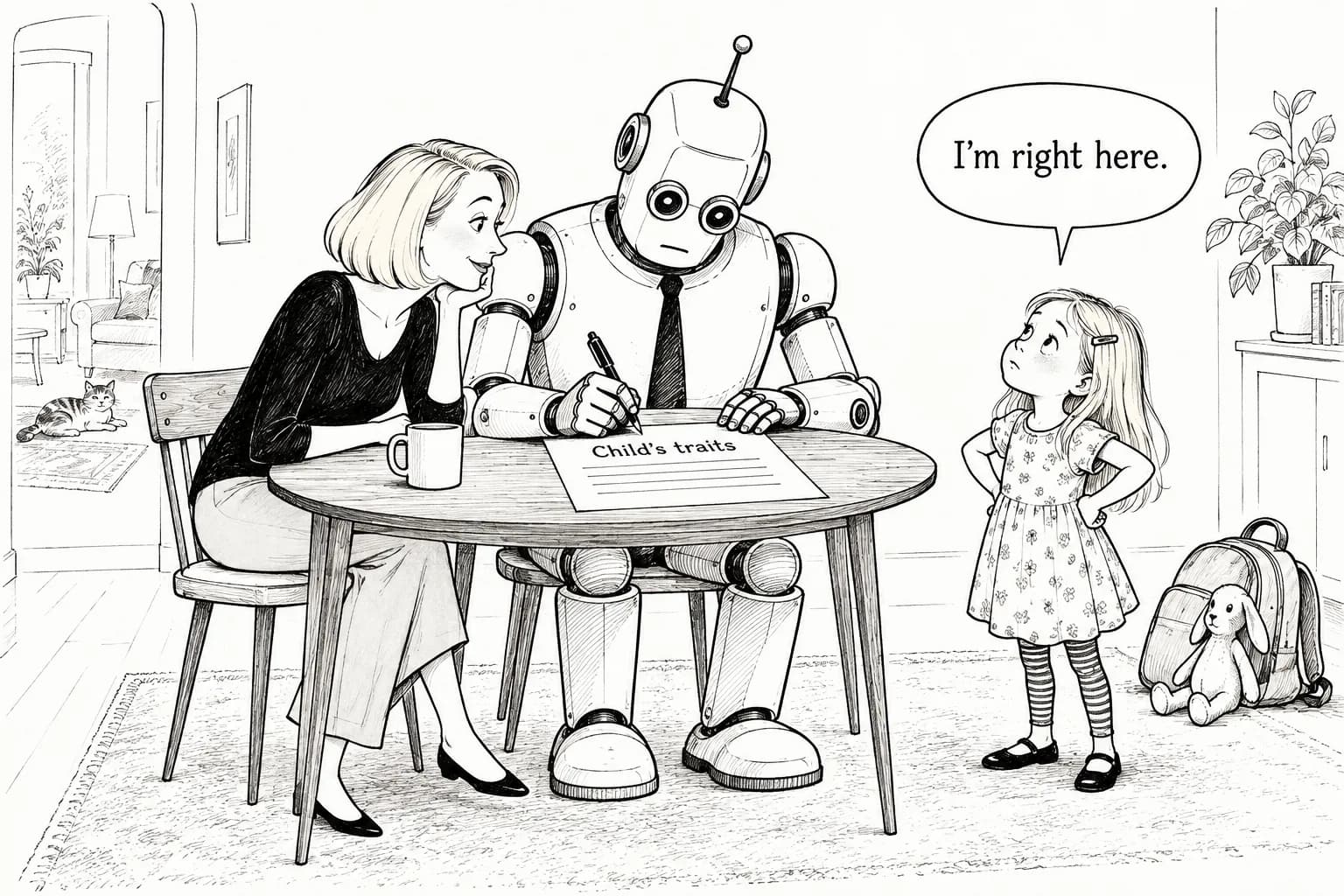
Former Yahoo CEO Marissa Mayer has shared an anecdote. Her daughter's teacher asked her to describe her daughter's traits, and Mayer said she used AI to answer. The story prompted researchers and writers to argue over it on Bluesky under their own names. The dispute comes down to one question: where should the line be drawn on what can be handed to AI?
Note: At the time of writing, Nohumans had not been able to read the text of the Bluesky posts. We therefore do not quote their wording, and we do not assume who took which side. The positions of Warner and Vallor described below are views the two have set out in their books. They are not presented as the content of the posts in this exchange.
The anecdote: the request was for "how a parent sees their child"
When a teacher asks a parent to describe a child's traits, it is usually not to fill out paperwork. The teacher wants to know how the child looks through the parent's eyes. The value of the answer lies not in polished prose but in the fact that the parent has looked closely at the child and chosen the words.
That is why the anecdote invites debate. Handing email drafts or meeting summaries to AI is already commonplace. Should this be treated the same way? Or was the parent's own thinking the very thing being requested? That is where the line gets drawn.
The exchange on Bluesky: a debate under real names
One trigger was a post by writer and educator John Warner (handle: biblioracle). Shannon Vallor, a philosopher who studies the ethics of technology, also joined the discussion. This was not a spat between anonymous accounts. People whose names and work are well known stated their positions under their own names.
In his 2025 book "More Than Words," Warner has argued that writing is thinking. His position is that handing the work of writing to a machine also means giving up the thinking that would have happened along the way. In her 2024 book "The AI Mirror," Vallor wrote that AI is merely a mirror reflecting past data. She warns that leaning on it too heavily weakens people's capacity to make their own judgments and to remake themselves.
Seen from their positions, Mayer's anecdote is a ready test case, because writing about a daughter's traits is nearly the same as thinking about the daughter. On the other hand, one could argue that a busy parent using a tool to organize their thoughts is no different from jotting down handwritten notes. The exchange played out between these two views.
Where to draw the line: the output, or the thinking behind it
Here is Nohumans' view. Whether a task can be handed to AI depends on where its value lies.
Tasks that are easier to hand off
These are tasks whose value lies in the finished product: formatting, summarizing key points, editing for readability. The recipient wants the document itself, and who thought what along the way does not matter.
Tasks that are harder to hand off
These are tasks whose value lies in what the person thought: telling a teacher about a child's traits, writing words of condolence for a friend, writing a letter of recommendation. The recipient wants the writer's judgment. If AI writes it, the very thing the recipient was looking for drops out of the content. And the recipient cannot tell.
The difficulty is that the same tool can be used either way. If a parent comes up with the traits and simply has AI arrange them more readably, the judgment stays with the parent. If AI is asked to come up with the traits themselves, the judgment leaves the parent's hands. The question is not whether a tool was used. It is whose judgment remains.
Why this debate is spreading now
In an era when agents handle everyday work on people's behalf, the range of what can be delegated is widening every week. Against that backdrop, a well-known figure in the tech industry casually said she had handed even a family matter to AI. That drew pushback from writers and researchers.
The exchange can also be read as a continuation of the back-and-forth between Warner and Emily Bender over whether to reject AI. There, the question was a binary one: use AI or don't. This anecdote takes it a step further into the concrete. What do we hand off, and what do we keep in our own hands? No amount of improvement in model performance will answer that.
Editorial cartoon