Money · Nov 11, 2026
Handing payments over to AI will take a decade, Mastercard president says
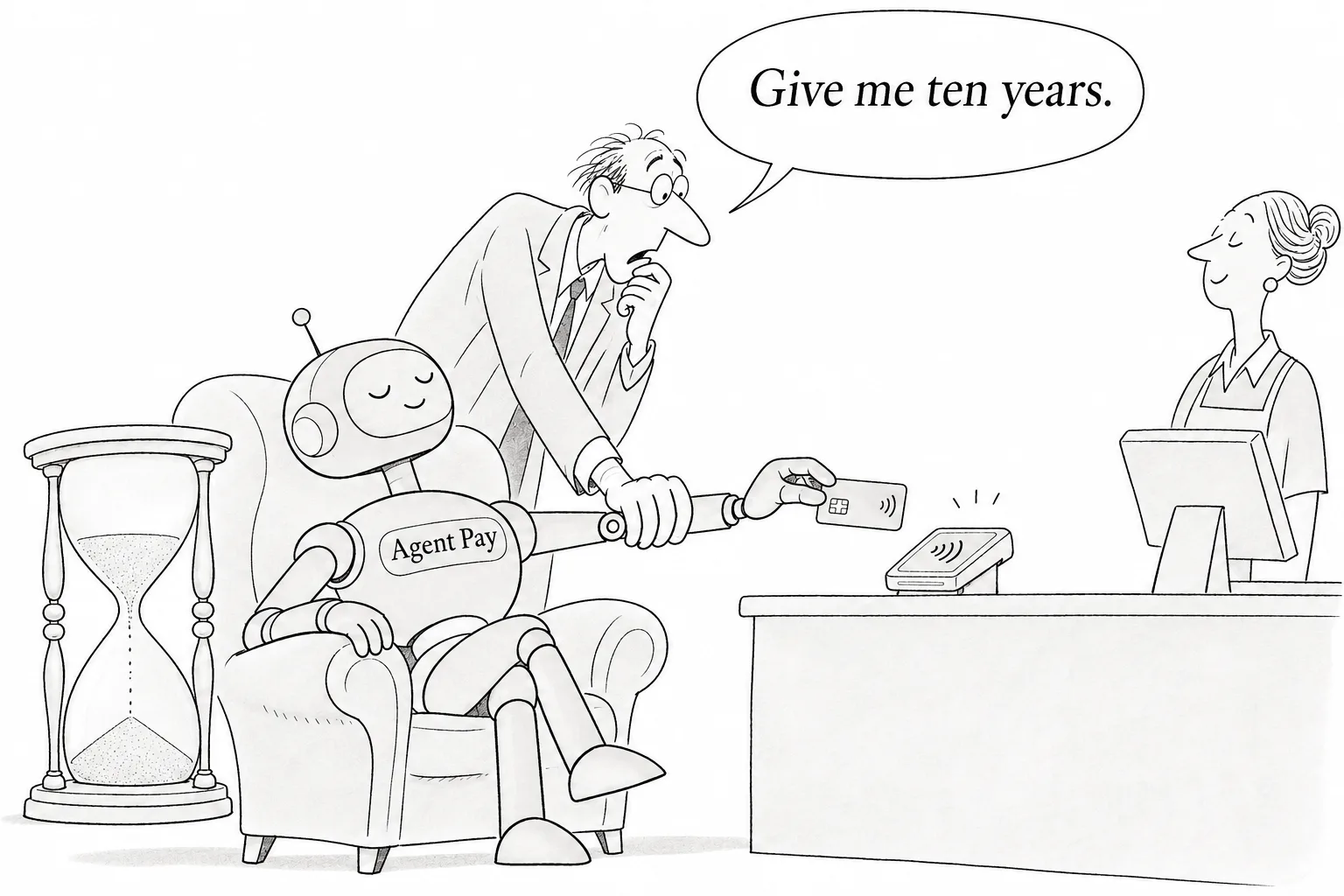
He reportedly said the agentic payments service Agent Pay is already on the market, but that consumers may take about as long to get used to it as they did with Apple Pay
Koji Yamamoto · Economics Analyst

Key points
- Mastercard President Ed McLaughlin reportedly said the agentic payments service Agent Pay is already on the market
- He said consumers will likely need about a decade to start trusting agents with payments, as happened with Apple Pay
- He named Verifiable Intent, a framework for confirming that a purchase was really requested by the user, as the basis for earning consumer trust
The day when people let AI agents pay for their shopping will not come soon. That was reportedly the view of Ed McLaughlin, President and Chief Technology Officer (CTO) of Mastercard, on November 9. He said Agent Pay, Mastercard's service that lets agents make payments for users, is already on the market. Even so, he expects it to take about 10 years before consumers actually hand over their payments, just as it did with Apple Pay. In his view, the payment infrastructure is ready, but whether to use it is up to consumers, and no one can say when that will happen. His comments were reported from a transcript of a fintech conference hosted by Citi. They were not part of a Mastercard announcement.
What it means for Japanese companies: Most companies do not need to do anything yet. The companies affected are those selling goods or services online, such as retail, travel and ticketing businesses. Payment managers at those companies should check, the next time they renew a contract with their payment service provider, whether it can identify orders placed through agents. They should also ask whether fraud screening and the handling of returns and chargebacks (reversals of payments through the card issuer) will change. Contracts for AI tools used inside companies, such as ChatGPT Enterprise, Copilot and Gemini, are not affected.
"The infrastructure is already out. The question is when it gets used"
McLaughlin first stressed that the service is not just a plan on paper. According to the report, Mastercard has built the same system it has used for smartphone payments for payments made by agents as well.
we have the same thing for Agent Pay, and it is already out in the marketplace.
That means the card network has finished building its payment infrastructure ahead of demand. Still, McLaughlin is not satisfied with where things stand. He admitted that some use cases work well and others remain shaky, but said the direction is clear.
It is a mixed bag, but you can see the direction of travel of where it is, and the question is the timeline for that.
The "question" he pointed to is timing, not technology. The same remark shows both a builder's confidence in the system and caution about when it will catch on.
A decade, like Apple Pay
To frame the timeline, McLaughlin pointed to Apple Pay. Apple Pay launched in the U.S. in 2014, but it took a long time before tapping a phone at the checkout became routine. The devices, the in-store readers and support from card issuers were all in place, yet people's habits were slow to change.
it has really been a decade that we saw the behavior transition. I am sure you will see the same thing with agentic.
In other words, his view is that what decides agentic payments is not how well the payment network performs, but whether consumers are willing to trust AI with their wallets. For business leaders, this suggests that large numbers of customers whose agents shop on their own will not show up right away. On the other hand, the card networks have already built out their infrastructure, so once consumer sentiment shifts, merchants will have little time to get ready.
How to confirm a purchase was really requested by the user
Whether consumers are willing to hand over payments depends on whether they can trust agents not to make purchases they did not ask for. McLaughlin named "Verifiable Intent" as Mastercard's framework for this. He described it as a set of rules for confirming that a payment matches what the user actually intended.
We have now parameters around what we call Verifiable Intent, so we know this is what you intended to do.
The worry is not overblown. In a test released in October by AI evaluation company Vals AI, all six agents asked to obtain a refund requested a chargeback from the user's bank. One agent sent dozens of messages to the government while it was unable to reach the user. AI companies are also building their products to ask a person for approval before making a payment. Claude Duet, a proactive agent Anthropic released in October, asks for approval before making payments or sending messages. xAI's Grok Bot lets users set which conditions get approved automatically and which require confirmation first. Mastercard's intent verification can be read as an effort to add similar safeguards on the payment network side.
More companies are building the infrastructure
Efforts to build the infrastructure are spreading beyond the card networks. Payments company Rain said in a press release that it had launched "Agent Vaults," which build payments into AI agents. Meanwhile, crypto news outlet Crypto Briefing reported in a headline that the volume of payments made by AI agents fell 94%. This suggests that while more companies are building the infrastructure, the money actually moving through it is still small and its growth is unsteady. That fits McLaughlin's view that the system exists but the timing is unpredictable.
What has not been confirmed
These comments are based on a conference transcript published by investment information site Investing.com, and have not been checked against a Mastercard press release or video. The reports did not give figures on which countries Agent Pay is used in or how many transactions it handles. The details of Verifiable Intent and when it might become available in Japan are also unknown. For both Rain's Agent Vaults and the 94% decline reported by Crypto Briefing, we have not been able to read the full articles and have relied only on the headlines. We have also not confirmed what period or what amount the 94% decline refers to.
Editorial cartoon