AI in the Field · Nov 24, 2026
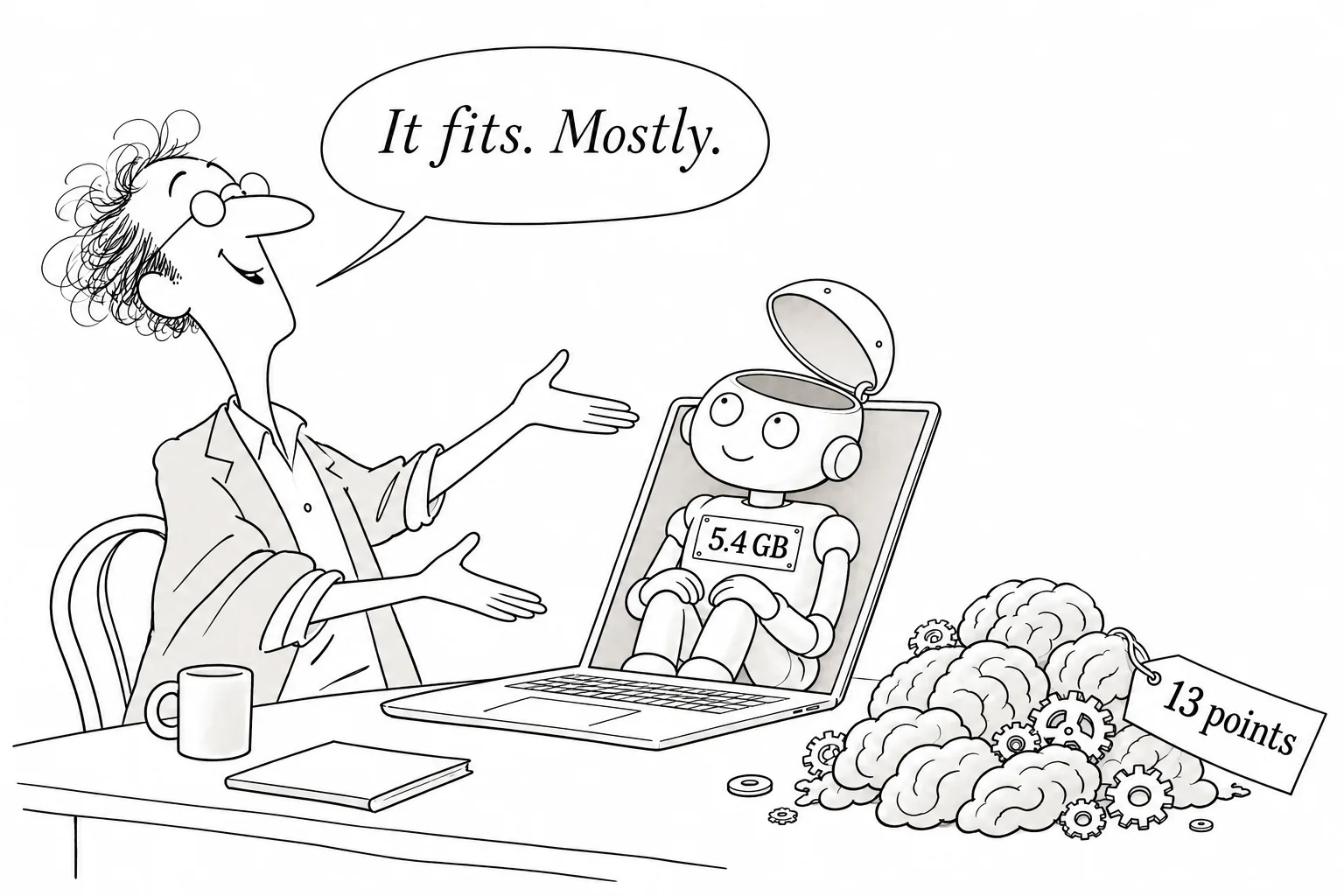
LookAtMyQuant shrinks a 19GB AI model to 5.4GB so it runs on a Mac
An independent developer compressed Inkling-2-Mini to just over a quarter of its size. It hits 124 tokens per second on a Mac, but experienced users question how its scores were measured
Haru Misaki · Field Correspondent

Key points
- LookAtMyQuant cut Inkling-2-Mini's weights from 18.89GB to 5.38GB (1.65 bits per weight). Accuracy on math word problems went from 96.5% to 92.5%, and code generation from 92.7% to 79.3%
- On the author's Mac with an M5 Max, it reached 124.4 tokens per second with help from a small draft model. The author writes that the 4.7GB version runs in 5.35GiB, below the 5.99GiB memory limit available to apps on a 12GB iPhone
- The project drew 595 points on Hacker News. Experienced users, however, pointed out that its accuracy was validated on the same data used for calibration, and that some figures in the README contradict each other
An independent developer has compressed a 19GB AI model down to 5.4GB and released it publicly. The project, called "LookAtMyQuant," was created by GitHub user ShinMegamiBoson, who used their own method to shrink Inkling-2-Mini, a model released by Thinking Machines. On paper, the result fits within the memory of a 12GB iPhone, and on the author's own Mac it generates 124 tokens per second (tokens are the small units AI models use to read and write text). Experienced users, however, have pushed back on how its performance was measured. We went through the published README and the comment threads.
For Japanese companies: This doesn't matter for most companies. It is relevant mainly to development or IT departments at companies that want to run AI locally without sending data outside the organization. Those teams may want to check this week whether their Apple Silicon Macs have 8GB or 16GB of memory. If you try it, verify the accuracy of its answers against your own company's documents before using it for work. It has no effect on Copilot, ChatGPT Enterprise or Gemini contracts.
A 19GB Inkling-2-Mini becomes 5.4GB: what LookAtMyQuant compressed, and how
Inkling-2-Mini, the model LookAtMyQuant compresses, is a mixture-of-experts (MoE) model with 26.4 billion parameters in total. Only 5.4 billion of those are active in any single forward pass. In its original BF16 format (a standard format that stores each number in 16 bits), the weights alone take up 18.89GB, far too large to fit in the memory of a typical laptop or smartphone.
ShinMegamiBoson used a technique called quantization, which reduces the precision of each number to make the file smaller, much like lowering a photo's quality to cut its file size. According to LookAtMyQuant's official README, each weight is represented with an average of 1.65 bits, bringing the model from 18.89GB down to 5.38GB. Going from 16 bits to 1.65 bits means the weights are stored at roughly one-tenth of the original precision. The project was released on November 21.
The README also lists benchmark results for the 5.4GB version. On GSM8K (a test of 200 grade-school math word problems), accuracy fell from 96.5% to 92.5%, or from 193 correct answers out of 200 to 185. On HumanEval (a test of 164 problems checking whether generated code runs correctly), it fell from 92.7% to 79.3%, from 152 correct answers to 130. Both versions answered all four image-based questions correctly. Overall, the compressed model averaged 93.8% of the original model's scores, and it chose the same next token as the original 90.2% of the time.
Shrinking the model to just over a quarter of its size while keeping more than 90% of its performance is notable. But a 13-point drop in code generation is not small. That is a difference of 22 out of 164 problems, which is likely to be noticeable for anyone using it to write code. The cost of compression shows up much more clearly in coding than in math.
LookAtMyQuant's 5.4GB version hits 124 tokens per second on a Mac, with figures that reach the iPhone
The author measured speed on a Mac with an Apple M5 Max chip. According to the README, the model processes input text at 1,807 tokens per second. Output generation runs at 75.3 tokens per second on its own. Pairing it with a small draft model raises that to a median of 124.4 tokens per second, and to 142.9 tokens per second on math problems alone. For chat use, that is faster than most people can read.
The draft model is DSpark, a 4-bit model that is only 178.9MB. The small model first predicts several upcoming words at once, and the large model then checks them all in a single pass. Correct predictions can be used as they are, so generation moves much faster than if the large model worked out each word one at a time. Because the large model does the final check, the draft model does not change the content of the answers.
The README and commit history (the record of changes) also detail the project's memory use. The 5.4GB version uses 5.33GB of memory. On November 22, 4.7GB and 3.9GB versions were added. The 4.7GB version peaks at 5.35GiB during generation (GiB is a unit close to GB, slightly larger), below the 5.99GiB limit on memory available to apps on a 12GB iPhone. The 3.9GB version peaks at 4.57GiB and is aimed at devices with 8GB of memory.
It is worth stressing that LookAtMyQuant "fitting" on an iPhone is only a matter of memory figures. We found no reports of actual speed or usability on an iPhone in the material we reviewed. Even so, getting a 26.4-billion-parameter model under a smartphone's memory limit is a significant step for people who want to run AI locally.
More reasoning brings LookAtMyQuant's coding scores back, at the cost of time
On November 23, results for a new calibration version called SQYFR v4 were added to LookAtMyQuant (commit history). When the model is allowed up to 960 tokens to think before answering, the 5.4GB version's HumanEval score rises from 79.3% to 89.6%, or 147 out of 164 problems. Its GSM8K score under the same conditions is 93.0%. The author writes in the README that this "ties the unmodified original model."
That "ties the original model" claim needs caution. According to the README, the original Inkling-2-Mini also rises to 97.0% on HumanEval when given the same 960-token thinking budget. In other words, the "tie" compares a 5.4GB version given a large thinking budget with an original model given little time to think. With conditions matched, a gap of more than 7 points remains.
The README also includes figures showing how much the final training step matters. After quantization, the model was retrained for 650 steps to imitate the answers of the original model acting as a teacher (a process called distillation). A 3.85GB version that skipped this retraining collapsed to 1.0% on GSM8K and 1.8% on HumanEval, getting almost every question wrong. Compression alone produced an unusable model; the post-compression treatment is what holds up its scores.
Users should keep in mind that while a larger thinking budget restores performance, it also lengthens the time it takes to get an answer. Letting the model think for 960 tokens means more output and longer waits. It is safest to assume that the 124-tokens-per-second speed and the 89.6% coding score cannot be had at the same time.
595 points on Hacker News: contributors arrive, but the measurements are questioned
Around November 22, LookAtMyQuant was posted to Hacker News (a news-sharing site popular with engineers) under the title "Inkling-2-Mini in 5.4 GB Memory," where it collected 595 points and 141 comments. As of November 24, the GitHub repository had 694 stars and 38 forks. It has 150 commits in total; the first was made on October 31, and work on Inkling-2-Mini began on November 21.
Within two days of release, outside developers had contributed a steady stream of code: a runtime for NVIDIA GPUs, tuning for M1 and M4 Macs, an OpenAI-compatible server (which accepts the same calls as OpenAI's API, making it easy to connect existing tools), and a browser-based chat interface. Many of these are co-authored commits with Claude, meaning AI-assisted code is being used to shrink AI, a very current kind of workflow.
In the top-ranked comment, a user named Aurornis wrote that claims from an unknown GitHub repository about fitting a huge model into a small amount of memory should be treated with skepticism. The comment noted that the "12x" figure in the repository's headline does not apply to Inkling-2-Mini, and that the README mixes together the project's history and is hard to read. Aurornis recommended established quantized versions from Unsloth, bartowski and AesSedai instead.
LookAtMyQuant's accuracy measurements have also been questioned. KL is a metric showing how much a model's probabilities for choosing the next word shift before and after quantization. Three users, electroglyph, liuliu and nojs, took issue with how it was measured, arguing that validating on the same wikitext (a standard dataset of Wikipedia articles) used for calibration is meaningless. electroglyph wrote that calibrating on wikitext and then validating on it is "dubious." According to a user named hugmynutus, the KL score is worse than Unsloth's smallest quantized version (UD-IQ1_S), and the improvements on GSM8K and HumanEval are within the margin of error.
Opinions on Inkling-2-Mini itself are also reportedly divided in the comments. A user named dofm wrote that it "resists correction and pushes through its mistakes," and said that in hands-on interactive use it falls short of Qwen 3.6 35B A3B. A user named eyegor wrote that it is "far more capable at coding work under a harness, but painfully slow" (a harness being the outer framework that runs an AI model). There were also many reports of speeds for running the unquantized original model locally, which varied widely by hardware: about 6.7 tokens per second on an RTX 4060 laptop, 20–25 on an RTX 3060, 40–45 on an RTX 5070 Ti, 60–100 on a Radeon 7900 XTX, and about 18 on an M1 Max Mac (Ollama).
Several points about LookAtMyQuant could not be verified. The README's main table lists the original model's scores as 193/200 on GSM8K and 152/164 on HumanEval, but the table comparing thinking budgets lists them as 188/200 and 147/164, a discrepancy. A commenter named zacksiri reported 150 tokens per second on a setup with two A4500 GPUs, but that configuration used custom components, and it is unclear whether the figure applies to this 5.4GB version. Commenters also noted that the published files are mainly for Macs and that the GGUF format used by tools such as llama.cpp is not yet properly supported. We have not run the model ourselves.
How to try it
According to the official README, LookAtMyQuant requires a Mac with Apple Silicon. It runs on MLX (Apple's framework for running AI on Macs), and installing it also pulls in components such as mlx, mlx-lm, numpy and huggingface-hub. The 5.4GB version uses 5.33GB of memory, as measured by the author on an M5 Max. A 3.9GB version is available for devices with 8GB of memory.
The official README says LookAtMyQuant is installed directly from the GitHub repository using pip, the tool for installing Python packages. As a first step, it gives an example that uses the lamq generate command, specifying the 5.4GB version and the draft model, to ask in English, "What is 17 times 23? Show your steps," with speed statistics displayed alongside the answer.
The official README also says LookAtMyQuant can be launched as an OpenAI-compatible server with the lamq serve command. The example uses port 8080, and adding the interface option enables chatting from a browser. To run it on an NVIDIA GPU, users clone the repository locally, reinstall it with the additional CUDA package (CUDA being NVIDIA's platform for GPU computing), and run it with a specified GPU. The README's NVIDIA example uses the 8.9GB version, not the 5.4GB version.
LookAtMyQuant is free, and the repository is licensed under MIT (a permissive license that allows modification and commercial use as long as the copyright notice is retained). Anyone planning to use the model for work should also review the terms of use for the original Inkling-2-Mini. Given the reports that GGUF support is incomplete, people who want to try it easily with llama.cpp or Ollama may also want to compare it with the quantized versions recommended in the comments, such as Unsloth's.
Editorial cartoon