Infrastructure & Security · Oct 23, 2026
Lam Research says its outlook "would have been higher" without supply-chain limits, with cleanroom and parts shortages lasting through 2027; chip stocks sell off worldwide the next day
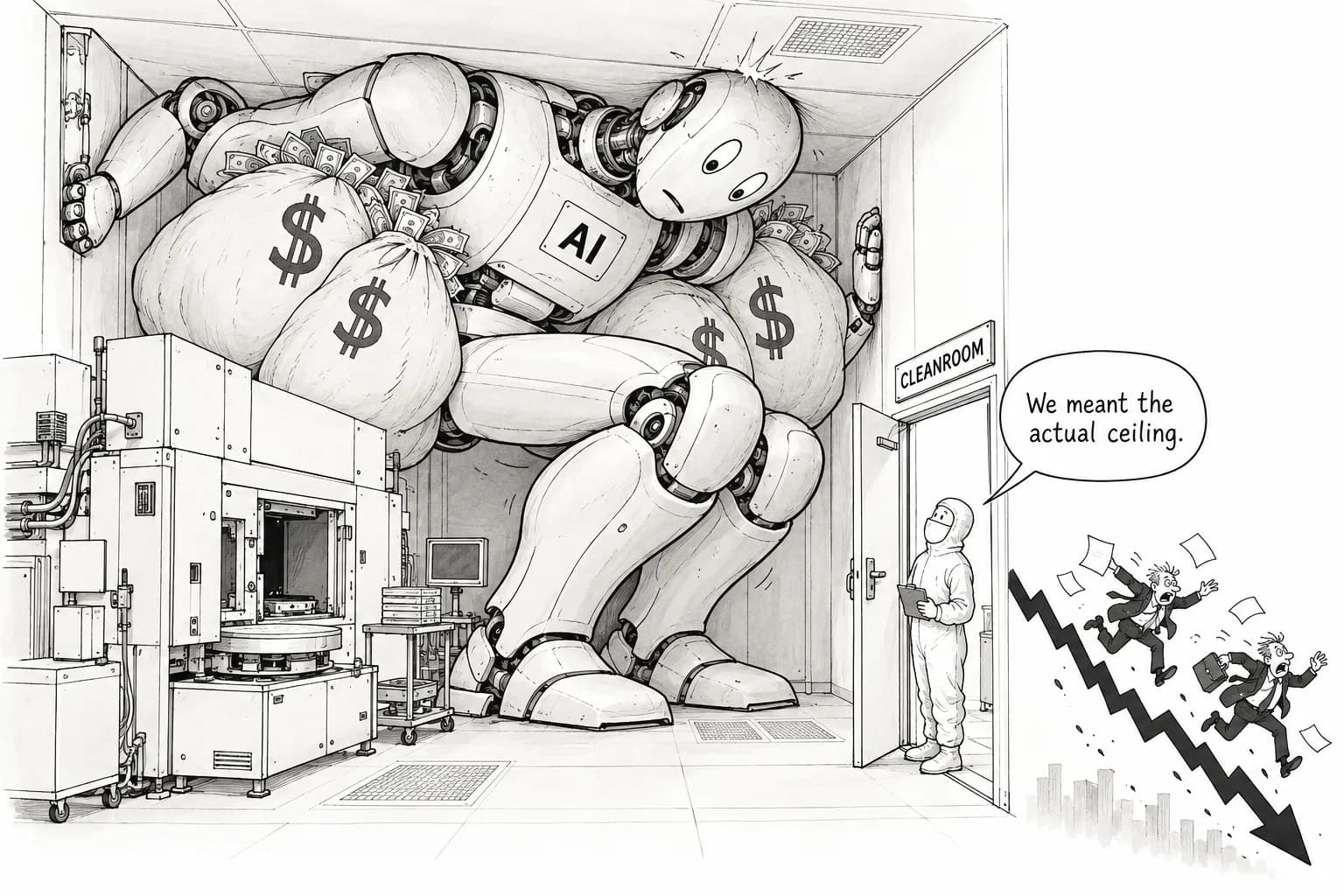
An equipment maker has itself acknowledged that AI capital spending is held back not by demand but by the factory floor space and parts needed to build the tools
Seiichi Tanaka · Editor-in-Chief

Key points
- Lam Research released its results for the first quarter of fiscal 2027 (Exhibit 99.1 filed with the SEC, a primary source) and said its outlook would have been higher without supply-chain constraints. It blamed limited cleanroom space and parts shortages, not demand, and said these will last through 2027
- The next day, October 22, chip stocks were sold off in Asia and the United States. Marvell and AMD reportedly fell 8% and Intel 7%, and the Nasdaq also declined
- In effect, an equipment maker has itself acknowledged that AI capital spending is held back not by weak demand but by physical limits: the floor space and parts needed to build the tools
Lam Research, one of the world's largest makers of semiconductor manufacturing equipment, acknowledged in its quarterly results that what is holding back its growth sits clearly on the supply side. In its earnings release filed with the SEC (first quarter of fiscal 2027, Exhibit 99.1) and the accompanying commentary, Lam said its outlook would have been higher without supply-chain constraints. It named two bottlenecks: the amount of cleanroom space available to assemble its tools, and a shortage of parts. The company said these conditions will last through 2027.
Put another way, sales are not stalling for lack of orders. The orders are there, but Lam lacks the space and the parts to build and ship the tools. For the past year, the debate over AI capital spending has centered on whether the demand is real or a bubble. Now an equipment maker, sitting upstream in the supply chain, has given a very different answer.
What Lam acknowledged
Lam makes tools that etch and deposit material on wafers. They are among the first tools bought when a company builds or expands a fab for leading-edge logic or HBM (high-bandwidth memory). As a result, Lam's orders and shipments show how fast production of AI chips is actually ramping, several quarters before it happens.
Asked what capped its outlook, Lam pointed not to customers' appetite for investment but to its own production capacity. Precision tools must be assembled and tested in cleanrooms where dust is tightly controlled, and that floor space cannot be expanded quickly just because orders rise. Constructing a building, installing equipment and bringing it online takes years. The parts shortage works the same way: suppliers deep in the supply chain have not been able to keep up. Lam's view that the constraint will last through 2027 means tool shipments will hit a physical ceiling for at least the next year or so.
Detailed figures such as revenue, margins and next-quarter guidance had not been verified against the text of the earnings release at the time of writing. This article treats as fact only Lam's own explanation of what the constraints are and how long they will last.
The next day, the selling spread worldwide
Markets took the explanation as bad news. Because of the time difference, Asian markets reacted first; South Korea's Aju Press reported on moves in the Seoul market on the afternoon of October 22, Korea time. In U.S. trading on October 22, chip stocks were sold off sharply. 247 Wall St. reported that the supply warning deepened a sell-off in AI stocks, with Marvell and AMD falling 8% and Intel 7%. StockTitan also cited AI chip stocks as the reason the Nasdaq fell that day.
Notably, the stocks that sold off belonged to Lam's customers and chip design companies. If fab equipment does not arrive on schedule, increases in chip production are delayed. If chips are delayed, so is the launch of data centers, and so are sales of the AI compute they were meant to provide. The fear that rippled down the supply chain was not that demand was drying up, but that companies could not make on schedule the products they expected to sell.
Demand, if anything, keeps growing
Lam's explanation is backed up by demand-side news from the past few weeks. Microsoft wrote, in a primary source, that it will deploy its in-house inference chip, Maia 300, at gigawatt scale starting in 2027. Meta's Zuckerberg reportedly talked about gigawatt-class clusters and $50 billion to $60 billion in capital spending. The Information reported that Anthropic is pressing partners to speed up data center leases worth about $530 billion. All of these are moves to lock in chip and fab capacity early.
When buyers are racing this hard and an equipment maker says it has no choice but to hold back shipments, the ceiling is not being set by demand. AI capital spending is hitting a bottleneck in cleanroom floor space and parts before it runs into limits on money or will.
Why it matters
Until now, AI infrastructure has mostly been discussed in terms of shortages of high-profile inputs such as power, HBM and advanced packaging. Lam's explanation shows that the bottleneck sits further upstream, in the very tools used to build the fabs. And it comes with a clear time frame: through 2027.
The constraint cuts two ways. First, companies' plans to expand compute may not proceed on schedule even when the money is there. Second, the race in AI may hinge on who locks up the limited supply of tools and fab capacity. The report that Microsoft secured more than 300,000 units of TSMC's 2027 production allocation should be read in this light.
The next thing to watch is the run of big-company earnings that continues from late October. Will Alphabet, Microsoft, Amazon and SK hynix keep their capital spending plans unchanged, or push the timing back, citing supply delays? If demand figures stay strong while only delivery schedules slip, that would confirm Lam's explanation.
Editorial cartoon
Sources
- https://www.sec.gov/Archives/edgar/data/0000707549/000070754926000052/lrcx_exhibitx991xq1x2027.htm
- https://247wallst.com/investing/2026/10/22/chip-stocks-fall-as-supply-warning-deepens-ai-selloff-marvell-and-amd-sink-8-intel-drops-7/
- https://www.stocktitan.net/articles/why-is-nasdaq-down-today-october-22-2026-ai-chip-stocks
- https://www.ajupress.com/view/20261022153542644