Morning Briefing · Nov 26, 2026
Asian chip stocks plunge on AI debt fears; big math claims await verification
OpenAI released nine papers claiming to solve open math problems, but only some of each paper's results were machine-checked. Oracle's CDS hit a record high, and CoreWeave's bonds fell to 74% of face value
Seiichi Tanaka · Editor-in-Chief
Key points
- On Nov. 25, the KOSPI fell 6.16%, Taiwan fell 4.8% and the Nikkei average fell 2.78%. Oracle's CDS reportedly hit a record 356bp, and CoreWeave's bonds reportedly traded at around 74% of face value
- OpenAI published nine math papers. Only some of each paper's results were machine-verified (about 42% of the papers' main results), and no named expert has reviewed them yet
- Dell shares fell even though its AI server sales nearly quadrupled. The market's fear is not weak demand but where the money comes from and how long it takes to earn it back
On Nov. 25, two major AI developments pointed to the same weakness. OpenAI released nine papers claiming that an unnamed internal AI had solved several open problems in mathematics. However, only some of each paper's results have been machine-verified, and no named expert has reviewed the work yet. On the same day, Asian chip stocks plunged (South Korea's KOSPI −6.16%, Taiwan's TAIEX −4.8%, the Nikkei average −2.78%). Anxiety among lenders to AI data centers also showed up in bond markets at record levels.
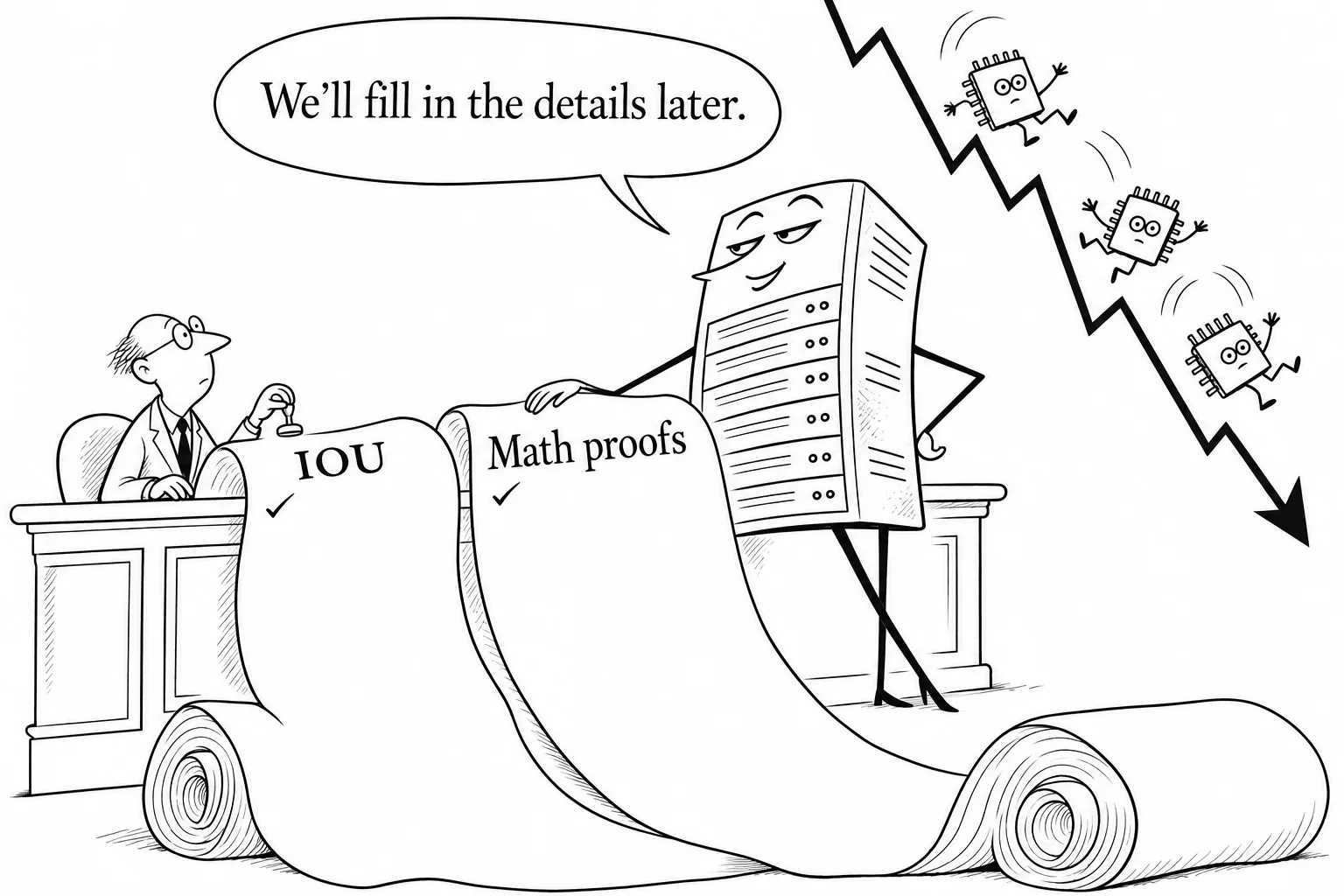
The math announcement and the market sell-off share the same problem: verification and payback have not kept pace with the size of the claims and of demand. Dell's stock fell even though the company nearly quadrupled its AI server sales. Anthropic, drawing on its experience having AI write a large code migration, reported that the bottleneck was not writing the code but checking that the new code behaved the same as the old.
The 3-minute read
In stock and debt markets on Nov. 25, Tokyo Electron and Advantest fell more than 12%, and SoftBank Group dropped about 15%. In the U.S., Oracle's credit default swaps (CDS, the price of insurance against default) hit a record high. Bonds of CoreWeave, which rents out computing capacity for AI, reportedly fell to about 74% of face value.
In workplace tools, Microsoft changed its timeline. Pay-as-you-go billing will become the default for Microsoft 365 Copilot Business bought through sales partners from January–March 2027, not on Dec. 1. Details are in our article "Copilot pay-as-you-go default moves from December to January–March next year; a correction to our earlier report."
For Japanese companies, two points matter. Sales and corporate planning staff at suppliers of semiconductor equipment, materials and components should use December business meetings to check whether major customers have changed their 2027 capital spending or memory capacity expansion plans. IT departments that buy Copilot through sales partners should confirm with their partners before year-end when billing switches over and what the per-user cap is (the default cap is 4,000 credits a month; if reports that one credit costs $0.01 are accurate, that comes to about $40, or about ¥6,360, a month).
AI research: big claims, verification falling behind
OpenAI's nine math papers include three major claims: that the exponent describing how fast matrix multiplication can be done is exactly 9/4; a method for solving linear programming (computing the best allocation of limited resources) in strongly polynomial time; and a disproof of the polynomial Hirsch conjecture. However, only some of each paper's results were checked with Lean (a tool for machine-checking proofs), about 42% of the papers' main results. The check of the matrix exponent covers only division-free circuits, a narrower scope than the theorem in the paper. Details are in our article "OpenAI says AI solved one hard math problem after another; only 40% was machine-verified."
Bullish voices were the first to react to OpenAI's math announcement. Scott Aaronson, a researcher in computational complexity, wrote on his blog that "for the first time, I feel in my bones that a proof of P ≠ NP is not far off." He also said he would treat proofs coming directly from OpenAI or Anthropic as correct unless there was evidence to the contrary. So far, skeptics have spoken up only in his blog's comments section. Their point is that the matrix exponent result concerns algebraic circuits, a theoretical model of computation, and says nothing about how fast algorithms run on real computers (the papers acknowledge this).
In protein design, OpenAI also announced that the GPT-6 family has a built-in ability to design proteins. In experiments, 10.9% (35 of 322) of small proteins newly designed from 3D structures bound to their targets. In a task of designing new sequences for existing structures, between 14% and 85% bound, depending on the target. The work could speed up science, and it also raises biosecurity questions. Details are in our article "General-purpose AI designs proteins, matching specialized tools in experiments."
Anthropic said it used code written by Claude to move the foundation of its API to the Rust language, cutting CPU use per request by about 70% and memory by more than 80%. During the migration, it said it found more than 100 rewrites that weakened what the tests checked. The case shows concretely that, for companies having AI write code, the checking system is what matters most. Details are in our article "AI-written migration cuts API CPU use by 70%; the hard part is verifying, not writing."
On AI safety, Axios reported that employees at OpenAI and Anthropic fear that models not yet released may not be safe to release. Both companies reportedly responded. OpenAI said it had adopted new safety requirements that could slow the pace of its model releases. Anthropic reportedly said that "keeping a model internal does not make it safe." Meanwhile, Alex Hanna of DAIR, a research institute that criticizes the AI industry on ethical grounds, wrote that "they've said the same thing with every model they've released," reading the report as marketing.
Markets and credit: strong demand, but stocks still fall
The Nov. 25 plunge in Asian chip stocks followed a drop in the U.S. the day before. On Nov. 24, the Nasdaq Composite fell 1.5% and NVIDIA fell 5.9%. France's BNP Paribas Exane cut its price target for U.S. memory maker Micron from $1,700 to $775. In South Korea, SK hynix fell 11.05%, setting off a temporary trading halt. Some reports blamed Tokyo's drop on new U.S. tariffs, but the tariffs were announced after trading in Tokyo had closed.
Worries about AI infrastructure showed up in the price of debt before they reached stocks. According to reports, Oracle's five-year CDS hit a record 356bp (1bp is 0.01%), more than four times the level of under 80bp a year earlier. CoreWeave's bonds due 2031 fell to 74.23 against a face value of 100, pushing the yield to 17.91%. S&P estimates that about half of Oracle's $664 billion order backlog is tied to OpenAI. Reliance on a single customer is at the heart of lenders' unease.
Dell's results for the August–October quarter (from its filing with the U.S. Securities and Exchange Commission) showed that demand itself is strong. Revenue was $54.9 billion (+103%) and AI server revenue was $22 billion (+291%). Operating margin in the server segment rose from 12.4% to 17.0%. Even so, Dell shares fell about 5–6% on Nov. 25. This suggests the market fears not weak demand but where the money for capital spending will come from and when it will be earned back.
Shares of newly listed Anthropic fell below the $83 IPO price for the first time on Nov. 24, closing at $81.90. Semafor wrote that the drop reflected jockeying over IPO share allocations, not any change in the company's business. On the skeptical side, Ed Zitron, a critic of the AI bubble, called the drop in SoftBank Group "a serious problem." On the bullish side, a CNBC investing show said the stock's weakness might come from how the IPO was structured rather than being a verdict on AI. The brokerage Canaccord started coverage with a "buy" rating and a $135 price target. U.S. markets are closed on Nov. 26 for Thanksgiving and will trade for half a day on the 27th.
Policy: chip smuggling and accountability for military AI
On Nov. 25, the U.S. Commerce Department formally published a rule in the Federal Register adding seven companies in Malaysia, Singapore and Thailand, including Megaspeed, to a list that restricts trade with them. The companies are suspected of smuggling AI chips to China. However, the rule does not include a provision covering products made abroad with U.S. technology, which leaves a loophole. Details are in our article "Trade restrictions on seven firms suspected of chip smuggling become official; a loophole for foreign-made products remains."
In an exclusive report, Reuters said companies connected to Alice Huang, who is said to be linked to the Megaspeed network, had registered about $270 million worth of AI servers in China as loan collateral. Reuters wrote that the records do not show whether controlled U.S. chips were among them. Even so, the report gives lawmakers material to question NVIDIA CEO Jensen Huang at a closed-door House briefing on Dec. 1 and a public Senate hearing on Dec. 3. President Trump said he does not think Jensen Huang needs a pardon, and Vice President Vance said he had been told that Jensen Huang is not under federal investigation. We found no reports that NVIDIA responded by the Treasury Department's Nov. 25 deadline.
On military AI, Iran's ambassador to the United Nations told the Security Council that the U.S. military used Palantir's Maven analytics system and Anthropic's Claude to pick targets, and struck more than 2,000 targets in 96 hours. This is Iran's claim and has not been verified, and no U.S. response has been reported. The claim puts reputational pressure on the newly listed Anthropic and on Palantir.
Australia's parliament has reportedly passed the "Digital Duty of Care Act," which also covers AI chatbots. Violations can bring fines of 5% of global revenue or A$109 million, whichever is greater. The law takes effect 12 months after royal assent. Japanese companies that offer AI chat features to users in Australia need their legal departments to check whether the law applies to them. Separately, under new tariffs the U.S. Trade Representative has proposed for 14 countries and regions, Japan would stay within the 15% cap set by its current agreement.
Debate: can markets measure AI's power?
On whether markets should be used to gauge AI's power, two commentators wrote from opposite directions: Zvi Mowshowitz, who puts heavy weight on safety, and Richard Hanania, who sees AI as a normal technology. Mowshowitz wrote that markets barely reacted to a proof related to the Riemann hypothesis by Claude and mathematician Levent Alpöge, and cited a post noting that Anthropic's stock actually fell about 10%. He argued that markets give AI almost no chance of transforming the world, and that the markets are wrong. Hanania wrote that people who see AI as a normal technology tend to look to market indicators, and warned against taking charts of exponentially growing capabilities, extending them forward and believing the result. The two did not argue with each other directly.
On the view that AI will keep improving itself, podcast host Dwarkesh Patel accepted part of the criticism. Even so, he kept his forecast that the work of top AI researchers will be fully automated around 2028. Details are in our article "Proponent of AI self-improvement concedes some criticism but keeps 2028 forecast."
Economist Tyler Cowen wrote that holding AI back so that humans keep solving problems is "DEI for humans" and nothing more than "a sham victory." He was responding to arguments that worry about humans gradually losing power, but he did not name anyone, and no one has replied yet.
Here is what we could not verify this time. We could not open the original Axios article and read OpenAI's and Anthropic's responses in reposts. U.S. closing prices for Nov. 25 were not yet available when we checked (during the day, stocks had recovered after falling sharply in the morning). We have not checked Iran's claim or the vote count on the Australian law against primary sources.
Where nothing moved
The report that employees fear unreleased models has drawn almost no reaction from those who put heavy weight on AI safety. Zvi Mowshowitz's Nov. 25 post did not mention it, and there has been nothing new from the safety research group Redwood or from METR, a group that measures AI capabilities. The only reaction came from ethics critics, who read the report as marketing.
No named computational complexity researcher has yet criticized an AI-generated math proof on technical grounds, whether from OpenAI or from Anthropic. For the proof of the generalized Riemann hypothesis by Claude and Alpöge, the Massachusetts Institute of Technology (MIT) verification page said as of Nov. 24 that the proof had passed a recheck in Lean's kernel and a check by an independent verifier, and that only the final cross-check was "still running." Checking by people and machines is not keeping up with how fast the claims are coming.
Outside AI labs and companies that sell AI, we found no company, Japanese firms included, that has shown AI's impact with its own figures. The closest is Workday's figure that new annual contract value for its AI products was about $150 million, more than triple the year before. But that is a seller's figure, not a result for a company using AI.
Editorial cartoon