Morning Briefing · Nov 24, 2026
NVIDIA reinstates Huang as CEO and US stocks rebound sharply as White House intervention draws fire
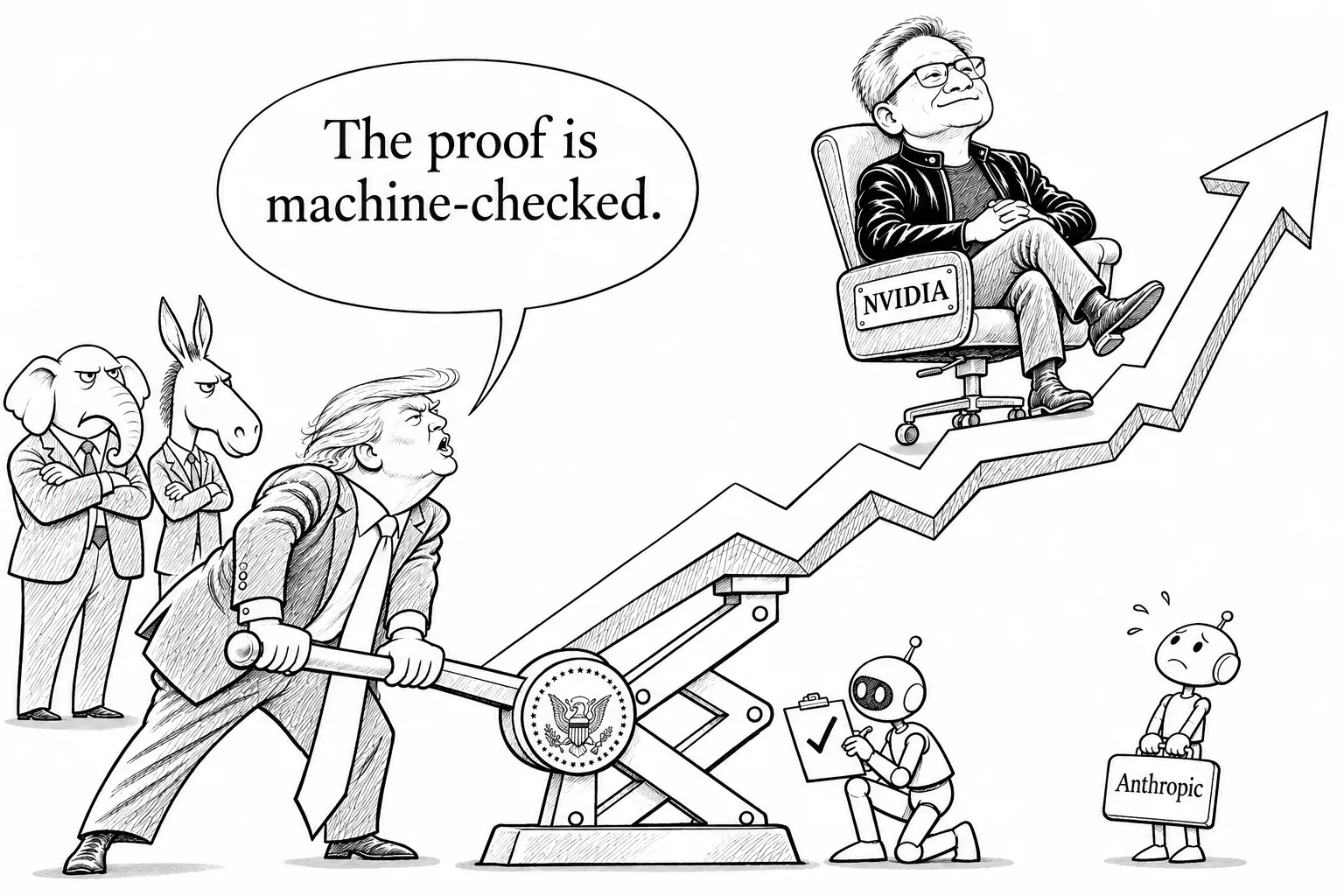
Trump says he "convinced" the board, and politics now moves AI stocks. Congress will question Huang in a public hearing on December 3
Seiichi Tanaka · Editor-in-Chief
Key points
- NVIDIA announced Huang's return as CEO in an 8-K filing. The S&P 500 was reportedly up about 4.8% intraday and looked set to snap a seven-day losing streak (closing figures not yet available)
- Trump reportedly said he persuaded the board himself, drawing bipartisan criticism. The Senate will hold a public hearing on December 3, and export-control bills targeting China are in their final stages
- Claude Opus 4.5 will be retired from the API on January 22, 2027. Gemini now lets users feed in only parts of PDFs and other files and pay only for what is read
NVIDIA's board on November 23 reinstated Jensen Huang, who stepped down on November 12, as CEO. President Trump has reportedly said that he "convinced" the board. US stocks rebounded sharply in intraday trading. This morning's events share a common dynamic: the prices of AI stocks are now moving not only on technology and earnings, but on decisions made in Washington. Markets welcomed the end of worries about a company without a leader. In Congress, meanwhile, lawmakers from both parties objected to the White House's involvement in personnel decisions at a company that is under investigation. Reassurance and a new kind of risk are both emerging from the same event.
The 3-minute read
Money and markets: The S&P 500, the benchmark US stock index, was reportedly up about 4.8% intraday and looked set to end a seven-day losing streak (closing figures are not yet available). Shares of newly listed Anthropic, however, failed to join the rally. Investors have begun picking individual names rather than buying AI stocks as a group.
What matters at work: Anthropic announced it will retire the older Claude Opus 4.5 from its API on January 22, 2027. Google's Gemini now lets users feed in only part of a long PDF or spreadsheet and pay only for what is read. Prices for enterprise plans, including Copilot, ChatGPT's business tiers and Gemini for Workspace, are unchanged.
For Japanese companies: IT departments at companies that have built Claude Opus 4.5 into their systems will set a schedule before year-end to test whether their systems run on the successor model. The Tokyo market will react to NVIDIA's reinstatement for the first time on November 24, when it reopens after a holiday. Finance staff at companies holding shares in SoftBank Group or semiconductor equipment makers will be watching the opening moves. Trading houses and systems integrators that ship AI servers to Southeast Asia will ask their suppliers this week about shipping terms, following reports that US approval will be required.
NVIDIA's CEO returns, with Washington's hand
NVIDIA's board unanimously reinstated Huang as president, CEO and director, effective the same day. This is primary information from an 8-K (the filing US-listed companies use to report material events) and the company's announcement. The filing says the board "received input from senior levels of the US government." It went on to say the board is confident that Huang's return poses no national security risk. Colette Kress, who served as interim CEO, will remain chief financial officer (CFO). The board recently created a national security and export control committee made up solely of independent directors. An internal investigation into reports that Huang was targeted by a foreign intelligence service will continue. Details are in our article "NVIDIA reinstates Huang as CEO, shares jump 33% as US stocks rebound sharply."
The dispute over NVIDIA's reinstatement centers on whether the administration's assurances are enough. Trump reportedly told CNBC that he had given the national security assurances the board sought, and that Huang had "done nothing wrong." In response, Democratic Senator Elizabeth Warren reportedly called it "reckless" and demanded the names of the officials who advised the board. Republican Senator John Cornyn reportedly wrote, "No security risk? Based on what?", making the criticism bipartisan. The Senate Banking Committee will reportedly call Huang to a public hearing on December 3. Details are in our article "Trump says he 'convinced the board'; Congress to question Huang publicly on December 3."
The export-control bills that Congress is rushing in the wake of the NVIDIA case could also affect Japanese companies. There are three bills: one would halt sales of Blackwell (NVIDIA's latest AI chip) to China for at least 18 months; one would require tracking the location of chips shipped overseas; and one would restrict sales of semiconductor manufacturing equipment to China. According to reports, all three are in final negotiations for inclusion in the National Defense Authorization Act (NDAA), the defense spending bill that typically passes in December. If the equipment bill is included, it could hit Japanese equipment makers' business in China.
Huang's return also drew criticism from AI skeptics. Gary Marcus, a cognitive scientist skeptical of AI, said the board reversed its decision under White House pressure and predicted shareholder lawsuits and congressional investigations. Ed Zitron, who writes a newsletter critical of the tech industry, called it "crony capitalism."
We are making two corrections to earlier reports. The first concerns the Treasury Department's deadline. We previously reported that the deadline for NVIDIA to respond to the Treasury had passed. However, reports of remarks by Treasury Secretary Scott Bessent put the deadline at November 25, so it most likely has not yet passed. As of November 23, there were no reports that NVIDIA had responded. The second concerns the date California sued OpenAI for creating a "public nuisance." According to the state attorney general's announcement, it was November 16; our earlier report of "around November 17–18" was incorrect.
Markets: inside the rebound, and the stock that missed it
The US stock rebound on November 23 was driven mainly by AI-specific factors. According to CNBC, as of about 1:39 p.m. Eastern time, the S&P 500 was up about 4.8% and the tech-heavy Nasdaq Composite was up about 6.7%. NVIDIA shares reportedly opened at $167.04, up 33% from Friday's $125.53, but remain about 30% below their all-time high. Last week's biggest losers posted the biggest gains: companies that rent out computing power for AI such as CoreWeave, memory makers, and Oracle.
Anthropic shares (ANT) failed to join the broader tech rally. According to Yahoo, after swinging up and down in the morning, the stock fell as much as 2% by midday, dipping below $88 and coming within about 5% of its $83 IPO price. Yahoo cited four reasons: profit-taking after the IPO; a valuation of about 40 times trailing revenue; up to 315 million insider shares that can be sold immediately; and commitments to pay about $900 billion for computing resources over 20 years.
Asian markets closed on November 23 before the Huang news. South Korea's KOSPI reportedly fell 3.31% and Taiwan's TAIEX rose 2.16%. The Tokyo market was closed, so its reopening on November 24 will be the first reaction to NVIDIA's reinstatement. We could not find Nikkei futures prices from after the news, so it is unclear whether the market will open higher or lower.
Cybersecurity company CrowdStrike announced it will acquire rival Zscaler in an all-stock deal worth about $43.9 billion (about ¥7 trillion). According to primary information in the 8-K, Zscaler shareholders will receive 1.135 CrowdStrike shares for each Zscaler share. CrowdStrike's Falcon Guardian, a product that protects AI agents, surpassed $100 million in annual recurring revenue (ARR) in its first year. Sierra, an AI company for customer service, raised $1.75 billion at a $30 billion valuation, TechCrunch reported. Its valuation doubled in six months.
Research: AI begins delivering results "with proofs"
The proof of the generalized Riemann hypothesis by mathematician Levent Alpöge and Claude has passed every machine check completed so far, according to a verification page (updated November 23; primary information) maintained by MIT mathematician Andrew Sutherland. It passed the standard check in Lean (a tool for machine-verifying whether proofs are correct), which took 48 hours. It also passed runs with different settings and checks using alternative methods. Two checks remain. Anthropic has not yet made an official announcement or disclosed the model used, and no human peer review has been published.
Google DeepMind announced that a team of Gemini 4 agents sped up quantum computing algorithms and proved every result in Lean (primary information). It cut costs in a nuclear fusion calculation to 1/11.8 and improved a calculation for a drug-metabolizing enzyme by a factor of 2.5. Coming in the same week as the Riemann hypothesis result, this is another example, from a different lab, of agents and machine verification producing new scientific results. Details are in our article "AI cuts cost of quantum calculations for fusion and drug discovery to as little as 1/11.8, with proofs."
Opinions split on whether the Riemann hypothesis result signals that general-purpose AI surpassing humans is near. Alexandr Wang, who leads Meta's AI division, reportedly said it was a sign that superintelligence is near and that AI research itself could soon be automated. Marcus, by contrast, said no new general method had emerged and that it was unclear whether the approach could extend beyond fields with well-developed tools like Lean, comparing it to the chess computer Deep Blue. The two did not engage each other directly.
OpenAI chief scientist Jakub Pachocki has proposed a "common ceiling" on the capability of AI from all companies, measured by perplexity (a measure of how confidently a model predicts the next part of a text). OpenAI CEO Sam Altman reportedly wrote on X that it was "the most important thing we've put out in a while." On the critical side, Vlad Makarov, writing for Traictory, raised two points: OpenAI calculates the figure using internal data, so it cannot be compared with other companies; and the proposal includes no ceiling value, no verification method and no penalty for violations.
In a debate over whether it is acceptable for AI to replace humans, University of Texas computer scientist Scott Aaronson acknowledged on his blog that he lost to economist Robin Hanson. Even so, he wrote that he would "vote for humanity continuing." Details are in our article "'I vote for humanity continuing': the scholar who conceded defeat in a debate on AI replacement."
Changes to AI tools for work
Anthropic's API release notes (November 23; primary information) included two changes that affect business use. First, Claude Opus 4.5 will be retired from the API on January 22, 2027; Opus 5.5 is the recommended replacement. Second, a beta feature now allows the top-tier models (Fable and Mythos) to be used with zero data retention (ZDR) at Anthropic. Encrypted data retained for safety purposes can be stored in the customer's own cloud. This widens the options for financial and healthcare companies that cannot leave data outside their control.
Google's Gemini API now lets users specify only part of a document to be read (primary information). Users can specify PDF pages, spreadsheet sheets or cell ranges, and time segments of videos. Charges apply only to what is actually read, and integration partner LiteLLM said it reduced PDF input by 67%. For internal systems that feed long documents to AI, this offers a way to cut costs.
OpenAI has begun rolling out GPT-6.2 Sol, tuned for ChatGPT's chat interface, to Plus, Pro, Business and Enterprise users (primary information). In the company's own comparison, its ability to follow complex instructions rose from 62.5% for GPT-6 to 78.1%. Developer tools gained a feature for setting a spending cap on a single agent task. It is part of a broader trend of controlling costs through systems that manage permissions and budgets outside the model (agent harnesses).
Where nothing moved
Competitors Anthropic and Google DeepMind have not responded to Pachocki's "common ceiling" proposal. Nor has there been any reaction yet from named commentators, whether from the AI safety camp, the accelerationist camp or ethics-focused critics. An industry-wide ceiling would require other companies' agreement, yet so far the only voices heard are from OpenAI's side.
We could not confirm any public defense of Huang's return by named bullish investors or accelerationist commentators. Criticism has come from AI skeptics, ethics critics and lawmakers of both parties. Support, by contrast, has been limited to the administration's statements and the board's filing.
Anthropic has made no official announcement about the Riemann hypothesis proof and has not disclosed the model used. For now, the proof's passing of the checks can be confirmed only on an outside researcher's page.
What we could not confirm: US stock closing prices were not available at the time of writing, and figures in this article are intraday. Accounts of whether Commerce Secretary Lutnick was involved in Huang's return conflict between Trump's remarks and those of unnamed sources. The report that shipments of AI chips to Southeast Asia will require US approval is based on Bloomberg reporting, and we have not been able to read the original article.
Editorial cartoon