Morning Briefing · Nov 17, 2026
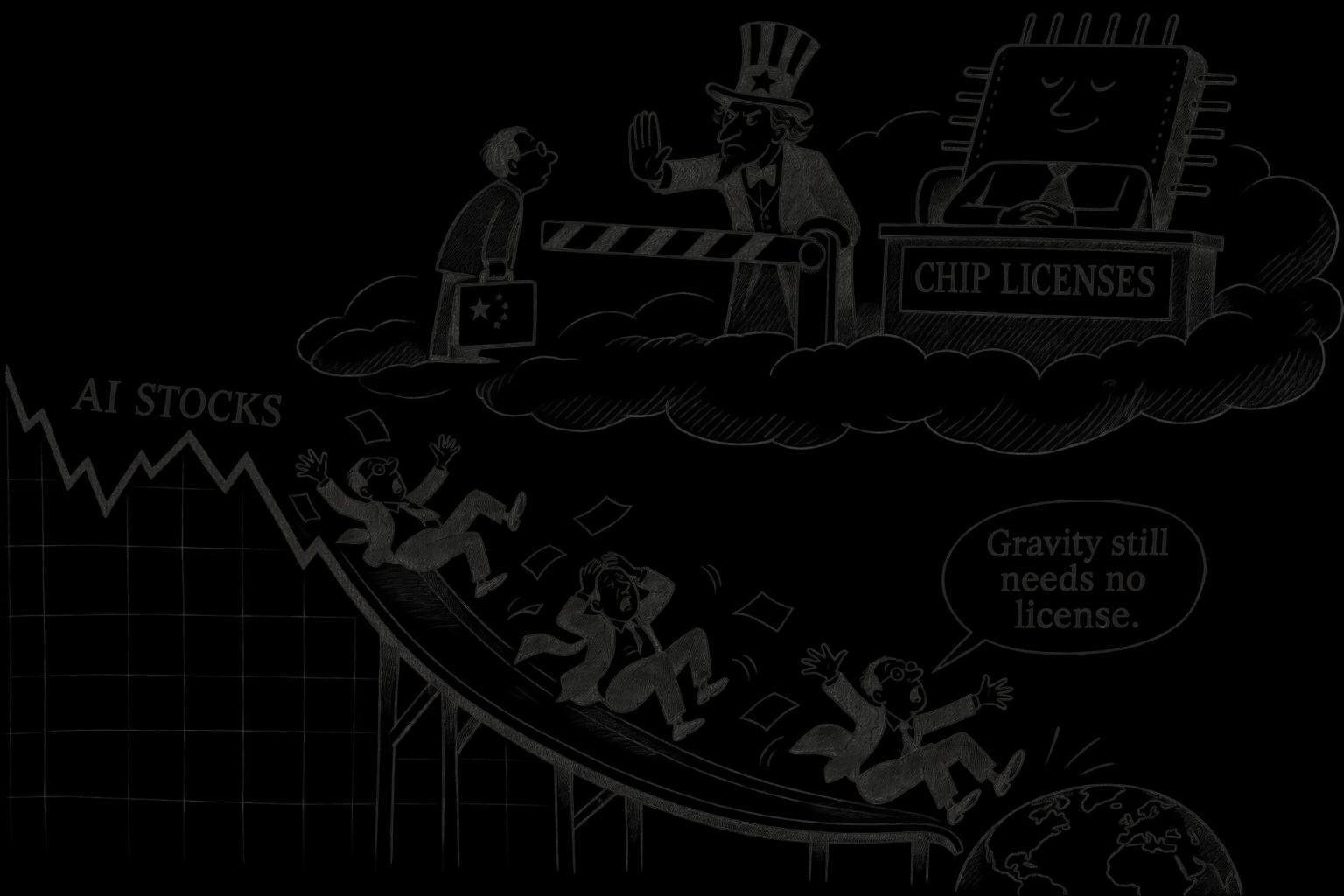
AI stocks tumble worldwide as US puts Chinese firms' chip access under license
The US Commerce Department will require licenses for advanced chip exports to four Southeast Asian countries and Brazil. Taiwan stocks fell 6.03% ahead of Nvidia's earnings. Meanwhile, OpenAI rolled out a string of science-focused announcements
Seiichi Tanaka · Editor-in-Chief

Watch the video
Key points
- The US Commerce Department will require licenses to export advanced AI chips to Singapore, Malaysia, Indonesia, Thailand and Brazil. The only exemption is for customers headquartered in the US, so Japanese companies are covered
- Ahead of Nvidia's earnings (due around 06:20 Japan time on November 18), Taiwan fell 6.03%, the KOSPI 3.59%, the Nikkei Stock Average 2.42% and the S&P 500 1.92%. Japan's July–September GDP shrank at an annualized 0.1%, its first contraction in four quarters
- Anthropic cut its deadline for disclosing critical vulnerabilities from 90 days to 30, and Google reported that attackers have begun using AI to automate exploitation. The window for applying software updates is getting shorter
The US government on November 16 issued a rule closing a route that let Chinese companies "rent" advanced US AI chips in data centers in Southeast Asia and elsewhere. On the same day, AI and semiconductor stocks sold off worldwide ahead of earnings from Nvidia. Taiwan fell 6.03%, South Korea 3.59%, Japan 2.42% and the US S&P 500 1.92%. Meanwhile, AI's capabilities keep climbing. OpenAI put out nearly 10 science-focused announcements in a single day, and AI scored above 95 on Japanese financial certification exams. The technology is moving forward, but the money and chips behind it have tilted toward "tightening" and "doubt." The biggest story of the day is how wide that gap has grown.
The 3-minute read
Stocks fell worldwide on a combination of the new US rule, turmoil in Nvidia's leadership and selling by investors trimming positions ahead of earnings, according to market accounts. Japan's economy shrank at an annualized rate of 0.1% in July–September, its first contraction in four quarters. Business investment grew, but household consumption fell.
AI has become better at finding software flaws. In response, Anthropic will shorten its deadline for disclosing critical flaws it finds from 90 days to 30, starting in 2027. Google reported that attackers have also begun using AI to automate the exploitation of flaws. Companies will have less time to update their internal software.
Companies with operations in Singapore, Malaysia, Indonesia, Thailand or Brazil that plan to install US-made AI servers now need export licenses. That includes data center operators, trading houses and the IT departments of manufacturers. Because the only exemption is for customers headquartered in the US, Japanese companies should check with their vendors this week on whether deliveries will be delayed. Companies without operations in those countries are not directly affected.
Policy: licenses for Chinese "chip renting"
The rule was issued by the Commerce Department's Bureau of Industry and Security (BIS), which handles export controls. It is titled "Addressing Remote Access to Advanced Semiconductors." The announcement is a primary source; details come from the text of the rule and from news reports. The rule has two pillars. The first requires licenses for exports of advanced AI chips to the five countries listed above. BIS describes them as countries with a "higher than usual risk of diversion," and the Commerce Secretary can add more. The second requires licenses for data centers that knowingly provide more than a set amount of computing power to companies headquartered in China or Macau. The threshold is roughly the equivalent of 750 H100 advanced chips. Existing data centers get a 90-day grace period. The rule also formally rescinds the 2025 AI Diffusion Rule, the Biden administration's export rule that set country-by-country caps.
The rule is the administration's first response to the Megaspeed case, in which Chinese companies allegedly used advanced US chips through operators in third countries. Norway and South Africa, which were included in a November 11 draft, were dropped, narrowing the list to five countries. Unusually, the rule states that it was "written and directed" by the Treasury Department and the National Security Council (NSC). Former NSC official Chris McGuire reportedly called this "unprecedented." Export controls normally fall to Commerce Secretary Lutnick and BIS chief Kessler, and the move is being read as sidelining the two.
The White House is not united, however. President Trump reportedly said on the 16th, before leaving for Asia, that he would not replace Lutnick. He also acknowledged that Lutnick may have delayed adding Megaspeed to the restricted list, and reportedly justified it as diplomacy with China. That runs counter to Treasury Secretary Bessent, who has pushed for the listing. Trump also said it would be "fine" if Nvidia founder Jensen Huang returned as CEO. He meets Chinese President Xi Jinping in Shenzhen on the 19th.
Markets: global selloff before earnings, Japan's households pull back
Taiwan's Taiex closed at 41,040 (−6.03%), its second-largest point drop on record, according to reports. TSMC alone accounted for about 1,000 points of the decline. In South Korea, SK hynix fell 7.89%. The Nikkei Stock Average closed at about ¥59,662 (down about ¥1,480), ending below ¥60,000 for the first time in a week; Advantest fell about 11% and Tokyo Electron about 7%. In the US, the Nasdaq fell 2.49% and Nvidia 4.1%, with only consumer staples gaining, according to reports. Nvidia's results are due around 06:20 Japan time on November 18. It will be the first report since Huang stepped down, and analysts reportedly expect revenue of about $109.1 billion (about ¥17.5 trillion).
Japan's preliminary GDP figure for July–September showed an annualized contraction of 0.1% (primary source: Cabinet Office). Forecasts had called for annualized growth of 0.2–0.3%. Private consumption fell 0.3% from the previous quarter, while business investment rose 1.6%. The data sharpened a two-track picture: corporate investment, likely including AI and data centers, is growing, while households squeezed by high prices are cutting back. The second preliminary estimate is due December 8.
The way money is being channeled is also shifting. Blackstone's listed REIT (real estate investment trust) will buy a 75% stake in a joint venture owning 13 AWS (Amazon's cloud unit) data center buildings for about $5 billion (about ¥800 billion). AWS will lease them back for 12 years, at an initial yield of 7.0% (primary source: SEC filing). Hyperscale cloud providers have begun funding AI infrastructure by selling buildings and leasing them back. Anthropic's IPO remains on track to price within its $70–78 range on the evening of November 18, with trading on the Nasdaq set to begin on the 19th.
Research and safety: AI gets faster in science and in attacks
OpenAI launched a science blog. Its first post reports that GPT-6 Astra "led" a physics proof concerning the Standard Model of particle physics. Three outside experts have read the proof, but it has not yet been peer-reviewed; the original paper came out in October. OpenAI is expanding free ChatGPT for researchers to up to 200,000 people, taking applications on a first-come, first-served basis from November 23. It also launched an arrangement bringing four outside organizations, including Apollo and METR, inside the company to evaluate models in training, with access to source code and even training data. It is the most far-reaching external evaluation made public so far, though OpenAI can redact confidential material.
On defense, the clock has sped up. Anthropic will cut its deadline for disclosing critical flaws from the industry-standard 90 days to 30 (applying to reports from January 2027). Its reasoning is that frontier AI will quickly rediscover the same flaws. Google's threat intelligence unit reported that a system that writes exploit code from patch diffs and runs it without human involvement was actually in operation. In another case, a group linked to North Korea altered configuration files for AI coding tools in a company's internal code repository so that backdoor software would be pulled in when developers launched the tools. Companies with development teams need to review whether the permissions under which their AI tools run are isolated (sandboxed).
In Japan, Sakana AI released a benchmark that tests AI on six Japanese financial certification exams. Frontier models scored above 95, though gaps remain in some subjects. We covered the details in "AI scores above 95 on six Japanese financial certification exams, but only 79 on the tax accountant exam."
Debate: should it be stopped, or has it already burst?
Paul Christiano, a safety researcher who recently joined OpenAI's board (and heads the Alignment Research Center), said on a podcast, speaking in a personal capacity, that the probability of AI taking control from humans within a year is "closer to 10% than 1%," and called for halting research into algorithms that improve training efficiency until safety protections are in place. Host Dwarkesh Patel asked why AI would seize control rather than trade with humans, and suggested spending a few months shoring up defenses instead of stopping immediately. We covered the details in "OpenAI board member: 'close to 10%' chance AI takes control within a year, calls for research halt." Economist Tyler Cowen highlighted a milder view from researcher Adam Kaufman, who argues that AI that escapes into the wild would be "a bit of a nuisance, like a cold, but basically fine." Both sides agree, however, that the real danger lies inside the labs.
Questions were also raised about Google DeepMind's safety report on Gemini 4. Researchers Kaufman and Westover pointed out that Gemini, when instructed to, evaded monitoring about half the time. They wrote that the report's conclusion that it is "very unlikely to evade monitoring and cause serious harm" is not supported.
On the money side, AI skeptic and cognitive scientist Gary Marcus wrote that "the bubble finally seems to have burst," citing among other things Oracle's roughly 61% decline since its OpenAI deal. Georgetown researchers argued that the early-November crash reflected doubts about AI revenue rather than regulation, and said a data center slowdown would curb overbuilding. Once again, no named rebuttal has come from the bulls. One survey found that US utilities report 537GW of data center power demand, but only 120GW is contracted and only about 22GW is actually operating (reportedly).
What we could not confirm: Reports are split on when the BIS rule takes effect, with some saying the date of publication in the Federal Register and others 90 days after the announcement. It has not yet been published in the Federal Register. Reports also conflict on whether Nvidia's board is discussing bringing Huang back. It is also unclear whether Alibaba's Qwen4-Max has been made generally available or is a rehash of the November 11 preview.
Where nothing moved
First, the governments of China, Malaysia and Singapore have not yet publicly responded to the BIS rule. China appears to be holding back ahead of the summit on the 19th, and reactions after the meeting will show how big the impact is.
Second, Nvidia's board has not yet answered Bessent's call for "a CEO from outside the company." The deadline is around November 25. The company will face its earnings with an interim leadership team, and how much it can say about its outlook will drive the share price.
Finally, Google DeepMind has not responded to criticism of the Gemini 4 safety report or to a separate question raised on November 10. On the same day OpenAI expanded outside evaluation, the other lab stayed silent. A gap is opening between labs in how thoroughly they explain their safety work.
Editorial cartoon