Infrastructure & Security · Nov 23, 2026
Prompts marked "zero data retention" were still read as leaks at AI inference routing continue
OpenRouter removed 125 endpoints from its "zero data retention" option, and Together AI disclosed a leak. The first line of defense is to keep passwords and keys out of prompts
Seiichi Tanaka · Editor-in-Chief

Key points
- Researcher Dragos reported that even requests marked "zero data retention" leaked from the inference providers that handled them, and that third parties tested whether the secrets inside them actually worked
- OpenRouter removed 125 endpoints from its "zero data retention" option. Together AI also reportedly disclosed a prompt leak that began when a coding agent exposed credentials
- Promises and settings can only protect so much. The first line of defense is to keep API keys and passwords out of prompts and agent work logs
[Update, November 23, 2026, 4:49] On the credentials the intruder tested, we replaced "five of them" with the facts: the intruder tested five credentials, and all five were decoys.
When someone uses an AI model, their request (the prompt) goes to an inference provider, the company that actually runs the computation. OpenRouter, an AI routing service, said on its blog that a security researcher's report had turned up data leaks at some inference providers, along with evidence that some were not keeping their data-handling commitments. According to the researcher, Dragos, requests marked "zero data retention" were among those stolen, and keys inside them had been tested. OpenRouter removed 125 endpoints (the access points that accept requests) from the option. Around the same time, inference provider Together AI also reportedly disclosed a prompt leak. Promises and settings cannot fully prevent this, and the first line of defense is to keep credentials out of prompts.
For companies in Japan: Development and IT teams that use AI APIs or coding agents should check this week whether their prompts or agent work logs contain API keys, passwords or connection details for internal systems, and should rotate any keys they find right away. Companies that do not use a router like OpenRouter or an inference provider like Together AI should still review their vendor contracts and internal rules on the assumption that any text given to an AI can be read on the other end.
OpenRouter's disclosure: prompts were read despite "zero data retention"
OpenRouter is a routing service that lets users call many AI models through a single access point and distributes their requests behind the scenes to multiple inference providers. By setting the "zero data retention" option, users can ask for their requests to go only to inference providers that have promised not to store data. According to OpenRouter's blog, the researcher found that data had leaked at some inference providers, along with evidence that some were not keeping their data-handling commitments. Dragos reported that requests with this option set were among those stolen by attackers who had gotten into inference providers, and that keys inside them had been tested.
OpenRouter responded by removing 125 endpoints from the "zero data retention" option. It also dropped three inference providers and notified users who may have been affected. Requests with the option set will no longer be routed to those endpoints. But the contents of requests sent before the removal are already in other hands.
The Together AI leak: a coding agent exposed credentials
Inference provider Together AI also disclosed a prompt leak, tech outlet Unite.ai reported. According to Unite.ai, it started when the company's coding agent wrote credentials for a private storage location to a public repository. In the meantime, a third party took some of the prompts from requests made between June and July 2026 and tested whether five credentials found in them worked. All five were Dragos's decoys. The case shows that when an agent working without human oversight mishandles keys, it can expose the customer prompts a company holds.
The Together AI case is one of the inference provider disclosures OpenRouter listed on its blog. In the OpenRouter case, data leaked or commitments were broken on the inference providers' side. In the Together AI case, an inference provider's keys leaked and the data it held got out. Both cases show the same thing: once a prompt leaves your company, whether it stays safe depends on how the other side runs its operations.
Why a "zero data retention" promise is not enough
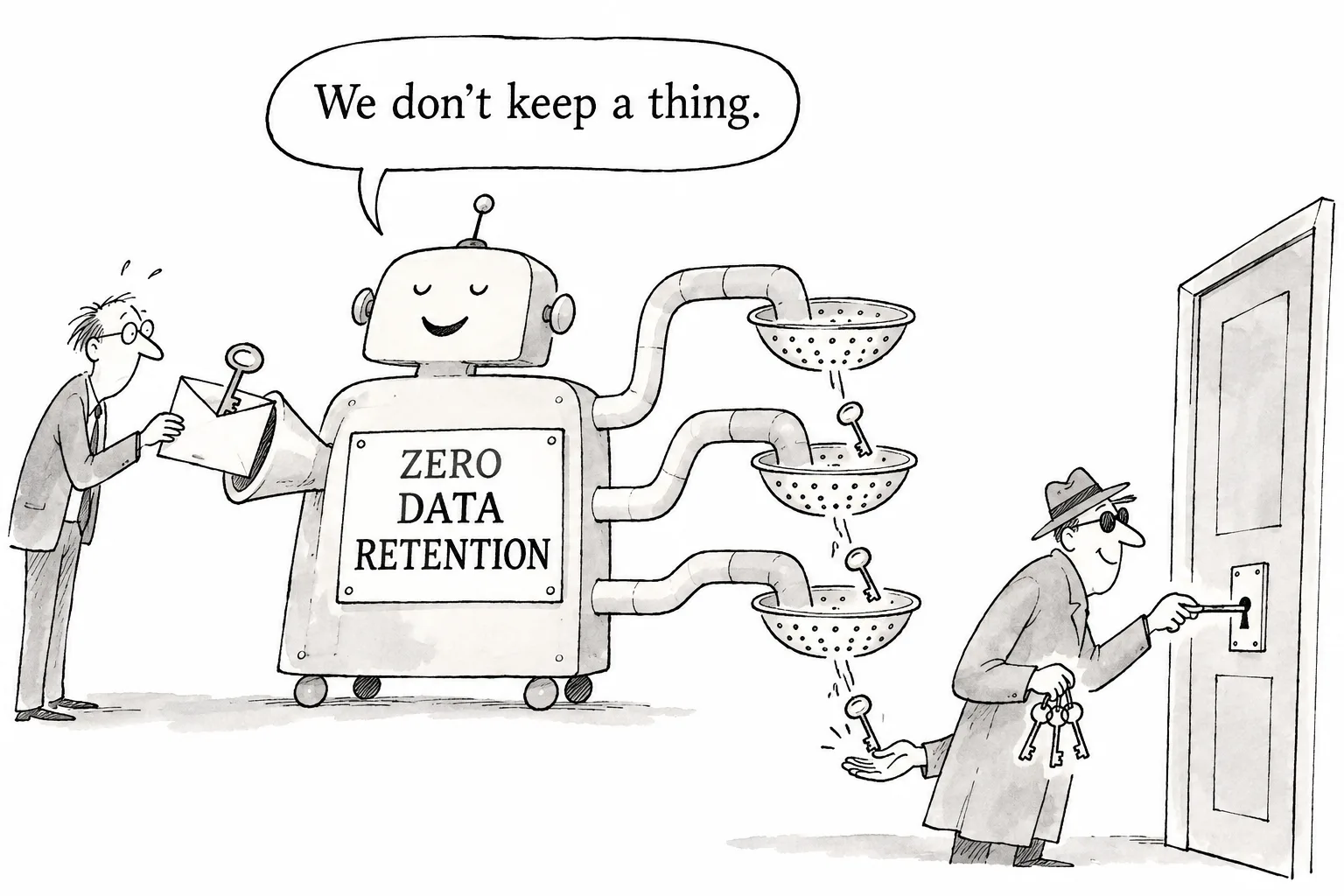
The "zero data retention" option is a promise not to store data. It is not a promise not to read it. To return an answer, an inference provider has to receive the prompt in plaintext. Users currently have no technical way to stop a provider from copying the contents at that moment or testing the keys inside. The endpoints OpenRouter removed include those of the providers the researcher flagged, plus others removed as a precaution.
Dragos, an industrial cybersecurity company, said on its blog that it sent about 2 million prompts seeded with traceable secrets to AI companies between July and November 2026, followed where they went, and found that data had been stolen at three or more companies. This is the research report OpenRouter cited. Canary tokens are fake credentials that look real and alert their owner the moment anyone tries to use them. Seeding prompts with such decoys lets a user detect that the contents were read and the keys were tested on the other end. But canary tokens detect snooping. They do not prevent it.
What companies can do: keep credentials out of prompts
The basic defense against prompt snooping at inference providers is not to put credentials in prompts at all. When coding agents are given tasks, keys in configuration files and work logs can easily be sent out as part of the prompt. Building mechanisms into the controls around the agent (the harness) that let the AI use keys without seeing them has become a challenge for harness engineering.
The safest approach is to treat any key already given to an AI as leaked and rotate it. Limiting each key's permissions to only what is needed, and restricting where it can be used, also reduces the damage if it leaks. Companies that use routing services need to know which inference providers their requests are going to, and should not rely entirely on promises in contracts or settings.
What we could not confirm
OpenRouter's blog does not say which inference providers the 125 removed endpoints belong to, how long each leak lasted, or how many requests were affected. Together AI has not disclosed the scale of its leak (how many prompts were involved). The Together AI case is based on press reports, and we have not been able to read the company's own disclosure.
Editorial cartoon