Rules & Policy · Nov 13, 2026
Sanctioned Chinese university reportedly obtained Nvidia H200 chips as US moves to ban offshore rentals
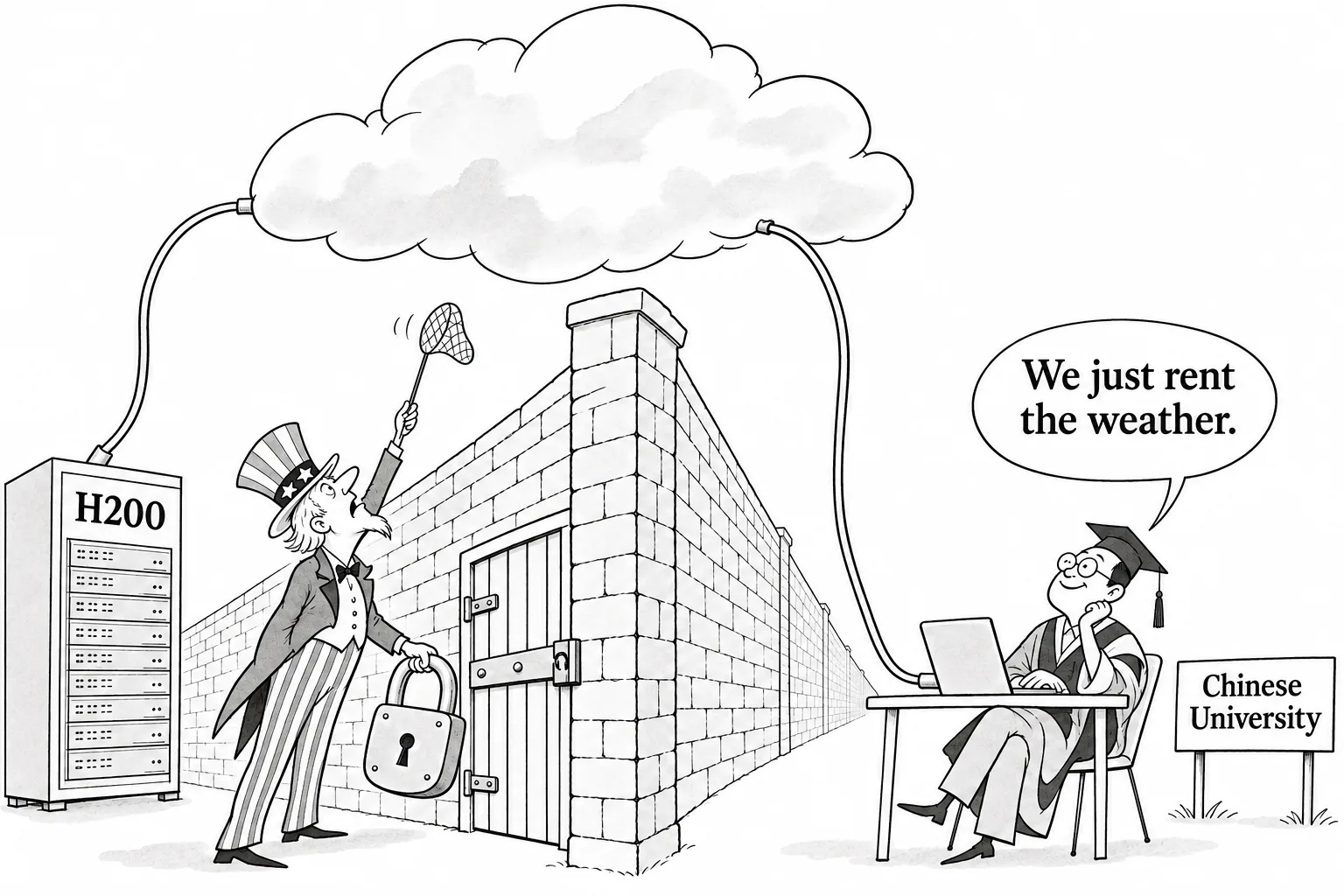
Reuters reported that a Chinese university on a US trade restriction list bought and also rented NVIDIA's high-performance H200 chips. The Commerce Department is reportedly finalizing a rule that would also close off the option for Chinese AI companies to rent chips abroad. The reports expose a gap between export control policy and how the chips actually move
Koji Yamamoto · Economics Analyst

Key points
- According to Reuters, a Chinese university on a US trade restriction list (the Entity List) bought and also rented H200 chips, which are subject to export controls
- The Commerce Department is reportedly finalizing a rule that would also bar Chinese AI companies from renting chips at data centers abroad. Until now, the controls have mainly blocked the export of the chips themselves as physical goods
- The gap between US policy and the actual flow of chips is now visible in concrete terms. Cloud providers and data centers that rent out GPUs will face greater responsibility for verifying who their customers are
[Update, November 13, 2026, 4:37] The closed-door briefing scheduled for November 18 is expected to be replaced by a different form of testimony that Huang has agreed to, and this article has been corrected to reflect that.
High-performance AI chips that the United States is supposed to be keeping out of China reached a Chinese university that Washington itself has sanctioned, Reuters reported. According to the report, the university bought NVIDIA's H200 chips and also rented them. Around the same time, the US Commerce Department is reportedly finalizing a rule that would also bar Chinese AI companies from renting chips abroad. Together, the reports offer a concrete example of the gap between the policy Washington has laid out and how the chips actually move. Both remain at the reporting stage, and no official statement from the US government or NVIDIA has been confirmed.
For Japanese companies: Most companies are not directly affected. Those that are include data center and cloud operators that rent GPU servers or cloud computing capacity to other companies, and trading firms that handle NVIDIA equipment. Sales and legal staff at these companies should check this month whether they have any China-linked customers or resale partners. The aim is to be ready to apply the Commerce Department's rule as soon as its details are released.
What was reported: H200 chips at a sanctioned university
The H200 is NVIDIA's high-performance AI chip, used to train and run large AI models. The United States has restricted the flow of such chips to China, citing the risk that they could be used for military or surveillance purposes.
According to Reuters, the university is on the Commerce Department's Entity List. The Entity List names parties that need a special license to receive US technology, and works in effect as a trade restriction. A university on that list reportedly bought H200 chips and also rented them, meaning it got access through two routes: buying and renting.
Where, through which vendors and in what quantity the chips were obtained has not been confirmed (see "What could not be confirmed" below). Even so, the report suggests that the assumption that adding a party to the list stops the flow did not hold up in practice.
The Commerce Department rule: closing off offshore rentals
Until now, export controls have mainly worked by stopping chips, as physical goods, from crossing borders. But what AI development needs is not the chips themselves but the computing power they provide. By renting GPUs over the internet at data centers abroad, such as in Southeast Asia, Chinese companies can train AI models without bringing the chips into China. This "remote access" has long been pointed to as a loophole in the controls.
The Commerce Department is reportedly finalizing a rule that would also bar Chinese AI companies from renting chips abroad. If it takes effect, the controls would expand from the export of goods to the use of computing power. Cloud providers renting out capacity would likely become responsible for verifying who their customers are and who the computing is ultimately for.
The gap between policy and practice
Taken together, the two reports point to a gap on two levels. First, chips reached even a party that had been placed on the list. Second, renting was not yet fully closed off under the existing rules. The report that a rule is being finalized can also be read as the US government itself acknowledging this second gap.
At the same time, US policy is not currently moving in a single direction. CNBC has reported on export control developments involving President Trump, NVIDIA CEO Jensen Huang and Chinese President Xi Jinping. Earlier reports said the treatment of H200 chips bound for China had become an issue in negotiations over a US-China truce on export controls, and that the House had sought a closed-door briefing over Huang's conduct. Negotiations that lean toward selling and a rule that tightens controls are moving forward side by side.
What comes next
The APEC leaders' summit will be held in Shenzhen on November 18-19, where a meeting between Trump and Xi is reportedly planned. Huang has agreed to address Congress and is expected to testify before Thanksgiving, though no date has been set. China's export control measure (No. 72) is due to expire on November 27. The next questions are when the Commerce Department's rule will come out relative to the summit, and how strict it will be.
What could not be confirmed
We were unable to read the full text of the original Reuters article, the Star-Advertiser's reprint or the CNBC article. As a result, the following have not been confirmed: the name of the university and when it was added to the Entity List; the route through which it bought H200 chips, the country and vendors it rented them from, the quantity and timing; responses from NVIDIA, the Commerce Department and the university; and the official name, scope and release date of the Commerce Department's rule. This article is limited to the outline conveyed in the reports.
Editorial cartoon