Products & Models · Nov 15, 2026
Google opens multi-agent research feature, claims proof of a conjecture but outside verification still pending
Google cited a proof of a mathematical conjecture and a kernel rewritten into about 800,000 lines of safe Rust. No outside party has checked either result yet, and Google did not disclose how many tokens were used or what the work cost
Rie Suzuki · Technology Editor

Key points
- Google has opened an Antigravity feature in which multiple AIs split up roles to carry out research to outside researchers
- The results it cited are the proof of a mathematical conjecture and a kernel rewritten into about 800,000 lines of safe Rust
- Neither result has been verified by outside parties yet. Google did not disclose the number of tokens used or the cost
Google has made a feature in its development tool Antigravity, in which multiple AI agents work together on research, available to outside researchers. The company announced it on the Google Research blog, which is the primary source. Google cited many results. Two of them stand out: the proof of a mathematical conjecture, and the rewrite of a kernel, the foundation that software runs on, into about 800,000 lines of safe Rust, a programming language designed to make memory errors less likely. Neither has been verified by outside parties yet. Google did not say how many tokens were used or what the work cost.
For Japanese companies: Most companies will see no immediate impact. The announcement matters to development leads at software companies and manufacturers maintaining legacy C or C++ code, and to departments using Gemini for research and development. Before treating the "800,000 lines" in this announcement as a basis for migration plans or budgets, they should ask Google or their sales contact what was checked beyond unit tests and how much it cost, and get the answers in writing.
What Google opened: a feature where AIs split up research roles
Rather than handing an entire task to a single AI, the feature has multiple agents take on separate roles to advance one research or development problem. A coordinator assigns the work, while other roles handle subtasks and check answers. In current industry terms, it resembles "LLM routing," which assigns work to stronger or cheaper models depending on the task.
Google has been pushing this approach for some time. It markets Gemini 4 Hydrogen, a low-cost model released on November 12, as a worker that runs under the higher-end Gemini 4 Carbon. By Google's own figures, using Hydrogen as a worker under Carbon in Antigravity achieved a success rate nearly matching Carbon alone while using about 24% less quota. On November 3, Google published an example of Antigravity being used in chemistry research and said it would give 10,000 scientists six months of its top-tier plan for free. The latest announcement follows that trend, opening the team-based way of working that Google has been testing internally to outside researchers.
The two results Google cited
Proof of a mathematical conjecture
The first is a claim to have proved a mathematical conjecture. Announcements of AI solving open mathematical problems have piled up this fall. In October, OpenAI and Anthropic published results refuting a major hypothesis in computational complexity theory (ETH). In November, an organization called PSI said it had used an unreleased Anthropic model to prove the Aaronson-Ambainis conjecture in quantum computing. With this announcement, Google has entered that race.
A rewrite into about 800,000 lines of Rust
The second is the rewrite of a kernel into about 800,000 lines of safe Rust. For many companies, this is the more relevant result. Legacy C and C++ code is prone to serious security holes caused by memory-handling errors, which has made migration to Rust a challenge for development teams worldwide. Rewriting that much code by hand would take years. If an AI team can handle it, the cost estimates for migration themselves change.
Three things the announcement leaves out
The announcement is missing some information, however.
1. Outside verification
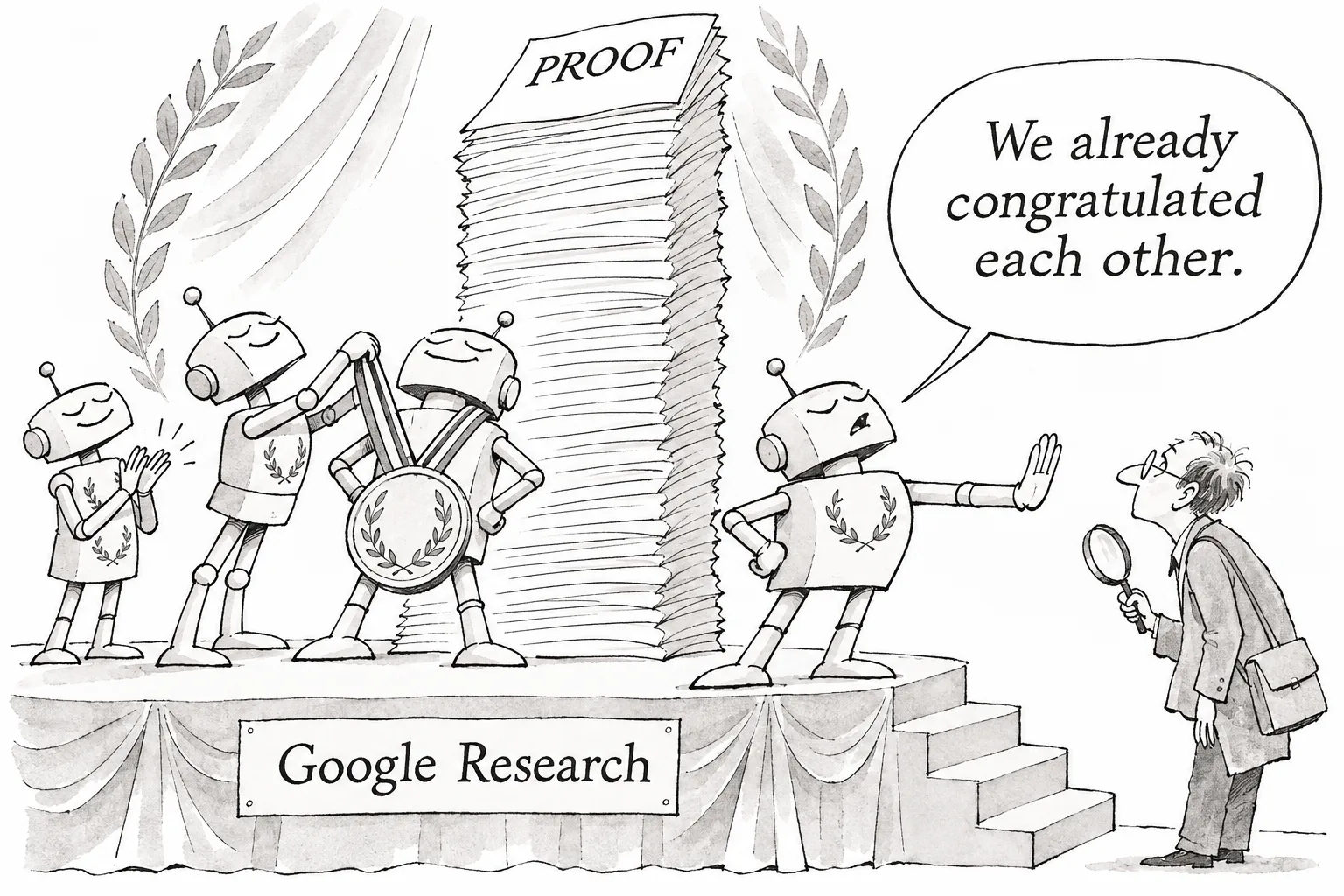
For neither result has confirmation from outside experts uninvolved in the work been shown yet. Comparing it with a similar claim makes the difference clear. In the case of the PSI proof, computational complexity expert Scott Aaronson, a professor at the University of Texas, wrote on his blog on November 8 that he "believes it is correct." He cited the proof passing verification in Lean, a tool for machine-checking proofs, and the existence of human experts who understood its contents. Even so, no formal peer-review verdict has been issued. Google writes that its proof was also fully formalized in Lean 4 and carried out jointly with mathematicians from the Chinese University of Hong Kong and other institutions.
The same goes for the kernel rewrite. Producing 800,000 lines of code is one thing; that code running as correctly and as fast as the original kernel is another. With AlphaProof Code, announced on November 10 to verify cryptographic schemes with AI, Google itself presented machine-checkable proofs and released its outputs as open source. The next question is whether outsiders can check the latest results in the same way.
2. The relationship to earlier human work
With AI-generated mathematical results, how far humans had already gotten has become a point of contention. With the Yang-Mills result OpenAI released in October, a Northwestern University researcher was found to have been writing up work using the same method while publishing it along the way. The researcher said they "may have been just a few weeks away." Regarding the PSI proof, Aaronson also wrote that it built on previous researchers' work and that humans might have solved it within a few years. Google's announcement does describe the division of labor. According to Google, Gemini first found a counterexample to a generalized conjecture in an earlier paper by the Chinese University of Hong Kong team; the team then provided a function reducing the conjecture to a 14-variable optimization problem; and Gemini then produced most of the new analytical bounds.
3. How much compute was used
Google says the kernel rewrite took two weeks of work with Argon but does not disclose how many tokens were used or what it cost. Pricing is available. Hydrogen costs $1.50 per million input tokens and $7.50 per million output tokens. Carbon costs $2 for input and $10 for output until November 30, after which it rises to $4 and $20. Without knowing how much was used, however, companies cannot calculate what it would cost to do the same thing themselves. On November 4, OpenAI disclosed that automatically probing the Linux kernel for defects cost about $1.21 million in API fees. Google's announcement contains no figures of that kind.
Running AIs as a team does not always win
Research from other companies has also exposed weaknesses in having multiple AIs work together. In a study Anthropic released on November 11, a single coordinator scored about 10 to 45 points higher than a team with one AI per user across all four environments. The teams also more often fabricated information about other people. In a report Google DeepMind released on November 13, even the strongest model, Gemini 4 Argon, blocked only 66% of attacks by swarms of agents. When reading about team results, it is necessary to look not only at the successes but also at failure rates and how results were checked.
What could not be confirmed
The conjecture Google says it proved is the Courtade–Kumar conjecture in information theory, posed in 2013, and Google says the entire proof was formalized in Lean 4. The rewritten kernel is the Zircon microkernel. Google says it rewrote the C++ that remained after an earlier 25% port, that all of the kernel's unit tests passed and that it booted on an arm64 device. Google did not mention performance. In preparing this article, the following could not be confirmed: pricing, and whether the feature is available under corporate Gemini contracts. The source says outside scientists and developers can already use /teamwork and /boost, and that applications are open for the six-month free plan for 10,000 researchers. It says templates for proofs and rewrites will be added in future updates. Companies with contracts such as Gemini for business should check with their account contact whether the feature falls within the scope of their contract.
Three questions come next: whether outside mathematicians and software experts independently verify the two results; whether Google discloses the amount of compute used and how the work relates to earlier human research; and whether outside researchers, once they start using the feature, achieve results similar to those inside Google.
Editorial cartoon