Products & Models · Nov 20, 2026
Google's new model ranks third overall at under 40% of the price of top models
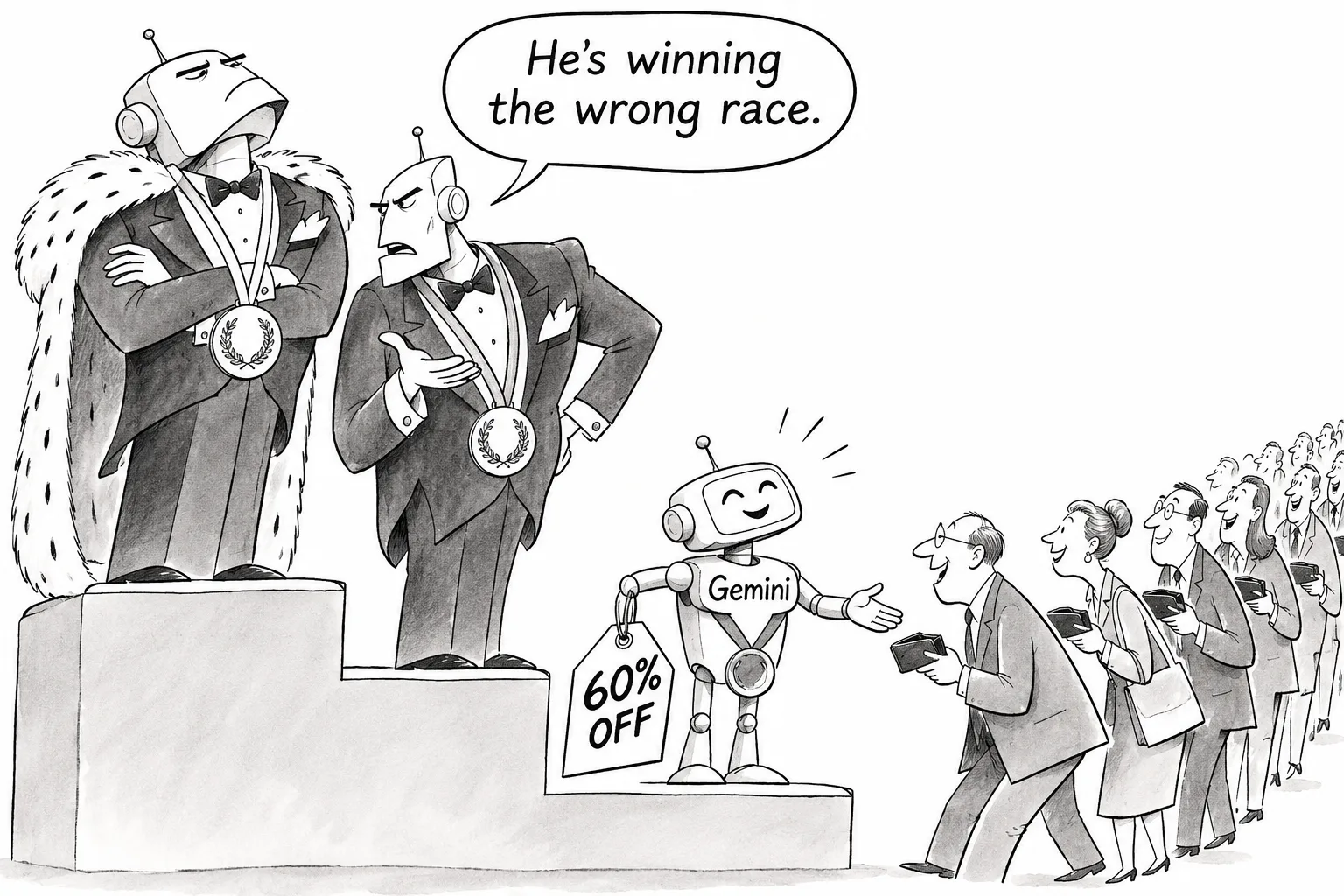
Gemini 4 Neon costs $3 per million input tokens and $15 per million output tokens. That is less than 40% of the $8 and $40 charged for GPT-6.2 Astra and Fable 5.2, yet it placed third on a third-party overall index. Google says it ranked first on several other third-party evaluations, including an index of coding agents
Rie Suzuki · Technology Editor
Key points
- Gemini 4 Neon costs $3 (about ¥480) per million input tokens and $15 (about ¥2,400) per million output tokens. That is 37.5% of the $8 and $40 charged for GPT-6.2 Astra and Fable 5.2
- It ranked third on a third-party overall index, just behind the two top models competing for first and second place
- Google says it ranked first on several third-party evaluations, including an index of coding agents. The indexes are run by Artificial Analysis and others, not measured by Google itself
Google on November 18 released Gemini 4 Neon, a mid-tier model. It costs $3 per million input tokens and $15 per million output tokens. That is less than 40% of the price of OpenAI's GPT-6.2 Astra and Anthropic's Claude Fable 5.2, which both cost $8 for input and $40 for output. Even so, Neon placed third on a third-party overall index that measures how capable models are. Google says it ranked first on several other third-party evaluations, including an index of coding agents (AI tools such as Claude Code and Codex that write and fix code on their own). The price gap shows that a model below the top tier can come close to top-tier results.
For Japanese companies: Companies whose development or IT departments run coding agents on Astra or Fable 5.2 through the API should try the same tasks on Gemini 4 Neon and compare quality and cost this month. It is best to finish this before drawing up next term's budget. Companies that use AI only through chat interfaces and do not pay for the API will see no immediate effect on costs. However, paid subscribers can already choose Neon in the Gemini app.
Gemini 4 Neon costs 37.5% as much as the top models
Gemini 4 Neon costs $3 (about ¥480) per million input tokens and $15 (about ¥2,400) per million output tokens. It can read 1 million tokens at a time (its context window). GPT-6.2 Astra and Claude Fable 5.2 both cost $8 (about ¥1,280) for input and $40 (about ¥6,400) for output, so Neon's input and output prices are each 37.5% of theirs. For the same amount of work, the bill comes to a little over a third.
Within Google's Gemini 4 lineup, Neon sits in the middle on price. The cheaper Gemini 4 Hydrogen, released on November 12, costs $1.50 for input and $7.50 for output, exactly half of Neon's price. The higher-tier Gemini 4 Carbon is available at its launch price of $2 for input and $10 for output until November 30, but this rises to $4 for input and $20 for output in December. From December, Neon will be cheaper than Carbon.
Third on a third-party overall index, just behind the top two
Gemini 4 Neon scored 61 points on the Artificial Analysis Intelligence Index, a third-party overall index, at its highest reasoning setting (xhigh), placing third. Because the score was not measured by the company itself, it can be compared with other models on the same scale. As of November 17, Claude Fable 5.2 ranked first on the Artificial Analysis index, a leading third-party benchmark, followed by GPT-6.2 Astra (62 points) in second. Gemini 4 Carbon (60 points) and Claude Opus 5.5 (59 points) came next. Neon now sits just below the top models, which cost more than twice as much.
Google has a pattern of pitting cheaper models against higher-tier ones. When it released Gemini 4 Hydrogen on November 12, Google said that model's overall index score beat the higher-tier Gemini 4 Argon. Neon, one price tier up, has come close to rivals' top models.
First on five third-party evaluations, Google says
According to Google, Gemini 4 Neon ranked first on the Artificial Analysis coding agent index (58.6 points), Vals' Legal Research Bench and Tax Agent Bench, Zapier's AutomationBench (56.3%), and Andon Labs' Vending-Bench 2 ($16,843). All of these are external evaluations, but it was Google that compiled and announced the figures. Rankings often change when other companies re-run the tests under the same conditions.
Coding agents are currently one of the most token-intensive uses of AI. Agents read files, test and fix code dozens of times over, so differences in token prices translate directly into differences in the bill. The main selling point of the announcement is that Google is claiming first place in this area at less than 40% of the price of the top models. Google also published a post introducing Neon for Antigravity, its coding tool. Starting the same day, Neon became available in the Gemini app and Antigravity to subscribers of the paid Google AI Pro and Ultra plans, and to businesses through Gemini for business.
OpenAI and Microsoft are also competing on price
Gemini 4 Neon arrives as price competition among AI models intensifies. GPT-6.2 Astra, released on November 17, is 20% cheaper than the previous GPT-6 Astra. Even so, developers who tried it early, including Matt Shumer, gave harsh verdicts such as "almost unusable." On the same day, Microsoft released MAI, its own family of models, and led with price, pitching them as delivering performance close to rivals' models at far lower cost. Microsoft's figures have not yet been independently verified. Within roughly the same period, three major companies are chasing customers with models cheaper than the top tier.
For companies using these models, it is time to work out, task by task, which jobs truly need a top-tier model. Leaving difficult design work to the top models and sending most other tasks to mid-tier models such as Neon can lower costs without much loss in quality. Companies adopting an LLM Router (a system that picks a model for each task) or an AI Gateway (a layer that relays AI calls and manages costs) to route work to different models based on the task now have another option that is easy to try.
What is still unknown about Gemini 4 Neon
We have not been able to confirm the following: whether long inputs carry a separate price; whether Neon is available in Google Workspace and when it will become available in Japan; and how much safety evaluation of dangerous capabilities has been published. Before trying it, companies should check Google's pricing page and model documentation for the price that applies to how they plan to use it.
Editorial cartoon