Rules & Policy · Nov 8, 2026
EU AI Act's Article 50 takes effect in August as countries move faster on AI labeling rules
China, South Korea and India already require labels; OpenAI and Anthropic move to add machine-readable marks
Koji Yamamoto · Economics Analyst
Key points
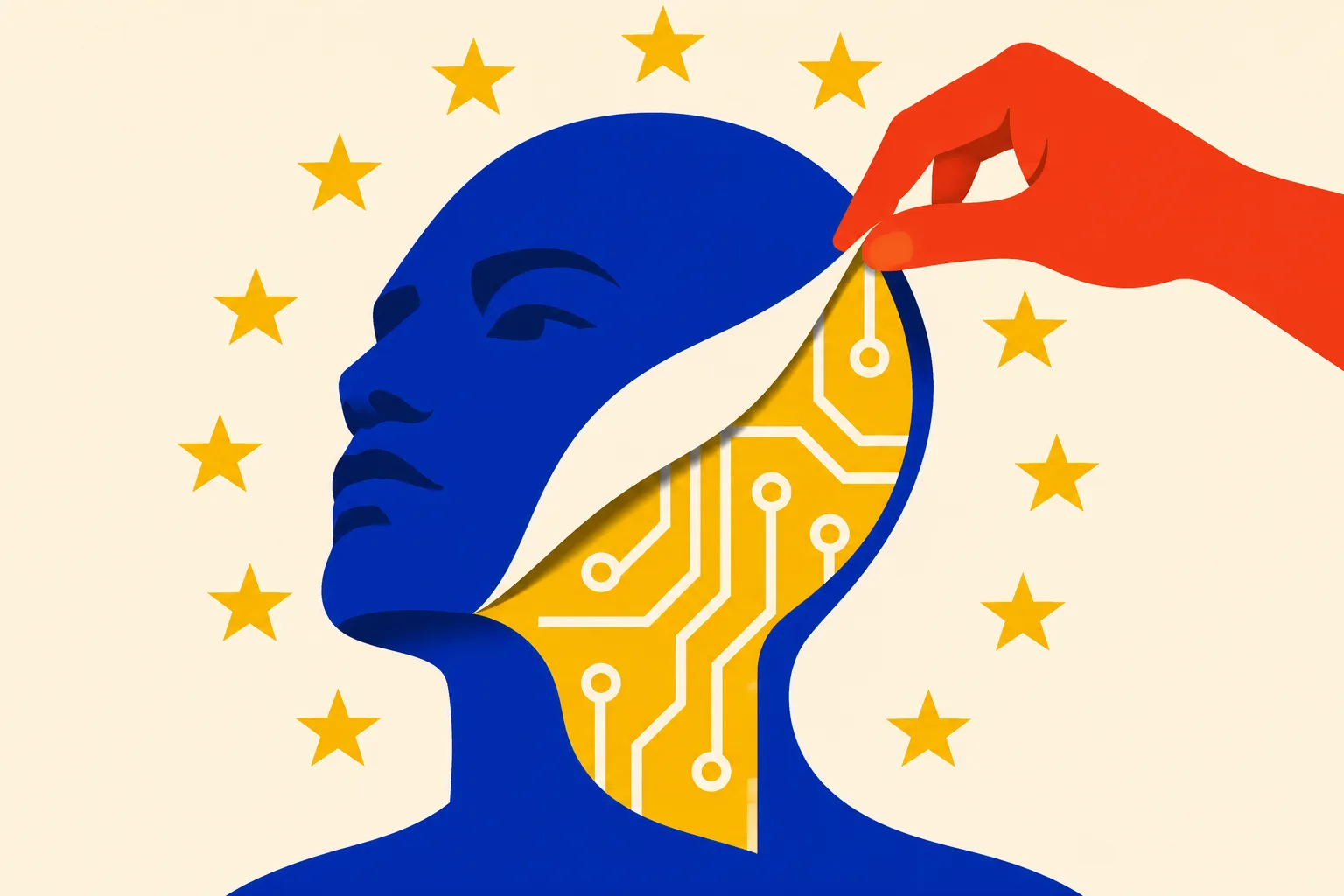
- Article 50 of the EU AI Act began applying on August 2, 2026; violations can bring fines of up to 15 million euros or 3% of worldwide turnover
- China, South Korea, India and Vietnam already require labeling, while the Philippines, Brazil, Turkey and Kenya are still debating rules
- OpenAI offers opt-in watermarking to API users, and Anthropic has introduced machine-readable marks on content generated by Claude
EU AI Act's Article 50 takes full effect on August 2
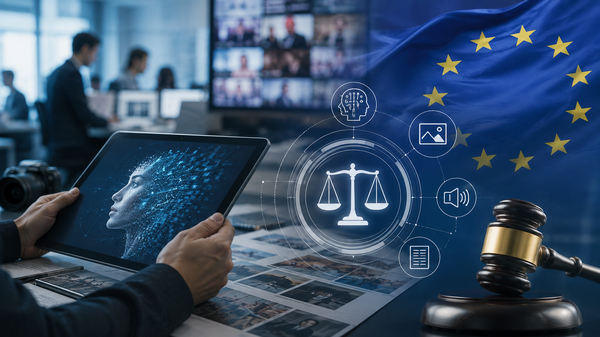
Article 50 of the European Union's AI Act began applying on August 2, 2026, making transparency for AI-generated content a legal requirement. The European Commission published guidelines dated July 29 that set out the obligations of providers and deployers. According to Media Innovation, providers must apply machine-readable markings and make sure deepfakes can be detected. Deployers must disclose when content has been artificially generated or manipulated. They must also label AI-generated text on matters of public interest when it is published without human editorial oversight.

Violations carry fines of up to 15 million euros or 3% of total worldwide turnover for the preceding financial year, whichever is higher. Existing systems get a four-month transition period. According to an analysis by PwC Japan, generative AI systems placed on the market before August 2, 2026 have until December 2, 2026 to comply, but only with the marking and detection obligations. The guidelines also say how labels should be shown. Images need a label somewhere immediately visible, such as the top-right corner. Videos need one at the start and at regular intervals during playback. Text needs one near the headline or at the start of the body. Audio needs a notice at the start and repeated reminders.
China, South Korea and India already require labels as approaches diverge globally
PwC Japan's research shows wide differences in how far countries and regions have gone in legislating transparency requirements. China already requires explicit labels and metadata identifiers through three layers of regulation: its deep synthesis provisions, its labeling rules, and its interim measures on generative AI services. South Korea's enforcement decree under its AI Basic Act requires advance notice and labeling when high-impact AI or generative AI is provided, and its guidelines set out how labels should be displayed. India requires clear labels, persistent metadata and provenance markers on synthetic content, putting the weight on identifiers that cannot be removed later. Vietnam has also passed laws requiring notification and labeling for medium-risk AI, with special labels required in news reporting.
Elsewhere, California is still drawing up watermarking guidance. The Philippines and Brazil are debating legislation, and Turkey and Kenya remain at the draft stage. Turkey is considering a broad labeling requirement for all AI-generated content, and Kenya has included labeling obligations in its draft AI bill for 2026. Many countries are moving ahead, but the U.S. still has no comprehensive federal law, so companies have to meet different standards in each region where they offer services.
How OpenAI and Anthropic are responding
Now that the rules apply, major AI companies are racing to roll out watermarking. In an official announcement, OpenAI said it has started letting API users opt in to watermarking on select models. The feature stays off by default. OpenAI also said that within weeks it plans to add invisible watermarks to text output from ChatGPT and Codex in the EU. The company stressed that text watermarking and detection are still at an "early stage" and have limitations, and said that is why it chose a phased rollout.
Anthropic has also said in its Help Center that it will apply machine-readable marks to content generated by Claude. An analysis by Rocket Boys says the move responds to Article 50(2) of the EU AI Act. It adds that the change will also affect Japanese companies that build Claude into services aimed at the EU.
C2PA as the foundation, and companies' own measures
On technical standards, the foundation is C2PA, which Adobe launched in February 2021 with ARM, Intel, Microsoft and Truepic. According to Adobe's explainer, about 100 companies take part, and Google joined its steering committee in February 2024. The standard uses cryptography to tie content to its provenance so that it cannot be tampered with or misrepresented. Still, Adobe itself says C2PA is "not a solution that guarantees every AI-generated item can be identified," and compares it to a food nutrition label.
Private companies are taking their own steps too. In July 2026, Amazon began requiring sellers to attach metadata to product images and A+ content that include AI-generated people. The move follows a New York state law that has taken effect, and the requirement is said to affect more than 60% of the marketplace. Apple Music has also said it will require tags on AI-generated songs starting in the second half of 2026, bringing labeling requirements to music streaming as well.
What it means for Japanese companies
In Japan, version 1.0 of the AI Guidelines for Business, issued by the Ministry of Economy, Trade and Industry and the Ministry of Internal Affairs and Communications, only "encourages" companies working with advanced AI systems to use labels and disclaimers. Even so, companies that offer services in Europe, or whose products build in OpenAI or Anthropic models, need to check soon how far they have implemented machine-readable markings and how their interfaces disclose AI content, ahead of the December 2, 2026 transition deadline. Companies planning to enter markets that already require labels, such as China, South Korea and India, should also rethink their designs on the assumption that labeling methods differ by country.
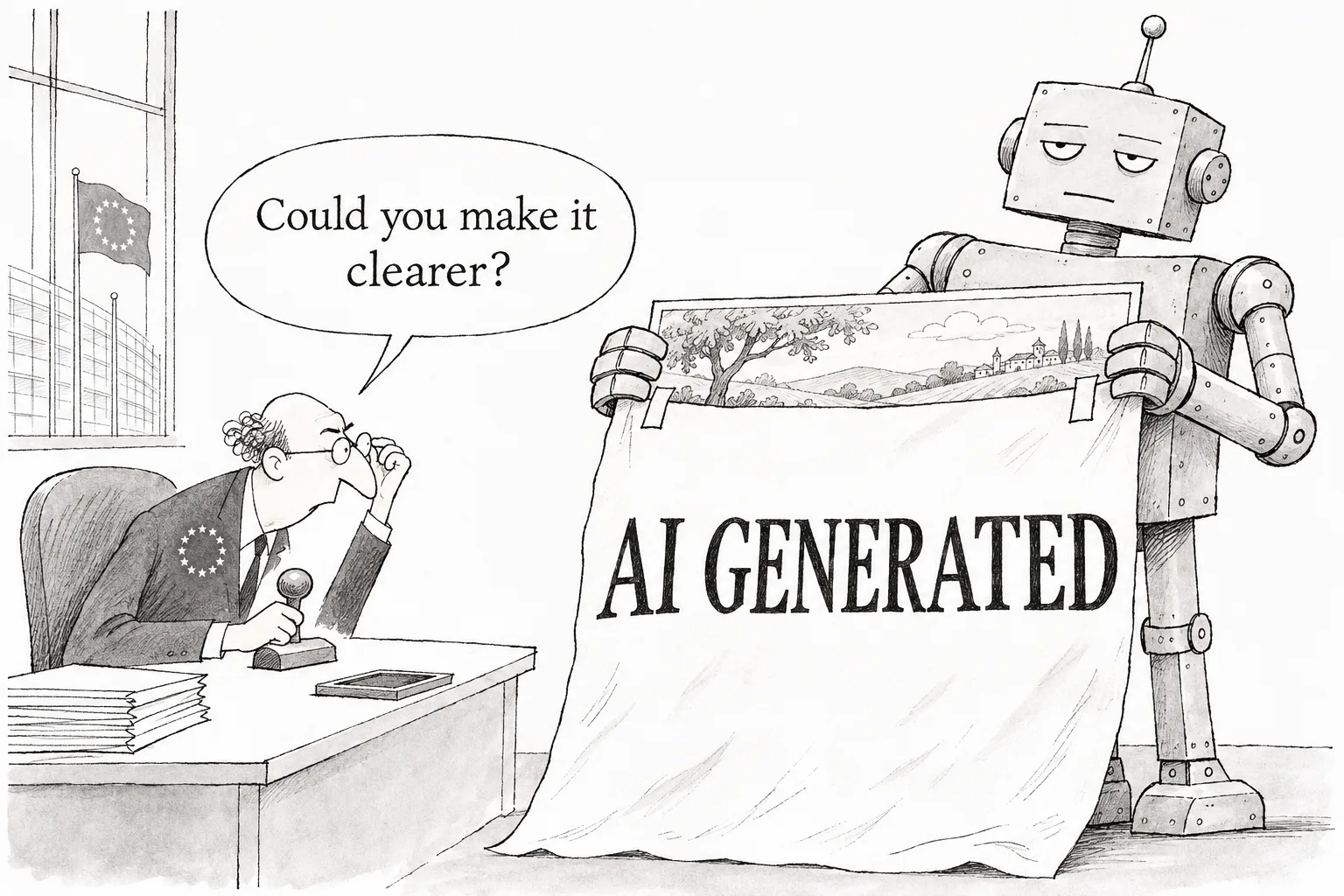
Editorial cartoon
Sources
- https://www.pwc.com/jp/ja/knowledge/column/awareness-cyber-security/eu-ai-act50.html
- https://media-innovation.jp/article/2026/08/04/143575.html
- https://ledge.ai/articles/eu_ai_act_ai_generated_content_transparency
- https://openai.com/index/eu-text-provenance
- https://rocket-boys.co.jp/security-measures-lab/claude-watermark-eu-ai-act-impact
- https://blog.adobe.com/jp/publish/2024/05/07/cc-firefly-generative-ai-and-copyright-authenticity-of-ai-generated-content
- https://innovatopia.jp/tech-social/tech-social-news/114239
- https://gigazine.net/news/20260821-apple-music-ai-labels