Money · Nov 26, 2026
Copilot usage-based billing default moves to January–March 2027, not December: a correction
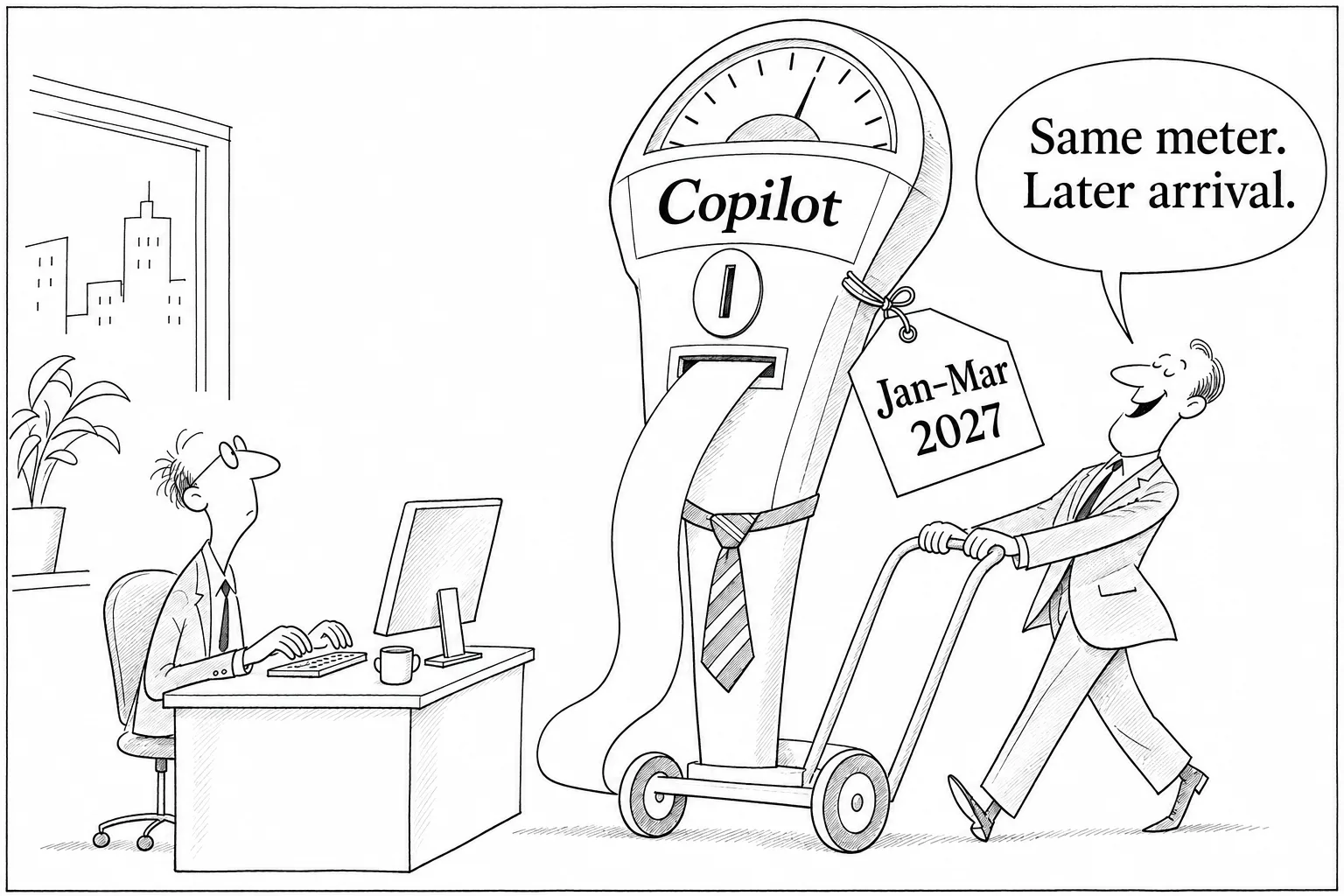
New purchases of Microsoft 365 Copilot Business through sales partners will have pay-as-you-go billing turned on by default. The start has slipped to January–March 2027. The default cap is 4,000 credits per user per month, and admins can change it
Koji Yamamoto · Economics Analyst

Key points
- New purchases of Copilot Business through sales partners will have pay-as-you-go billing on by default. The change starts in January–March 2027, not December 1 (Microsoft notice dated November 3)
- The default cap is 4,000 credits per user per month. A 100-user company could use up to 400,000 credits a month. Admins can change the cap
- A new purchase also turns on this billing by default for existing Copilot Business users at the same company. The notice does not give the price of one credit
Microsoft has changed when it will make pay-as-you-go billing the default for companies that newly buy Microsoft 365 Copilot Business (the version of Copilot for companies with up to 300 employees) through a sales partner. The change will start in January–March 2027, not on December 1, 2026, as Microsoft had previously announced. The new timing appears on a Microsoft partner notice page dated November 3. Our previous article reported the date as December 1, and we are correcting that here. The default cap is 4,000 credits per user per month, and admins can change it. Companies preparing to deploy Copilot can use the extra time to revisit their budgets and approval timelines.
For Japanese companies: Companies planning to deploy Copilot Business through a reseller (CSP partner) should have their IT and accounting staff check with the reseller this week or next. They should ask three things: the price of one credit, the exact date billing starts, and what to set the default cap to. For companies whose fiscal year starts in April, January–March 2027 is the last quarter of the current fiscal year, so they should also decide whether to put this cost in the rest of this year's budget or in next year's. The notice does not directly affect companies with no plans to deploy Copilot, companies that buy directly from Microsoft, or contracts for companies with more than 300 employees.
Copilot Business pay-as-you-go becomes the default in January–March 2027, not December 1
According to Microsoft's partner notice, new Copilot Business contracts bought through resellers will have pay-as-you-go billing enabled from the start. The start date has moved to January–March 2027. In the notice, Microsoft says it "adjusted the date to take feedback into account and allow more time to prepare," and that this "replaces the previously announced date of December 1, 2026." In Microsoft's fiscal calendar, this period is the third quarter of fiscal 2027 (FY27 Q3).
Microsoft's November 3 notice says the company "plans to start during this period" and does not yet give a specific date. A test environment (sandbox) for resellers, which had been scheduled for November 2, has also been delayed. Microsoft says it will announce the date in advance and make testing available at least 30 days before general availability. The new date applies to all markets, including countries that were not in the original initial rollout, such as Australia, Germany, France, India and South Korea.
Copilot Business default cap is 4,000 credits per user per month, and admins can change it
Explaining the move to pay-as-you-go, Microsoft says some AI features incur usage-based charges on top of the monthly subscription fee. Examples it lists include Copilot Cowork, which handles long-running tasks; the Work IQ API, which uses a company's internal work data; and the GitHub Copilot harness (the outer framework that runs AI with tools). Microsoft will automatically create the Azure setup needed for billing and apply a default spending cap of 4,000 credits per user per month to everyone in the company.
In an example Microsoft gave, a company using Copilot Business with 100 users could use up to 400,000 credits a month at the default cap. Charges apply only for what is actually used. The cap can be changed in the reseller's management portal (Partner Center) or in the company's Microsoft 365 admin center. Companies can also turn this billing off, but Microsoft says doing so may make some AI features unavailable.
A new purchase also changes billing for existing users
One point in Microsoft's notice is easy to miss. A new purchase also turns on this billing by default for existing Copilot Business users at the same company (tenant). Both standalone and bundled subscriptions are covered. Buying even a single additional seat could change the billing settings for everyone already using the product.
What companies preparing for Copilot Business can revisit
For small and midsize companies planning to deploy Copilot Business, the shift in the billing start from December to January–March gives them more time to talk with resellers. Microsoft is asking partners to revisit plans built around the earlier date, tell their staff about the monthly cap, and explain pay-as-you-go billing options to customers. On the company side, the first step is to decide whether to keep the 4,000-credit cap for everyone. One option is to lower the cap for departments that won't use heavy features such as Cowork and raise it only for those who will.
In internal approval requests, listing a cap on usage-based charges alongside the monthly Copilot Business subscription fee can help avoid surprises from higher bills later. In November, Microsoft also released tools for partners that let resellers set spending rules for each customer and see how credits are being used. Companies should also decide before signing how much the reseller will monitor and where their own admins take over.
What we could not confirm about Copilot Business pay-as-you-go
Microsoft's November 3 notice leaves out the following. It does not give the price of one credit, only pointing readers to a separate licensing guide. That means we cannot say how much 4,000 credits would cost in yen. It also does not say which day in January–March 2027 the change starts, how it will be handled at contract renewal, or how Japan fits into the covered markets (the notice says all markets but does not name Japan). The page also does not show when the original December 1 notice was published. The page itself was last updated on November 24.
Editorial cartoon