AI in the Field · Nov 26, 2026
Cerulion triples a cheap AI model's robot success rate just by changing its tools
Gemini 3.8 Flash went from 25 to 73 of 100 tasks, at one-twelfth the cost and close to GPT-6 Astra's 71. The tools did not help stronger models, and every test ran in simulation
Haru Misaki · Field Correspondent
Key points
- With Cerulion's harness of 44 tools, Gemini 3.8 Flash solved 73 of 100 tasks, up from 25. Its cost per run fell from $1.666 (about ¥265) to $0.348 (about ¥55)
- The cheaper the model, the bigger the gain. Claude Haiku 5.5 rose from 4 tasks to 44 and Grok 4.7 from 4 to 53. Twelve of 16 models solved more tasks, and the improvement was statistically robust for nine
- The top four models solved slightly fewer tasks. The repository's own test found "no demonstrated difference" between Flash with the harness at 73 tasks and GPT-6 Astra at 71. Nothing was measured on physical robots
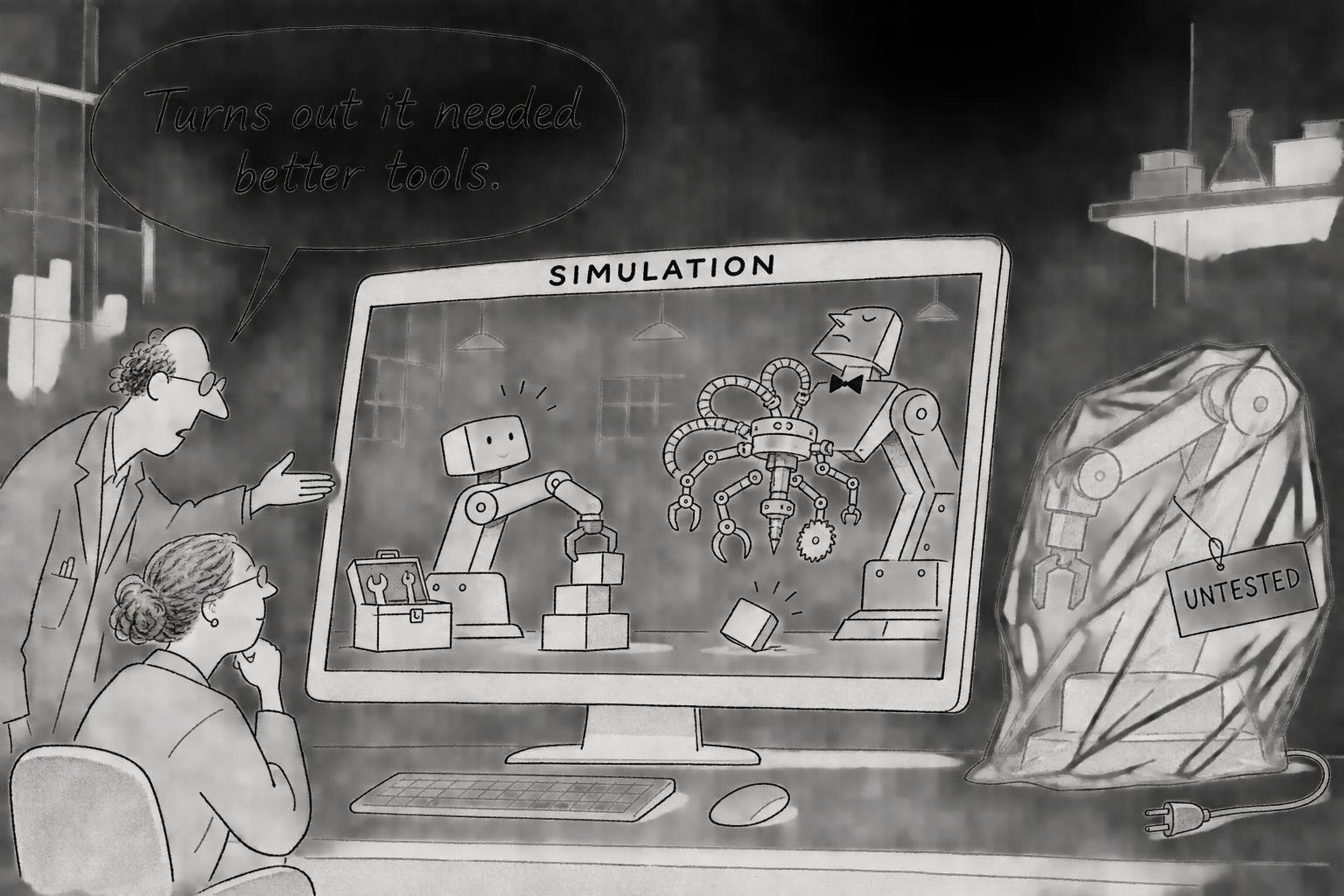
The same AI models got the same robot tasks, and only the tools they could use were changed. That alone nearly tripled the number of tasks solved and cut the cost per run to about one-fifth. The results come from Cerulion, a small U.S. company that builds a harness for robots: the layer around an AI model that gives it tools and runs it. Hal went through the evaluation results in the official repository, Cerulion's own posts and the reactions to them. The short version: the idea that "tooling matters more than model intelligence" clearly held for weaker models and did not hold for stronger ones.
For companies in Japan: This is robotics research, so most companies won't be directly affected. The people it matters to are development teams and IT departments building AI agents in-house. Before your next review, and before deciding to switch to a top-tier model or buy a more expensive plan, it is worth adding a step: review the tools and documents your AI is given, then compare against a cheaper model. Contracts for Copilot, ChatGPT Enterprise or Gemini are not affected.
Cerulion's experiment: going from 3 tools to 44 lifted results from 25 tasks to 73
Cerulion is a small company that came out of Y Combinator's Summer 2024 batch. Cerulion's official repository publishes the evaluation results from runs on Cerulion 2.1.0. The benchmark is LIBERO-PRO, a set of tasks in which a simulated robot arm does things like "put the bowl on the plate." This comparison used 100 tasks.
The setup is simple. One side got only the minimal toolset published with the LIBERO-PRO paper, which has just three tools: move_to, done and give_up. The other side got Cerulion's harness, which has 44 tools. They cover seeing through cameras, moving the arm, checking by touch, grasping, placing and reading the robot's calibration records. The AI gets far more to go on when working out how to move.
The standout result was Google's low-cost Gemini 3.8 Flash. With the three tools, it solved only 25 of 100 tasks. With the harness, it solved 73. Cost per run fell from $1.666 (about ¥265) to $0.348 (about ¥55), and time per run dropped from 846.6 seconds to 258.7 seconds. Measured as cost per solved task, that works out to a fall from $6.67 (about ¥1,061) to $0.48 (about ¥76).
More tools making runs cheaper and faster is a little surprising. The repository's numbers suggest that with only three tools, the AI fumbled around, moving the arm and failing again and again, and paid in money and time each time. With more eyes and hands, it apparently got lost less often.
Cerulion's 16-model comparison: cheaper models gained the most
Cerulion ran the same comparison on 16 models, listed in the evaluation evidence document (evidence.md). Overall, 12 of the 16 models solved more tasks. After a correction for chance differences, however, the improvement was statistically robust for only nine.
The most striking pattern is that models with lower baseline scores gained the most. Anthropic's small Claude Haiku 5.5 rose from 4 tasks to 44, and its cost per run fell from $0.256 (about ¥41) to $0.023 (about ¥4). OpenAI's GPT-6 Luna went from 0 tasks to 29, and xAI's Grok 4.7 from 4 to 53. Models that could do almost nothing were solving close to half the tasks.
Some large models benefited too. Claude Opus 5.5 rose from 32 tasks to 74, and its cost per run dropped sharply, from $8.235 (about ¥1,309) to $0.614 (about ¥98). Claude Fable 5.2 went from 10 tasks to 84, the largest gain of any model.
What struck Hal here is how plainly the numbers carry the message "choose your tools before you choose your model." People who use AI at work often assume a smarter model will fix the problem. This table suggests a different reading: what the weaker models lacked was not brains but eyes and hands.
Did it really "match GPT-6 Astra"? A look at everything that didn't work
Lakshay of Cerulion presented the results in a Show HN post on Hacker News: 73 tasks for Gemini 3.8 Flash with the harness, against 71 for OpenAI's GPT-6 Astra using only the three tools. The post also said Astra cost about 12 times as much and took about 3 times as long. Working from the table, cost per run was $4.183 (about ¥665) against $0.348, about 12.0 times, and time was 787.9 seconds against 258.7 seconds, about 3.05 times. Both figures match the post. It closed with: "Model intelligence is not the bottleneck. You just need a harness." According to Trendoday, a site that tracks Show HN rankings, the post reportedly peaked at No. 11, averaged No. 23.4 and appeared on the list in 81% of that day's snapshots. The post itself drew only 8 points and 2 comments, though, so it did not take off.
The repository's own statistics tell a more modest story. In a test specified in advance, Flash with the harness at 73 tasks and GPT-6 Astra at 71 showed "no demonstrated difference" (p=0.864, meaning the gap can't be told apart from chance). The word "match" does not appear in the repository's write-up and shows up only in the HN post. Flash with the harness also trailed the higher-end GPT-6.2 Astra (81 tasks) by 8 tasks.
The most important negative result is that the top four models, those with the highest baselines, solved fewer tasks with the harness. GPT-6 Astra went from 71 to 70, Gemini 4 Carbon from 82 to 76, GPT-6.2 Astra from 81 to 77 and Gemini 4 Neon from 93 to 90. None of these drops is statistically significant, but they mean the harness did not help strong models.
Claude Fable 5.2 was the only model whose cost per run rose with the harness, from $1.50 to $2.00, while its run time more than doubled, from 250.4 seconds to 535.0 seconds. Without the harness, though, 86 of its 100 runs were stopped by the provider's content filter (the system that blocks dangerous instructions), so its baseline may have been artificially low.
Another result worth flagging is how often a model finished a failed run by falsely reporting success. The rate was 37.1% with the harness and 28.2% without it, higher with the harness. More tools brought more successes, but the models' self-reports still can't be taken at face value. Each model was run once, at a temperature (the setting that controls output randomness) of 1.0. Other research groups have published higher success rates using their own methods, and part of the cost difference comes from caching, which reuses identical inputs to cut costs.
The limits Cerulion acknowledges, and what could not be verified
Cerulion's official materials are quite candid about the limits. The biggest is that every task ran in simulation, and the company states plainly that "nothing was measured on physical robots." On top of that, the 25 task types underlying the 100 tasks are the same ones used to develop the harness. That is a bit like scoring a student who studied knowing what the test would cover.
Some conditions in the comparison were also not matched. Only the harness side could read the robot's calibration records, and the effects of the tools, records and documentation were not separated. The baseline was, in Cerulion's own words, "a minimal published toolset, not the best harness." The "3x" figure, in other words, is measured against the most bare-bones setup.
Here is what could not be verified. Hal did not run the experiments, so every number comes from Cerulion's published results and posts. Within the scope of this reporting, no reports were found of a third party reproducing the results. The repository also offers no explanation for why the top models solved fewer tasks.
Even so, the fact that Cerulion ran all 16 models under the same conditions and kept the unflattering results in the table earns some trust. Publishing findings such as "it doesn't help strong models" and "false success reports go up" shows a candor rarely seen in purely promotional material.
How to try it
The requirements for running Cerulion's local simulator are set out in the official README. You need macOS on Apple silicon, or Linux on x86_64 or ARM64 (glibc 2.31 or later). Windows is not supported. According to the README, no GPU is required, just 5GiB of free space (about 4GB is downloaded on first run). On Ubuntu, a few extra rendering packages are needed. You also need an MCP client (MCP is a standard interface connecting AI to external tools; Claude Code is one example) running a model that can call tools and read images.
According to the official README, setup goes like this. Install with a one-line command (Homebrew is also supported), check the version and log in with a free account. Cerulion 2.1.0 or later is required. Then start the simulator locally and connect it to Claude Code. From there, you can ask in English, "Use cerulion-sim to put the bowl on the plate, and give me a link so I can watch," and, the README says, watch the arm move in your browser. A benchmark feature also lets you rerun the same tasks with a model of your choice.
On pricing and licensing, the core is licensed AGPL-3.0-only (a license requiring you to publish source code if you distribute modified versions), and a commercial license is also available. Internal use, research and evaluation are free and don't require publishing source code. The local simulator does not use credits. You pay each provider directly for model calls. The hosted version, which runs on Cerulion's servers, is in early access and closed source. It uses one sim credit per second while open, but the price of a credit has not been disclosed.
There are two things to watch before trying Cerulion. First, the prompt in the README's "get started with a coding agent" section ends with a step that stars the repository using your GitHub account. If you hand it to an AI as-is, the star is added without asking for confirmation (the instructions do tell the AI to inform you afterward and explain how to remove it). Second, telemetry that sends usage data is on by default. The README explains how to turn it off, so if you are trying it on a work computer, it is best to disable it first.
Editorial cartoon