Opinion · Nov 15, 2026
Authorship isn't decided by a score: literary prize uses drafts to rule suspected AI story human-written
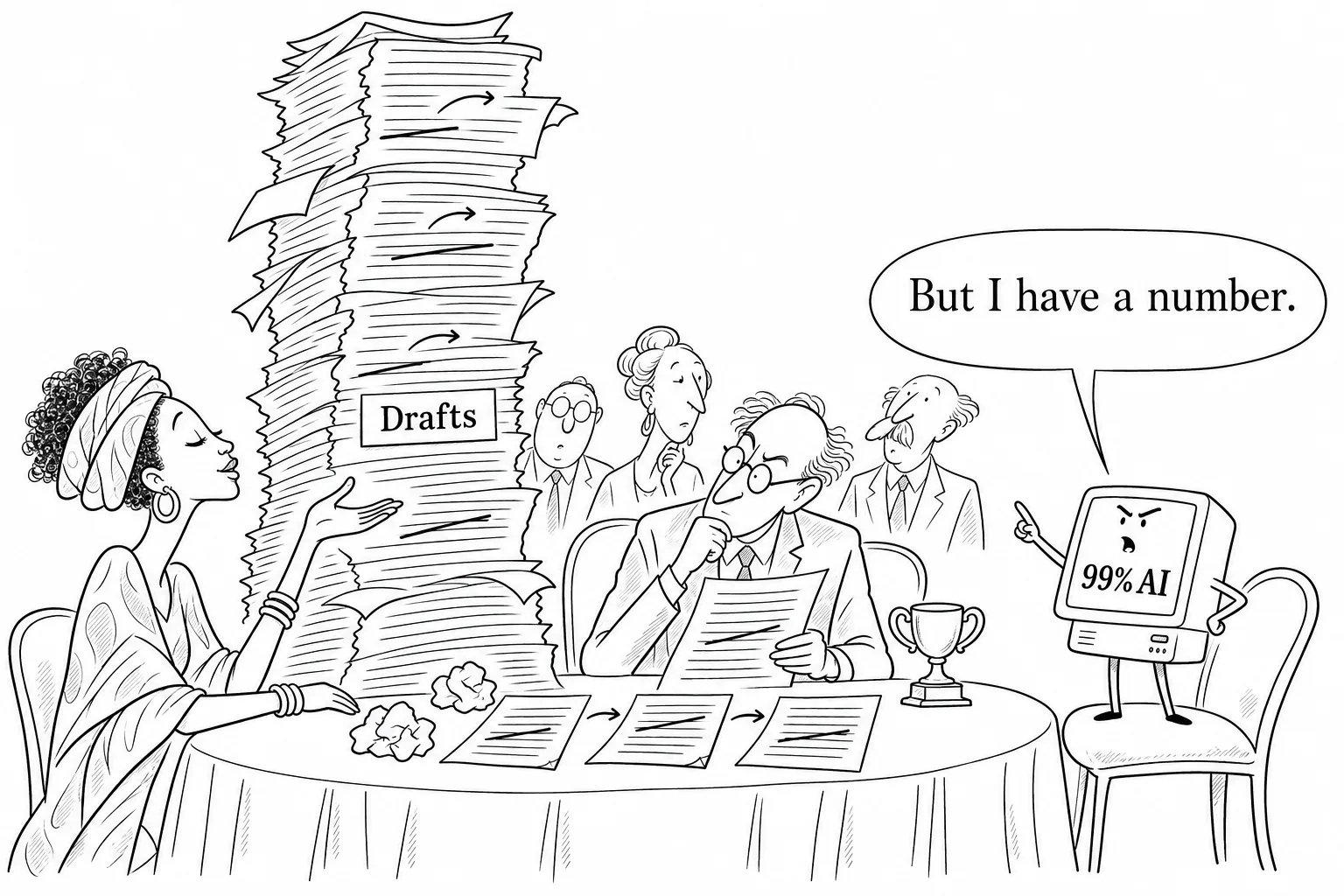
On November 11, the Caine Prize reportedly concluded that its winning story, "The Blue Fighter," was written by a person, even though an AI detector had flagged almost all of it as AI-generated. The prize based its decision on draft records and interviews with people involved. It drew a line: who wrote a work should be settled by evidence of how it was written, not by a detector's score.
Koji Yamamoto · Economics Analyst

Key points
- The Caine Prize reportedly confirmed its 2026 award on November 11, saying it found no evidence that the winning story used generative AI. It examined the drafts' metadata (records of when files were created and edited) and conducted interviews, and outside experts carried out the analysis independently
- The prize reportedly said that "AI detection tools alone are not a reliable basis for determining authorship." A detector score should only prompt suspicion; the ruling should rest on evidence of how the work was written
- There are counterarguments: drafts can be fabricated after the fact, the approach penalizes writers who keep no records, and small prizes lack the resources to investigate. Even so, a process that lets the writer make their case is more sound than deciding on a score alone
The Caine Prize for African Writing, a literary award for African writers, has reportedly concluded that its 2026 winning story was written by a person, according to reports on November 11. The winner is "The Blue Fighter," a short story by Simbarashe Steyn Kundizeza, which an AI detector had reportedly judged to be almost entirely AI-generated. The detector's score did not decide the matter. The deciding evidence was the record of the author's drafts and interviews with people involved. This writer's position is clear: the ruling is right. Who wrote a work should be established by evidence of how it was written, not by a probability produced by a machine.
For Japanese companies: Most companies are not directly affected. The exception is HR, communications and editorial staff who use AI detection tools to screen job application forms, review internal papers, or vet outsourced manuscripts and translations. Before this term's selections or commissions, make it a set procedure that no one is rejected or has a contract terminated on a score alone, and that there is a channel through which people can submit drafts or edit histories and explain their work.
What happened: the detector said "AI," the draft records said "human"
According to reports, suspicion that the winning story had been written with AI arose because an AI detector judged almost the entire text to be AI-generated. The prize reviewed the case and reportedly confirmed the award in a statement on November 11. At the heart of the statement, according to reports, is the following sentence.
AI detection tools alone are not a reliable basis for determining authorship.
Do not treat a detector's verdict as the conclusion. That was the first line the prize drew. It then reportedly described the findings of its review as follows.
The review found no evidence that the story was produced using generative AI,
Ellah Wakatama, chair of the prize's board, reportedly went further in a video statement.
From our detailed investigation, we feel the evidence is clear: The Blue Fighter was human-written,
What was the basis for saying "the evidence is clear"? Wakatama reportedly described what the investigation covered.
It also included independent and expert-led metadata analysis of drafts written by the author.
Metadata is the record of when a file was created and when and how it was changed. A stack of drafts revised over many days leaves a different trail from the way generative AI is typically used, producing a text all at once. The prize had that trail read by outside experts rather than its own people. It then added interviews with those involved and reached its conclusion.
Why a score should not decide
What an AI detector returns is a probability that "this text resembles something written by AI." It is not evidence of who wrote it. Critics have long pointed out that polished prose, writing that follows set patterns, and writing by non-native English speakers are more likely to be flagged as AI-generated. In this case, too, a story written by a person was reportedly judged almost entirely AI-generated.
What would have happened if the score had decided? The award might have been revoked, and the writer's name might have been left attached to the label "someone who had AI write for them." And the writer would have had nothing to rebut it with. A detector's inner workings are invisible from the outside, and no one can explain why it produced a given score. Hannah Bowman, who chairs the AI task force at AALA, the US association of literary agents, reportedly said the following in a report dated November 14.
I worry for authors when they don't have a chance to make a case in defence of their work
This is the core of the problem. Judging by a detector score alone takes away a writer's chance to defend their work. Checking evidence of how the work was written lets the writer submit drafts, show records and protect their work. The Caine Prize chose the latter.
The strongest objections: drafts can be faked, and some writers keep no records
This approach has weak points too. There are three main objections.
The first is that drafts can be faked as well. By retyping AI-written text bit by bit, one can build a plausible edit history. Metadata can also be altered. The second is that it is unfair to some writers. People who write by hand on paper, who keep overwriting a single file, or who throw away old manuscripts have no evidence to offer. Demanding to see the writing process also means peering into a writer's workshop. The third is cost. Large prizes may be able to commission outside experts and interview those involved, but small open competitions, schools and corporate selection processes cannot. That, the argument goes, is why detectors, which can cheaply sort thousands of submissions, get used.
All of these are fair points. Even so, the conclusion stands. On the first, the absence of perfect evidence is no reason to decide by a score that is not evidence at all. Faking takes effort, and the more checks are layered on top of each other (draft records, interviews, shifts in style), the easier deception becomes to spot. The answer to the second is not to decide on the presence or absence of records alone, but to combine other methods, such as interviews or having the person write on the spot. On the third, using detectors for sorting is not in itself the problem. Scores should go no further than picking "candidates for closer review," and before any serious decision, such as rejection or revocation, there must always be a procedure that lets the person explain.
Where the line was drawn: not whether AI was used, but how the work was written
The same week brought news pointing in a different direction. Philippe Jaenada, winner of France's biggest literary prize, had disclosed on his own that he used AI, according to a report on November 13. He reportedly made the disclosure around the day after he won the prize on November 3. At first glance, this looks like the opposite of the Caine Prize case, in which suspicion was raised and then rejected.
But the two stories point to the same place: the key to establishing authorship is not a score applied from the outside, but the process the writer can show. Whether one is showing that a person wrote a work or showing where AI was used, it takes drafts, records and the writer's own account. The more routine it becomes for AI to write text, the narrower the path of having machines guess "whether AI wrote it" becomes. What widens instead is the path of recording who did what at which stage, and being able to show it when asked.
The same goes for corporate documents. Writing proposals and reports together with AI is no longer unusual. What is needed is not to use AI detection tools to cast suspicion on employees and business partners. It is to keep a record of how important documents were produced, and to be able to explain it when asked. The Caine Prize ruling is more than an internal matter for a literary award; it is a model for how to establish "who wrote it" in the age of AI.
What we could not confirm
This article is based on media reports; we were unable to consult the original text of the prize's statement. According to reports, the suspicion was first made public in an October 11 article by Vauhini Vara, a writer for the US magazine The Atlantic, and the detector used was Pangram. The prize began its review the same day, leading to the November 11 statement. The specific score the detector produced and the names of the experts who analyzed the metadata have not been confirmed. According to reports, the author is a Zimbabwean writer, and the prize money is £10,000 (about $13,000). Jaenada has disclosed that he used ChatGPT three times: to insert a sentence designed to test readers, for a passage satirizing technology, and for research.
Editorial cartoon
Sources
- https://brittlepaper.com/2026/11/caine-prize-confirms-simbarashe-steyn-kundizeza-as-2026-winner-after-ai-review-finds-no-evidence-of-generative-ai-use/
- https://gazettengr.com/caine-prize-finds-no-evidence-simbarashe-kundizeza-used-ai-in-winning-story/
- https://www.newzimbabwe.com/caine-prize-for-african-writing-finds-no-evidence-kundizezas-winning-story-was-ai-generated/
- https://au.headtopics.com/news/ai-accusations-rock-publishing-industry-as-authors-embrace-89844684
- https://artsloungenyc.com/2026/11/13/winner-of-frances-biggest-literary-prize-philippe-jaenada-discloses-use-of-ai/