Products & Models · Nov 16, 2026
AT&T runs nearly 500 AI-driven workflows, cutting dedicated internet setup time in half
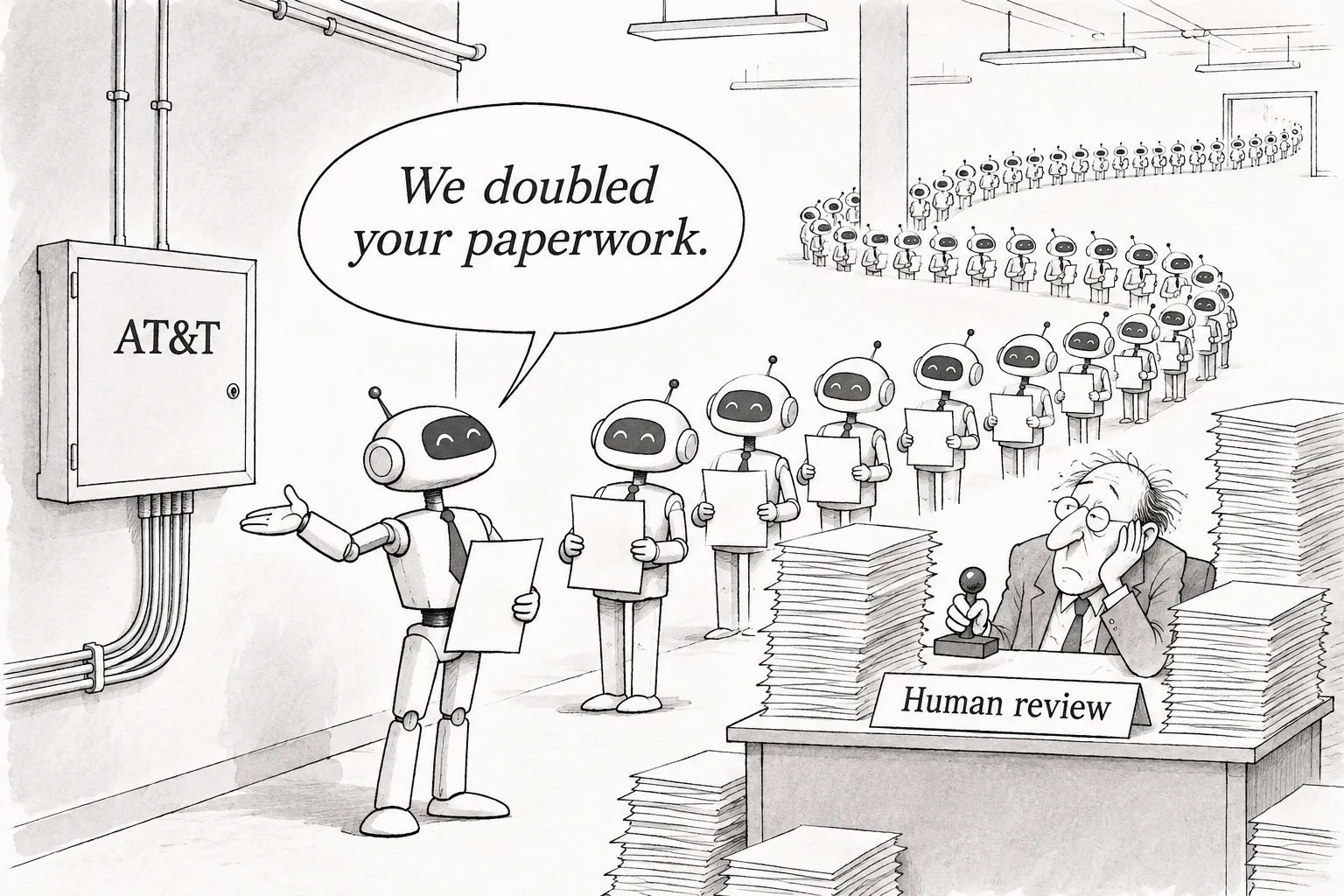
Human review stays in place until accuracy reaches the mid-to-high 90s percent. All figures come from company staff and have not been independently verified
Rie Suzuki · Technology Editor

Key points
- AT&T reportedly has about 500 workflows handed over to AI agents
- The time needed to provision dedicated internet service in buildings with existing fiber has reportedly been cut in half
- Human review is not removed until accuracy reaches the mid-to-high 90s percent. All figures come from company staff
About 500 workflows handed over to AI agents are running in real production work, not pilots, at U.S. telecom giant AT&T, U.S. tech news site SiliconANGLE reported on November 14. The time needed to provision dedicated internet service in buildings that already have fiber has been cut in half, according to the report. However, the company reportedly keeps human review in place until the AI's accuracy reaches the mid-to-high 90s percent. All the figures came from AT&T staff and have not been verified by outside parties.
For Japanese companies: Operations and IT departments at companies testing AI agents for order processing, provisioning, or invoice reconciliation should decide, and document, the accuracy level at which human review can be removed, and how that accuracy is measured, before moving to production. AT&T's threshold is reportedly in the mid-to-high 90s percent, which can serve as one benchmark. There has been no indication of any direct impact on line contracts or pricing for Japanese companies that do business with AT&T.
What was reported: 500 workflows and provisioning time cut in half
According to SiliconANGLE, AT&T is not adding AI to existing processes but deploying agents by redesigning workflows from scratch. About 500 workflows built this way are now running, the report said.
One example highlighted was provisioning dedicated internet service in buildings where fiber is already in place. For a telecom operator, connecting a business customer involves many departments and systems, from taking the order to checking available capacity to scheduling installation work. Halving the time means customers get their service up and running sooner, and the company can handle more orders with the same headcount.
The threshold for removing humans: "mid-to-high 90s"
The most practically useful part of the story is not the figure of 500 but the condition for removing human review. AT&T reportedly does not take humans out of the loop until the AI's accuracy reaches the mid-to-high 90s percent.
The weight of that threshold becomes clear when viewed the other way around. At 95% accuracy, one in 20 cases is wrong; even at 98%, one in 50 is. For a process handling thousands of cases a day, that means dozens of errors daily. Removing humans is therefore only feasible for processes where errors can be caught and fixed later, or where the harm from a mistake is small. Conversely, for processes that fall short of this level, the AI will continue to produce drafts that humans check and approve. The report does not make clear whether the halved provisioning time includes the effort of this human review.
The nature of the figures, and what could not be verified
The figures of about 500 workflows, half the time, and the mid-to-high 90s percent were all reportedly provided by AT&T staff. They do not come from the company's financial filings or an external audit. It could not be confirmed here how large a unit of work "one workflow" represents, what accuracy was measured against and how, which AI models or vendor tools are being used, or how many workflows have actually had human review removed. The figures were reportedly given by Luke Corbin, an AT&T Business executive responsible for transformation and AI, at an Amazon Web Services event held in Boston in early November. He reportedly said the company plans to triple the number of workflows next year and that many are already running without human review.
An approach companies can borrow when testing in-house
What Japanese companies can borrow directly from AT&T's story is not the scale but the sequence. First, record whether the AI's answers were correct for each process, and track accuracy as a number. Next, set the threshold at which humans can be removed in advance, based on how much harm a mistake in that process would cause. Finally, reduce human review starting with the processes that clear the threshold. Using an approach that records and scores not just the answers but the steps the agent took (known as trajectory evaluation) also reveals where errors tend to occur.
Products and initiatives that claim to have "deployed AI agents" while humans re-check everything behind the scenes are sometimes criticized as agent washing. Whether a company has a numerical condition for removing human review is one way to tell a nominal deployment from a real one.
Editorial cartoon