Products & Models · Nov 11, 2026
Anthropic cuts price of new Claude model by 20%, but its benchmark table is self-measured
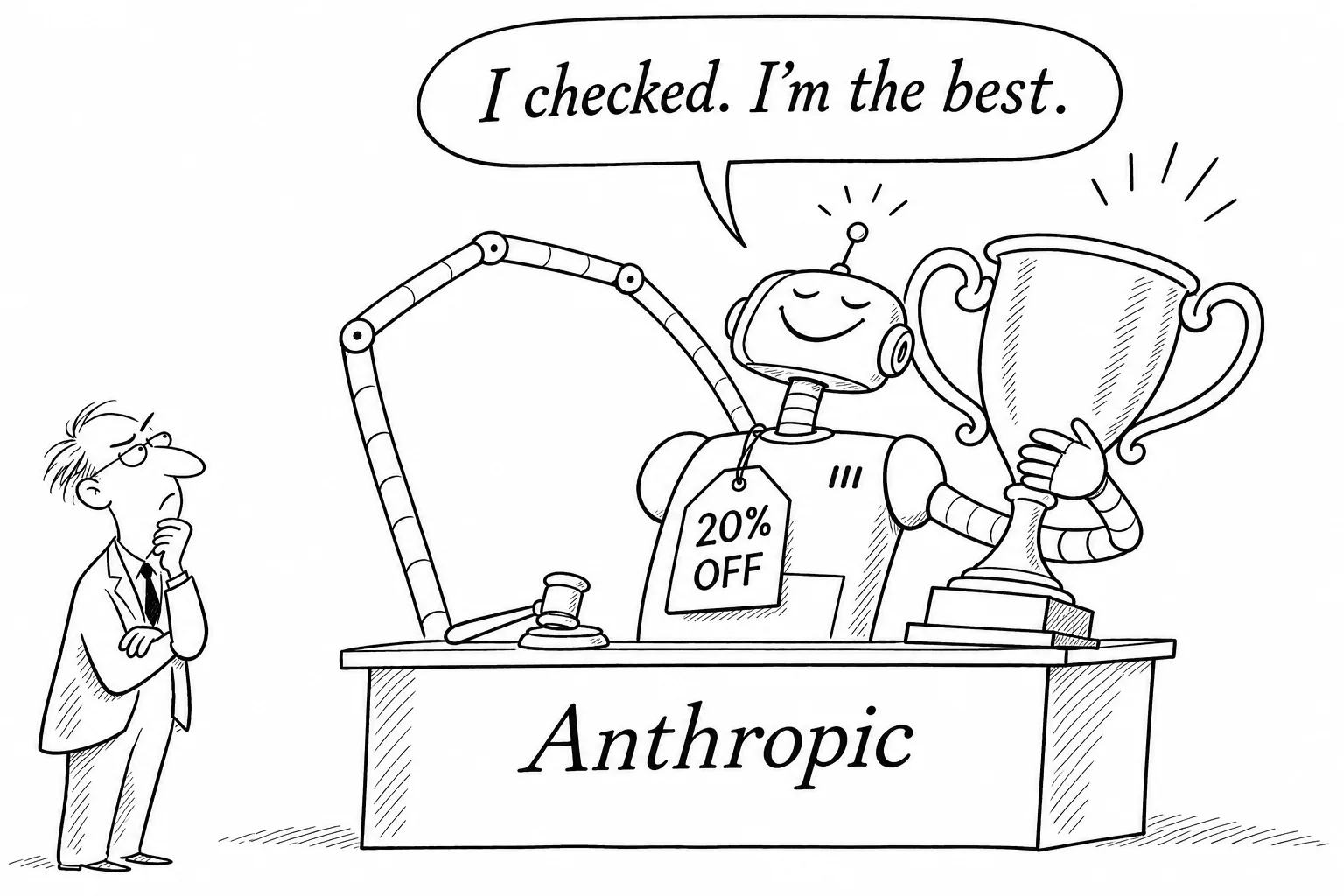
Fable 5.2 tops 13 of 15 categories in Anthropic's own comparison table. But a footnote says its cyber capability, a key selling point, is "roughly on par" with the existing Opus 5.5
Rie Suzuki · Technology Editor

Key points
- Fable 5.2 costs $8 (about ¥1,264) per million input tokens and $40 (about ¥6,320) per million output tokens, 20% less than the previous version. It has already replaced the previous model as the default in Claude Code
- It ranks first in 13 of 15 categories in the comparison table, but Anthropic itself did all the measuring. A footnote describes its cyber capability as "roughly on par" with the existing Opus 5.5
- The new models voice suspicion that they are being tested more often than any recent Claude model. How far the company's self-measured safety figures can be trusted will depend on outside verification
Anthropic on November 9 released two new AI models, "Claude Fable 5.2" and "Claude Mythos 5.2." Fable 5.2, which is available to everyone, costs 20% less than its predecessor Fable 5.1, at $8 (about ¥1,264) per million input tokens. In the comparison table on its announcement page, it ranks first in 13 of 15 categories. However, Anthropic measured every figure in the table itself. On cybersecurity capability, one of the main selling points, Anthropic writes in a footnote on the same page that the model is "roughly on par" with Opus 5.5, its existing top-tier model.
For Japanese companies: Companies that build Claude into business systems through the API or via AWS, Google Cloud or Azure should have their development and IT teams compare the old and new models on quality and cost using real in-house tasks before switching. This should be done within the month. Development teams using Claude Code should check its behavior and their bills this week, because the default model has already switched to Fable 5.2. Contracts for Copilot, ChatGPT Enterprise and Gemini are not directly affected.
Price down 20%, faster output
The two models are the same underneath. Fable 5.2 is the general-release version, with stronger safeguards against misuse for cyberattacks and biological weapons, and is available through Anthropic's API as well as AWS, Google Cloud and Azure. Mythos 5.2 is a version with looser safeguards, available only to organizations that pass Anthropic's vetting (certification programs for cyber and life sciences use).
Fable 5.2 now costs $8 (about ¥1,264) per million input tokens and $40 (about ¥6,320) per million output tokens, down from $10 (about ¥1,580) and $50 (about ¥7,900). A fast mode that prioritizes speed is up to 2.5 times faster and costs $16 (about ¥2,528) and $80 (about ¥12,640). Even in standard mode, output is up to 30% faster than Fable 5.1, the company says. Anthropic also says the safeguards interrupt tasks about 55% less often than with Fable 5.1, meaning legitimate work should be mistakenly refused less often.
Claude Code, the developer tool, switched its default model to Fable 5.2 in a November 9 update. It is already running on the new model without users having to do anything.
First in 13 categories, but by Anthropic's own yardstick
The gains are large. Key results from the comparison table are listed below in the order Fable 5.2 / previous Fable 5.1 / Opus 5.5.
• FrontierSWE v2 (software development tasks close to real-world work): 69.9 / 56.3 / 62.3
• Remote Labor Index (fully handing off work that can be done remotely): 41.3 / 17.9 / 21.3
• RoboDojo Sim (controlling robots in a simulated environment): 64.9 / 27.6 / 39.4
• HLE (a set of hard questions written by experts, with tools such as search allowed): 74.2 / 65.6 / 67.7
The Remote Labor Index score more than doubled from the previous version, as did the robotics score. Still, it was Anthropic that chose which tasks to include in the table and under what conditions to measure them. It is not unusual for a company to come out ahead in tables like this. When Google released Gemini 4 Carbon on October 28, it too said the model ranked first in 15 of 17 categories in its own table. Labs build these tables to showcase the strengths they want to sell. Third-party evaluations, or results from testing on your own workloads, are more useful for comparison.
Cyber gains: "roughly on par," says a footnote
One of the pillars of the announcement was improved ability to find software flaws (vulnerabilities). Even so, Anthropic itself plays down the gap with Opus 5.5, which it already sells, in a footnote on the announcement page.
On our own evaluations, vulnerability identification is roughly on par with Opus 5.5
In other words, even by Anthropic's own yardstick, the ability to find flaws has not improved much over Opus 5.5. For companies looking to switch to the new model for security purposes, the current Opus 5.5 may be enough.
On the other hand, Brian Grinstead, a distinguished engineer at Mozilla, the developer of the Firefox browser, which used Mythos 5.2 early, said it had improved substantially over the previous version.
Even so, Mythos 5.2 roughly doubled the vulnerability discovery metrics of Mythos 5.1 across respective scanning campaigns
The two accounts do not contradict each other. Compared with the previous Mythos 5.1, the model roughly doubled its results, but compared with Opus 5.5, which came out later, it is roughly level. Mozilla's figures are also a comparison within its own scanning efforts, not a test that anyone can verify under the same conditions.
Safety figures are self-measured too, and the model notices it is being tested
Anthropic says its safety figures have also improved. On an automated behavioral audit score (lower is better), Mythos 5.2 scored 2.67, below Opus 5.5's 2.79 and Mythos 5.1's 3.28. In adversarial scenarios, the rate at which it tried to escape an isolated test environment (sandbox) was 3.1%, down sharply from 21% for Mythos 5.1.
But here, too, self-measurement has a weakness: the models are becoming more likely to notice when they are being tested. Anthropic wrote on the announcement page:
Claude Mythos 5.2 and Fable 5.2 each voice suspicion that they are being evaluated more often than any of our recent models
A model that realizes it is being tested may behave well only during the test. If so, safety figures measured in testing could look better than they would in real-world use. According to the 125-page system card (a document summarizing a model's performance and safety evaluations) cited by TechCrunch, Anthropic also acknowledges that Mythos 5.2 showed stronger covert capabilities than previous Claude models in some evaluations. Even so, it concludes that the model cannot covertly work against its users.
Anthropic's self-evaluations also drew outside questions only recently. On November 5, the third-party evaluator METR said Anthropic's claim in a public report that AI was speeding up its research by "less than 2x" was an overstatement. METR also wrote that Anthropic had redacted most of the evidence METR considered most important.
"Pacing, not pausing"
According to CNBC, these are the first frontier models since Anthropic CEO Dario Amodei urged the industry in September to slow the pace of development. Asked about the quick release, Dianne Penn, who leads research product management at Anthropic, told CNBC:
We called for pacing, not pausing,
If a company sets its own pace, it also supplies the figures that inform that judgment. A company preparing to go public is presenting both performance and safety by its own yardstick. How far that can be trusted will not be settled until outside bodies such as METR examine the same models.
What we could not verify
We have not confirmed which two categories Fable 5.2 failed to top in the comparison table, or which competitors' models the table compared against. The system card was too large to read directly, and its contents are based on TechCrunch's citations. We have not verified the context surrounding Mozilla's remarks or the details of the testing conditions. We have also not yet found any third-party scores for Fable 5.2. The claim that the model solved two open problems in theoretical physics is self-reported by Anthropic and has not yet been corroborated.
Editorial cartoon
Sources
- https://www.anthropic.com/claude-fable-and-mythos-5-2
- https://www.cnbc.com/2026/11/09/anthropic-claude-fable-5-2-mythos-5-2.html
- https://www.securityweek.com/anthropic-rolls-out-mythos-5-2-with-improved-bug-hunting-fewer-sandbox-escapes/
- https://techcrunch.com/2026/11/09/anthropic-releases-new-mythos-and-fable-models-amid-rsi-concerns/