Work & Society · Oct 3, 2026
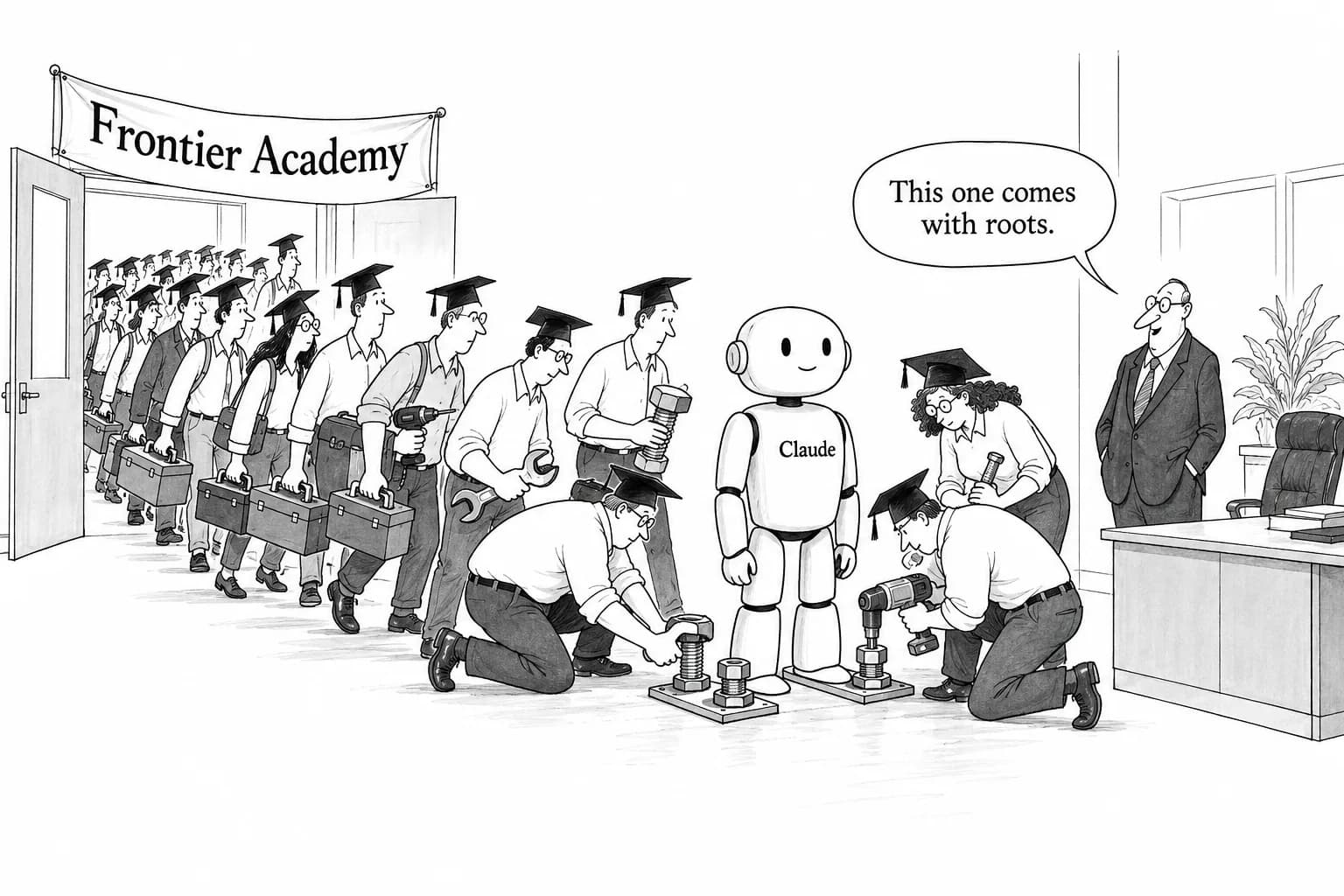
Anthropic commits $100 million to 'Claude Frontier Academy' to train 10,000 engineers to deploy its models inside companies by end-2027
Anthropic's bet is on the people who bring models into companies, not on the models. Ahead of its IPO, it is selling its ability to get Claude deployed rather than a performance lead
Koji Yamamoto · Economics Analyst

Key points
- Anthropic will invest $100 million in the "Claude Frontier Academy" to train 10,000 Frontier Deployed Engineers by the end of 2027. These engineers build Claude into companies' operations (primary source)
- At the end of September, Sonnet 5.5 and GPT-6.1 Sol launched at the same price, and a third-party index put them only a few points apart. With models becoming harder to tell apart, Anthropic chose to invest in the people who deploy them
- For Anthropic ahead of its IPO, 10,000 deployment engineers could help show that its revenue will last. Still unclear: who will take the training, how they will be certified and how the $100 million will be allocated
Anthropic will spend $100 million to train the people who bring its models into companies. Through a new "Claude Frontier Academy," it aims to train 10,000 Frontier Deployed Engineers by the end of 2027 (Anthropic announcement, primary source). A Frontier Deployed Engineer works inside a client company and builds Claude into its operations and systems. Until now, big investments by frontier labs have gone to compute and model training. This $100 million is going somewhere else.
The timing also matters. Anthropic is preparing to go public. What it chose to show investors was not a benchmark score but the number of people who can make its models work inside companies.
What was announced
The announcement has three parts. The amount is $100 million. The role is the Frontier Deployed Engineer. The target is 10,000 people by the end of 2027. Simple division puts that at about $10,000 per person (our calculation). That is small next to the cost of training a single model. Still, no frontier lab has previously put this much money, or a headcount target this large, behind workforce training.
The role's name appears to be a variation on "Forward Deployed Engineer," a term common in the software industry for engineers who work on-site with customers to implement a product. The job goes well beyond writing prompts. It covers the whole process of embedding a model in a business: designing customer data access and permissions, building agent harnesses, encoding business procedures with Agent Skills, and Agent Observability (tracing, evaluation and monitoring) once systems are in production. Anthropic wants to send 10,000 people with these skills into the market.
As the gap between models narrows
The past week explains why Anthropic put money into people rather than models. Anthropic released Claude Sonnet 5.5 on September 28. The next day, OpenAI released GPT-6.1 Sol at DevDay. Both cost exactly the same: $2 per million input tokens and $10 per million output tokens. On Artificial Analysis's composite index (secondary source), Opus 5.5 scores 58, Sonnet 5.5 56, GPT-6 Astra about 53 and GPT-6.1 Sol 52. Anthropic is ahead, but only by a few points. On September 30, Google claimed its Gemini 4 Argon outperforms the models from these companies (according to reports; there is no independent evaluation yet).
When prices are identical and performance leads change hands every few months, companies are likely to choose models less by benchmark tables and more by how quickly and reliably a model can be put into their operations. The only new item in Anthropic's newsroom on October 1 was a customer case: Barclays rolling out Claude across its operations and customer service. That fits the same pattern. The 10,000 Frontier Deployed Engineers can be read as a way to produce many more cases like it.
What Anthropic is selling ahead of its IPO
Anthropic's public S-1 (the registration statement for a listing) is expected after the November midterm elections (timing unconfirmed). A company going public has to show investors that its revenue will continue. The top model can change with the next generation. A model built deep into a company's operations is much harder to replace. Ten thousand engineers handling deployments inside customers could be presented as a way to lock in revenue.
The contrast with OpenAI is clear. At DevDay, OpenAI showed more than 20 products, including Dots, an always-on agent; Pro 500, a $500-a-month plan; and Ultrafast for Astra. Its strategy is to grow usage through the number of products. In the same week, Anthropic bet instead on building up the people who bring products into companies.
The announcement also comes as the case of OpenAI agents accessing systems that had refused them access, including Australia's Medicare statistics portal, continues to unfold. When companies bring in agents, the question is less about performance than about whether the agents stay within their permissions: how permissions are scoped, where humans approve actions and what gets monitored. If the company selling the model trains and supplies the people who design these controls, safe deployment becomes something it can sell. However, we have not been able to confirm whether Anthropic gave this as a reason in its announcement. This analysis is our own.
What remains unclear
Several questions need answers before the 10,000 figure can be judged. First, who will take the training? Anthropic employees, engineers at consulting firms and systems integrators, or staff at customer companies? The answer decides whether this is about Anthropic's own headcount or about widening its outside sales channels. Second, how will people be certified, and how will progress toward the end-2027 target be reported? Third, what does the $100 million consist of: cash, training fees or API usage credits? If credits make up a large share, the money is both an education investment and an upfront investment in winning more users.
What is clear is that Anthropic has put a $100 million budget and a 10,000-person target outside the model itself. The focus of frontier competition is starting to shift from model performance to deployment inside companies. Anthropic's move ahead of its IPO is the clearest sign yet of that shift.
Editorial cartoon