Work & Society · Oct 18, 2026
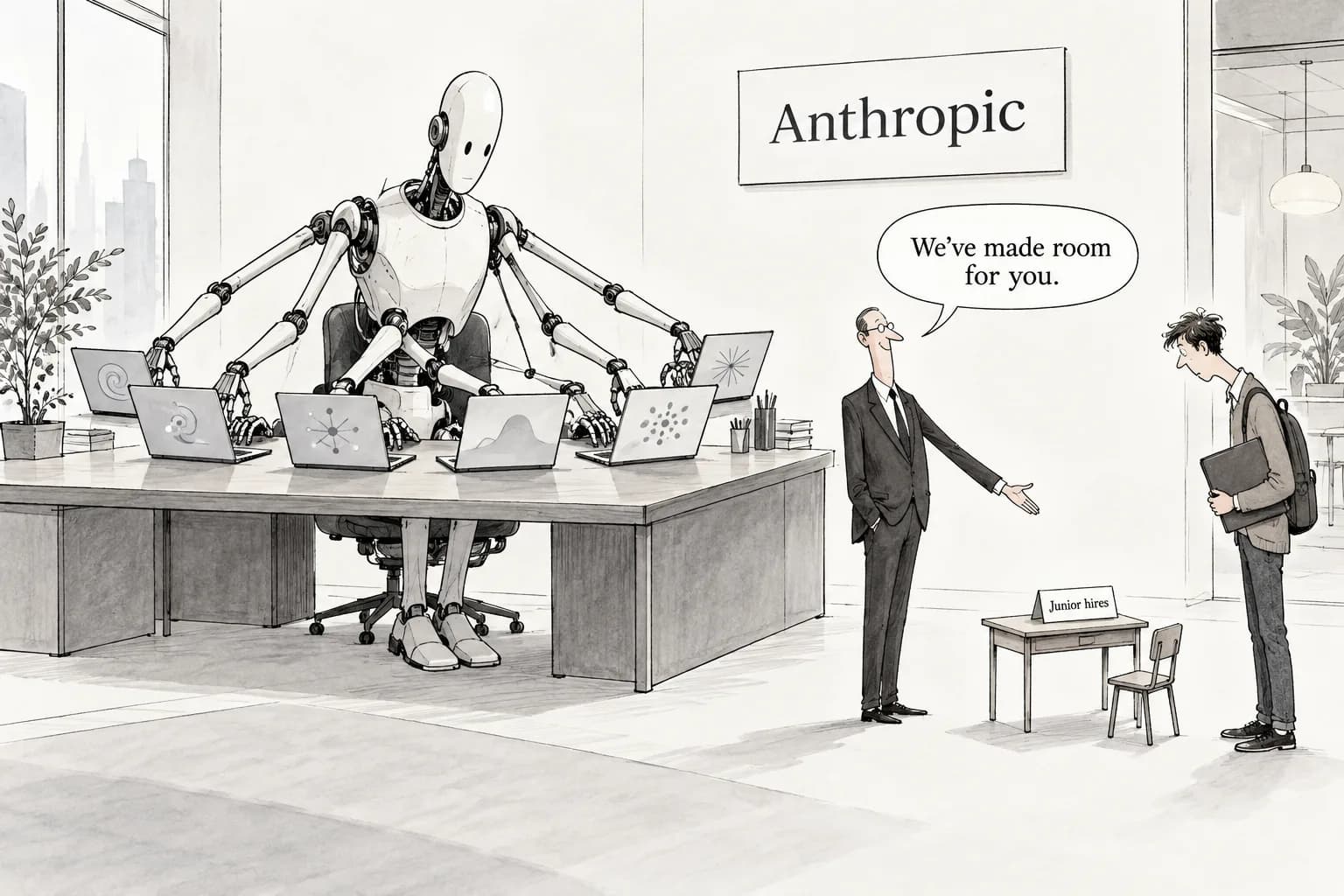
Agents now work six times as many hours as humans at Anthropic, and junior technical hires fall from 27% to 9% as the lab puts numbers on its own workforce shift
Is AI taking junior jobs? A question fought over with outside statistics and estimates now has a frontier lab's own HR numbers
Koji Yamamoto · Economics Analyst

Key points
- Inside Anthropic, agents now work six times as many hours as humans (primary source)
- The share of new hires who are junior technical staff fell from 27% to 9%, roughly a third of its former level
- Taken together with the previously reported figure of more than 30,000 monorepo merges a day, the numbers suggest the work inside the lab is passing from humans to agents. But they come from one company, and it cannot be concluded that agents caused the drop in hiring
Anthropic has put numbers on how its own workforce has changed, in a research page titled "Employment at Anthropic". There are two figures. First, agents inside the company now work six times as many hours as humans. Second, the share of new hires who are junior technical staff has fallen from 27% to 9%. Until now, the debate over whether AI is taking junior jobs has been fought with outside statistics and estimates. It now has HR figures from a company that builds frontier models itself.
Two numbers
The first concerns the volume of work. Inside Anthropic, the hours worked by agents have reached six times the hours worked by humans. That suggests agents have moved past being assistive tools and are now doing most of the work.
The second concerns hiring. Among new hires, the share who are junior technical staff fell from 27% to 9%, roughly a third of its former level. Junior engineers usually learn on the job by taking on well-defined coding and analysis tasks, which is exactly the kind of work agents do best.
The study was also picked up in Marginal Revolution's Saturday links roundup. Around the same time, Anthropic published two research pages on expectations about AI: "AI expectations gap" and "Expectations for the future". Taken together, the company has shown the changes inside its own walls alongside how the wider public sees AI.
The sixfold figure fits earlier disclosures
The claim that agent work far exceeds human work is consistent with what Anthropic has disclosed before. Around October 13, in an engineering blog post titled "Redesigning source control at Anthropic," the company wrote that merges into its monorepo rose from about 2,500 a day in May 2026 to more than 30,000 a day in September. The "primary user" of the new source control system is Claude, it said. A seven-person team had to migrate off Git in five months because the changes pushed by agents, not humans, had outgrown what the existing tools could handle.
OpenAI has similar figures. On October 5, Epoch AI, drawing on an OpenAI report from September, estimated that internal use of coding agents at OpenAI is roughly doubling every month, with agents doing 3.1 days of work for every day of work by a single human. Anthropic's sixfold figure is a step beyond that. A Cambridge working paper from late September, citing Anthropic data, also reported that the share of approved code written by AI had climbed from the low single digits to more than 80%.
Those figures described the scale of the work flowing through the system. The new disclosure goes further, showing how hiring has changed as a result.
The junior entry point is what got cut
The drop from 27% to 9% matters because what shrank was not overall hiring but the share of junior technical roles. Experienced engineers still have a role checking agents' output and setting direction. Entry-level work, where people gain experience by implementing tasks of a fixed scope, is the easiest for agents to replace. Epoch's "Can AI automate Epoch?", published October 8, likewise reported that models reliably handled well-defined coding and analysis, while no model could handle open-ended judgment calls or work that has to meet an organization's standards. Much of what junior staff do falls into the first category.
Anthropic itself has pushed back on the view that AI will take every job. In "What work can robots do?" on September 30, it said only 0.3% of physical tasks could be done by robots at a cost competitive with humans. The new figures are consistent with that cautious stance: the impact shows up first in knowledge work, where agents are strongest, and among the most junior workers. There are also hints of where hiring is shifting. On October 2, Anthropic announced it would spend $100 million to train 10,000 "Frontier Deployed Engineers" by the end of 2027. One reading is that instead of hiring junior staff in-house, the company is putting its effort into training people who handle deployment on the customer side.
What lab data adds to the debate, and its limits
The debate over AI and junior employment has mainly drawn on data such as job placement rates for new college graduates and job-posting statistics. Those statistics make it hard to separate out factors other than AI. This time, the numbers come from inside the workplace where AI adoption has gone furthest. At the company that uses agents most deeply, hiring of junior technical staff has fallen to a third. This is likely to be read as an early sign of the path other companies will follow.
The limits, however, are clear. First, these are one company's numbers. Anthropic is growing fast and is reportedly preparing for a stock market listing, so its hiring mix differs from that of a typical company. Second, the fall in the hiring share and the rise in agent work happened at the same time, but the two numbers alone do not show that the second caused the first. Third, this is a self-reported disclosure that has not been verified by a third party.
Even so, it matters that a company building AI has published numbers on how its own workforce has changed. Progress in research automation (RSI) has so far been measured with benchmarks and code volume. Hiring now adds a measure of what actually happens at a workplace where agents work six times as many hours as humans. The next question is whether other frontier labs will publish the same numbers.
Editorial cartoon