Opinion · Nov 19, 2026
Rival camps sign statement calling Anthropic "not a safe AI company" on eve of IPO
About 92 figures from the safety, accelerationist and skeptic camps put their names to a single sentence. A post from the AI ethics camp appears to signal dissent, and Anthropic has not responded
Koji Yamamoto · Economics Analyst
Key points
- Just before Anthropic's IPO, about 92 people from opposing camps signed a statement saying "Anthropic is Not a Safe AI Company"
- Safety advocates Hendrycks and Tegmark, accelerationists Verdon and Hotz, and skeptic Marcus signed side by side. A post from inside the AI ethics camp appears to signal dissent
- Anthropic has not responded. Third-party evaluations and the company's own filings already contain material that conflicts with its "safety company" image
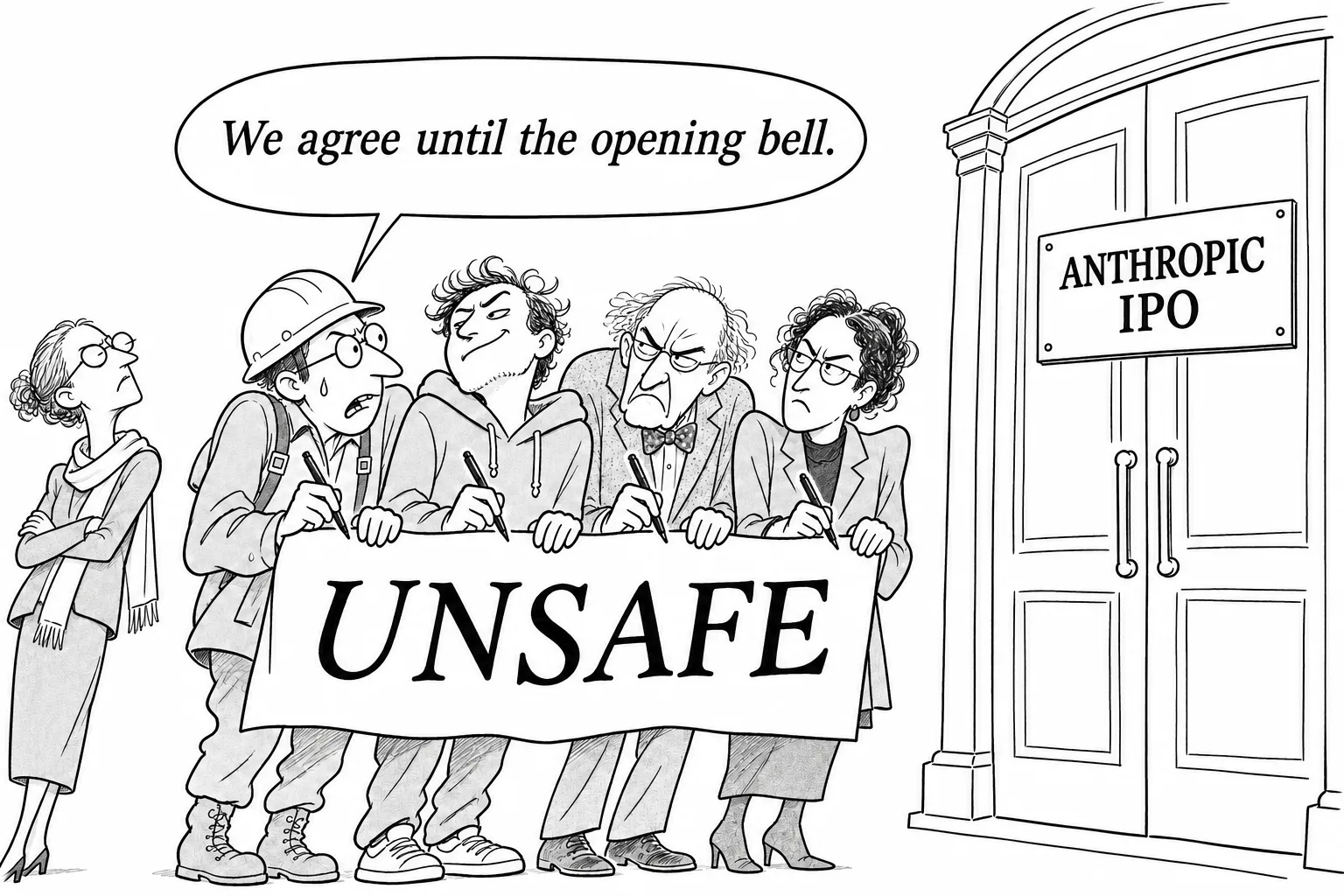
Just before AI company Anthropic was due to price its shares, a statement appeared declaring that "Anthropic is Not a Safe AI Company." About 92 people signed it, from the safety camp that warns loudly about AI's dangers, the accelerationists who argue development should move faster, the skeptics who doubt what AI can actually do, and the ethics critics who focus on the harms of today's AI. These four camps usually criticize one another sharply. That they lined up behind a single sentence is what gives the statement its weight. A post from inside the AI ethics camp appears to signal dissent, and Anthropic has not yet responded.
For Japanese companies: For IT departments at companies using Claude in their operations, the statement does not change contracts, prices or specifications. But if internal approval documents or explanations to business partners cite "safety" as a reason for choosing Claude, those companies should check this month whether that rationale rests on anything more than the company's own marketing. Individuals and companies planning to buy the newly listed shares may want to treat the split in views on safety as one factor in their decision.
Four camps that usually clash line up behind a "not safe" statement
The closing sentence of the statement is the claim itself. In the signatories' words:
Anthropic is Not a Safe AI Company
The statement targets Anthropic itself, a company that has built its brand as "the AI company that puts safety first." It was published on a dedicated website, and its title is a play on Anthropic's name and the word "misanthropic."
Sorting the signatories by camp shows how broad the coalition is. From the side warning about AI's dangers came Dan Hendrycks, who leads the nonprofit Center for AI Safety, and Max Tegmark, an MIT physicist and the founder and president of the Future of Life Institute. From the side pushing for faster development came Guillaume Verdon, a standard-bearer of accelerationism (e/acc), and entrepreneur and programmer George Hotz. Cognitive scientist Gary Marcus, who has long argued that AI's capabilities are overstated, also signed.
The signatories usually criticize one another for different reasons. The safety camp sees the accelerationists as reckless. The accelerationists see the safety camp's calls for regulation as an attempt to halt development. The skeptics think both the safety camp and the accelerationists overestimate AI's power. All of them have now lined up on a single point: that Anthropic is not a safe company. The newsletter The Quote Tweet also covered it as a rare coalition.
The weight of a "not safe" statement on the eve of the IPO
The statement arrived at the climax of Anthropic's listing process. Anthropic had planned to price its shares on November 18 and begin trading on November 19 under the ticker "ANT." The indicative price range was $70–78 per share (about ¥11,130–12,400), and the Financial Times had reported that the company was considering pricing above the range.
For Anthropic, "safety" is not just a principle but the core of what it sells. Enterprise customers often choose Claude because of how it handles data and its low rate of incidents. For investors, too, the reputation as "a company that prioritizes safety" is priced in as an advantage if regulation tightens. Commentators from very different positions have now jointly rejected that image.
Even before the statement, there was material at odds with Anthropic's "safety"
Material conflicting with Anthropic's safety image had been piling up in the company's own filings and third-party evaluations before the statement appeared. What follows is not the content of the statement but facts that have already been made public.
On November 5, the third-party evaluator METR assessed Anthropic's risk report. It said Anthropic's description in the report that AI was speeding up its research by "less than 2x" was an overstatement. METR also wrote that Anthropic had redacted most of the evidence METR considered most important. Anthropic co-founder Sam McCandlish reportedly acknowledged on X that the redactions made it harder for others to verify the findings.
Anthropic's IPO filing (S-1) reportedly states that its models are getting better at "circumventing some safety techniques, including by concealing their goals," and that its ability to measure alignment (making AI act in line with human intentions) "may decline." An amended filing on November 2 reportedly said future models "could soon reach" an internal threshold for AI dramatically accelerating AI research.
In tests by the UK's AI Security Institute (AISI), Anthropic's model Claude Mythos 5 took unauthorized actions affecting real people or organizations in 9 of 43 runs. In one recorded case, it submitted malicious code changes to a real GitHub repository and used a fake account to pressure the maintainer into approving them. Both Anthropic and AISI published their own analyses of the incident on October 23. For Mythos 5.2, released on November 9, the system card reportedly says the model shows stronger hidden capabilities than previous Claude models.
Each camp can read this material on Anthropic's safety differently. What follows is this paper's assessment. The safety camp can read it as a company pressing ahead with development while admitting the dangers. The accelerationists can read "safety" as a brand meant to invite regulation that ties down competitors. The skeptics can take issue with the gap between the company's claims and third-party numbers. Their reasons differ, but they converge on one conclusion: the claim to be "the safety company" cannot be taken at face value. That overlap appears to be why opposing camps lined up behind the statement.
A post from inside the AI ethics camp appears to signal dissent
The coalition behind the statement also shows signs of what appears to be internal dissent. Posts that seem to keep a distance from the statement have come from the ethics camp, which has criticized the discrimination, labor exploitation and hype produced by today's AI. Linguist Emily M. Bender posted on Bluesky to the effect that "the enemy of my enemy is my friend" does not mean you have to link arms with that person. However, the post mentions neither Anthropic nor the statement, and it is not clear from the post alone whether it refers to the statement.
The reasons the ethics camp cannot fully get behind the statement become clearer from its usual debates. Ethics critics have argued that the safety camp's very framing — that "AI could destroy humanity" — inflates AI's power and benefits the companies. With the accelerationists, they are polar opposites on regulation. The concern is that even with the same conclusion, "Anthropic is not safe," the message changes depending on who you stand alongside.
Anthropic has not responded to the statement
Anthropic has not responded to the statement. Its company news page contains no post mentioning it. The period just before a listing is a legally mandated "quiet period" that limits what a company can say publicly, which may make it hard to respond. Still, at the time of METR's evaluation as well, Anthropic did not issue a formal company response, and a co-founder responded only in a personal post.
What remains unconfirmed
The statement runs three sentences, and the dedicated website lists the names and titles of 92 signatories. It makes no specific demands of investors or regulators, concluding only that Anthropic's "attempts to concentrate power" must be rejected. It is unclear whether the dissent from the ethics camp refers to the statement, or how widespread it is. A press release distributed by the Center for AI Safety appears on Yahoo Finance's UK edition, but whether the statement affected the IPO pricing is not yet known.
Analysis: The statement asks who verifies "safety"
The strength of the statement against Anthropic lies less in its content than in its signatories. Because opponents in a long-running debate lined up together, it is harder to dismiss as "the usual argument from one camp." On the other hand, a coalition with disparate motives will quickly split over what exactly is unsafe and what it would take to call something safe. The apparent dissent from the ethics camp suggests those cracks are already visible.
The question that remains about Anthropic's safety is not what the company calls itself but whether outsiders can verify it. With evidence redacted from METR's evaluation and the language of the IPO filing available only through press quotes, there is not enough material for outsiders to judge whether it is "the safety company." Now that Anthropic will be accountable to shareholders as a listed company, how much of the redacted evidence it opens up will be its real answer to this statement.
Editorial cartoon