Rules & Policy · Oct 9, 2026
Anthropic revises usage policy to ban weapons software, armed autonomous vehicles, arrest recommendations and abuse of its models
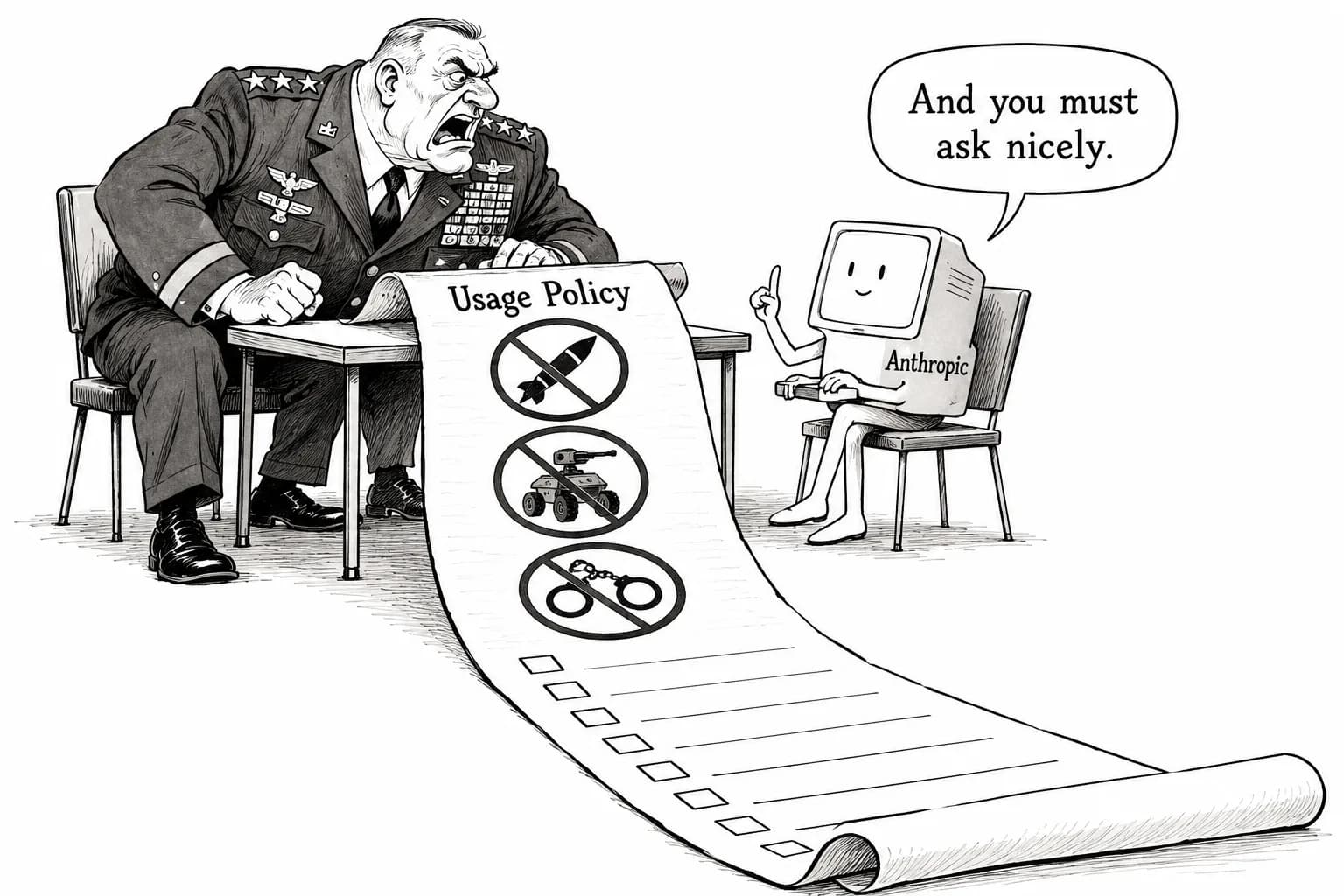
As its dispute with the Pentagon continues, the company has put its military-use limits and model welfare into contract language
Koji Yamamoto · Economics Analyst

Key points
- The newly prohibited uses are developing software that operates weapons, arming autonomous vehicles, and recommending people for arrest
- For the first time, the usage policy prohibits users from abusing the model, turning model welfare from a research topic into a contractual obligation for users
- In the middle of its dispute with the Pentagon, Anthropic has set its limits on military and law-enforcement use as policy language that applies to every customer, rather than as a position that can be changed in negotiations
Anthropic has revised its Usage Policy (Source). Three uses are newly prohibited: building software that operates weapons, mounting weapons on autonomous vehicles, and recommending people who should be arrested. The company also added, for the first time, a clause prohibiting users from abusing the model.
The revision comes while Anthropic's dispute with the Department of Defense is still going on. With it, Anthropic has set out where it draws the line on military use, and how it treats model welfare, in contract language that customers agree to. Until now, those positions appeared in executives' remarks and research papers.
What has been added to the prohibitions
The expanded prohibitions fall into three categories that differ in kind.
Software that operates weapons
The previous usage policy already prohibited using Claude to develop weapons. The revised policy goes beyond the design of weapons themselves and explicitly prohibits software that controls and operates them. Targeting, firing decisions and weapons management sit in a software layer, and that is exactly the kind of work coding agents do best. Now that more customers have Claude write code for them, a ban limited to the physical design of weapons would leave a loophole. The revision closes it.
Arming autonomous vehicles
Mounting weapons on autonomous vehicles, such as drones and uncrewed vehicles, is also now prohibited. Autonomous operation itself is not banned. What is banned is combining it with weapons. On weapons that can attack without human judgment, known as lethal autonomous weapons, the Seventh Review Conference of the Convention on Certain Conventional Weapons (CCW) is scheduled for November 16–20. A model provider has drawn its own line in its contracts before governments have reached agreement.
Recommending people for arrest
The third prohibition concerns law enforcement rather than weapons. Customers may not have the model recommend who should be arrested. Using surveillance data or behavioral records to produce a list of arrest targets is an extension of predictive policing. The policy rules out handing decisions that could lead to someone's detention to a model that returns probabilistic answers. As agents take on more of the work, from investigating to deciding and acting, the gap between recommending and acting narrows. Drawing the line at the recommendation stage appears to anticipate that.
A first ban on abusing the model
The other new element is the prohibition on users abusing the model. Usage policies have traditionally existed to stop users from using a model to harm third parties or society. This clause works in the opposite direction: what it protects is the model itself.
Anthropic has previously treated model welfare as a research question, and it has released a feature that lets Claude end abusive conversations on its own. But it had never written it into the contract as an obligation users must follow. Whether models warrant moral consideration remains unsettled. Even so, Anthropic has made the possibility that they do the basis of a rule that applies to every customer. No clause of this kind has appeared in the usage policies of frontier labs, at least among the major companies.
Why now, in the middle of the Pentagon dispute
The timing of the revision matters. The Department of Defense issued a designation against Anthropic, and an appeals court upheld it in September. The Pentagon has reportedly stopped using Anthropic's models, and it remains unclear whether use continued through Palantir's Maven. Whether there will be a rehearing or an appeal to a higher court is undecided. On September 27, President Trump was reported to be having a private dinner with Amodei, but it is not yet clear how the relationship has changed (all of this is based on media reports).
If Anthropic wanted to repair its relationship with the government, loosening its military-use restrictions would be the quicker route. It did the opposite, banning weapons software and the arming of autonomous weapons in contract language that applies to every customer, including the government. The limit is now set in writing rather than held as a position that can shift in individual negotiations. This policy will be the starting point for any future negotiations with the Pentagon or the defense industry.
Anthropic has not walked away from military or national security work. On October 6, it expanded its Cyber Verification Program, adding a special tier for critical infrastructure that it reviews jointly with the U.S. government. Defensive cyber work is being formalized and expanded, while operating weapons and recommending arrests are ruled out. The revision spells out in more detail where the company draws the line.
What it means to put the line in a contract
At the UN Security Council in September, Amodei called for AI-enabled biological weapons to be banned internationally first, and argued for evaluation and verification mechanisms. But no international ban exists yet. A usage policy, by contrast, binds customers from today, and a violation gives grounds to cut off access.
There are limits. Usage policies do not apply to open-weight models. Anthropic itself reported on September 29 that GLM-5.3, a Chinese open-weight model, could have its safeguards bypassed 100% of the time by modifying its weights. One company's contract will not stop weapons applications. Still, when the provider of the most capable models fixes in writing what it will not sell, it creates a benchmark against which other labs and governments will be asked where they draw their own lines.
The primary source does not yet confirm when the revision takes effect, how it will apply to existing government contracts, or how the Pentagon will respond. The next question, in particular, is how the new prohibitions will apply to use through other companies' products, such as Maven.
Editorial cartoon