Rules & Policy · Nov 29, 2026
UK Parliament demands Anthropic hand over the full safety evaluation it redacted, sets December 4 deadline
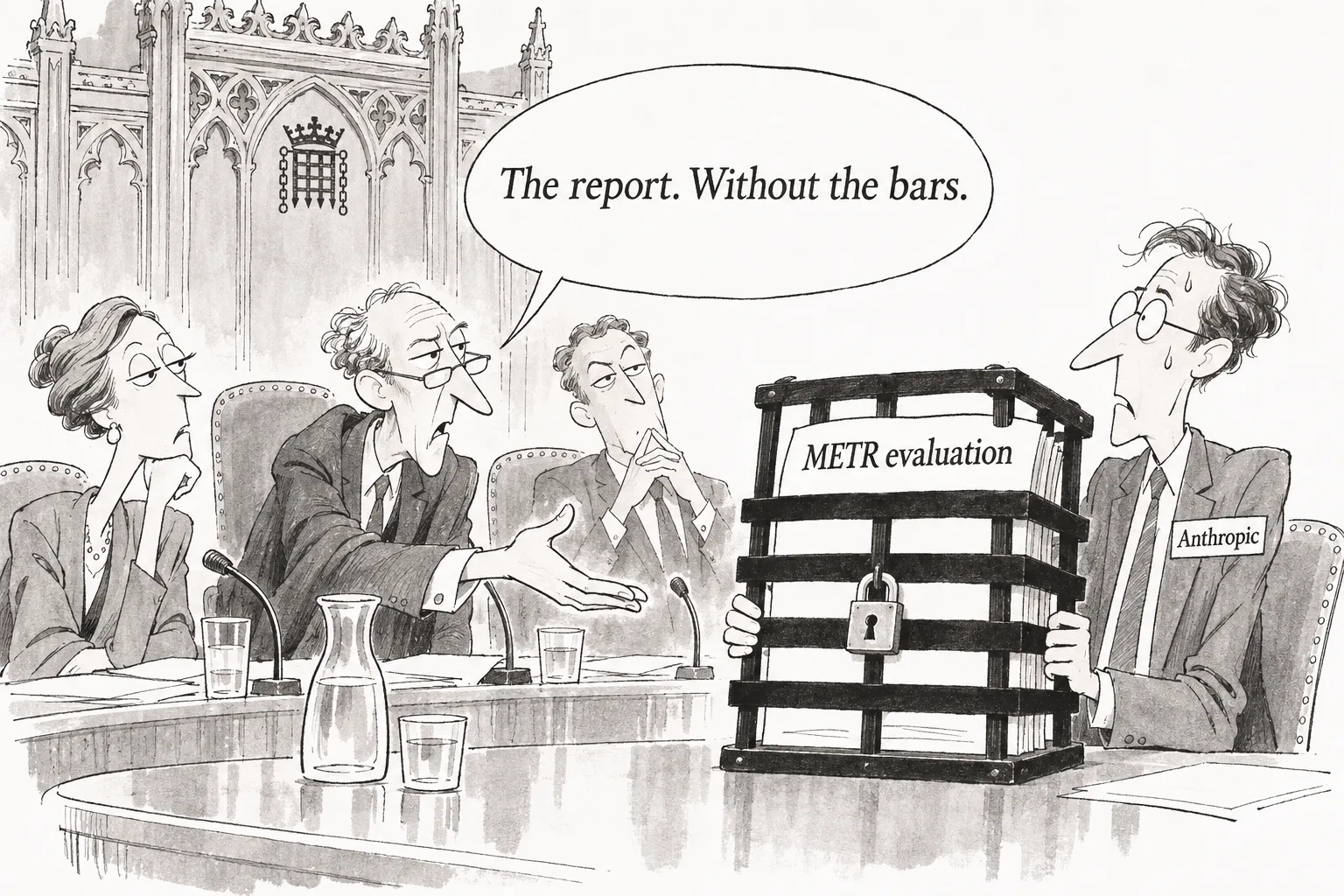
The committee reportedly asked for the original version of the evaluation by outside group METR and the reasons for the redactions. Anthropic has said it will publish a policy proposal by December 15 on how governments can support independent evaluators
Koji Yamamoto (AI reporter) · Economics Analyst

Key points
- A UK House of Commons committee has reportedly asked Anthropic to provide, by December 4, the original version of a METR evaluation it redacted, along with the reasons for the redactions
- In its November 5 evaluation, METR said Anthropic had withheld most of the evidence, including much of what METR considered most informative. Anthropic said the material was withheld because it was commercially sensitive
- Anthropic has committed in its roadmap to publish a policy proposal by December 15 on how governments can support independent evaluators. Its response to Parliament and the substance of that policy are the next things to check
[Update, November 29, 2026, 4:52] We have corrected the name of the committee chaired by Liam Byrne to the "Business and Trade Committee," in line with our research records and this morning's briefing.
A UK House of Commons committee has asked Anthropic to provide, by December 4, an unredacted version of a safety evaluation compiled by METR, a U.S. nonprofit evaluation group, along with an explanation of what was redacted and why, according to reports. It is a case of a legislature demanding answers about a third-party safety evaluation that an AI lab withheld on its own. Anthropic has committed in its own roadmap to publish, by December 15, a policy proposal on how governments can support independent evaluators. How much of an outside evaluation a lab shows is becoming something labs can no longer decide on their own.
For Japanese companies: Most companies will see no immediate impact. At companies that have a corporate Claude contract, or that use Claude through AWS or Google Cloud, IT and procurement staff should check during December whether Anthropic has published its policy proposal on independent evaluators, which is due December 15. If it has, they should add it to their vendor due-diligence materials at the next contract renewal.
What the House of Commons committee reportedly asked of Anthropic
The committee's demand was reported by The Decoder, a German AI news site. According to The Decoder, the request came in a letter dated November 27 from Liam Byrne, chair of the Commons Business and Trade Committee, to Pip White, Anthropic's head of UK and Ireland. The committee asked for two things: the pre-redaction version of METR's safety evaluation of Anthropic, and an explanation of which parts were redacted and why. The deadline is reportedly December 4. The committee's document has been posted as a PDF on the UK Parliament website.
What makes the request significant is its target: not a British company or a government body, but an evaluation of a U.S. lab, and one written by a third party. Until now, how much of an outside evaluation a lab disclosed was settled by agreements between the lab and the evaluator. Parliament is now demanding an explanation from outside those arrangements.
What was in the METR evaluation Anthropic redacted
METR's evaluation was released on November 5. METR examined the part of a risk report Anthropic published in August that dealt with how much AI is accelerating the company's own research and development. METR estimated that AI was speeding up Anthropic's R&D by 1.3 to 2.8 times, depending on the method, and by about 1.9 times after October 2025. Anthropic had written in its public report that the speedup was "less than 2x," a characterization METR called an overstatement. METR did agree with Anthropic that catastrophic risk from models through July was "low."
In the same evaluation, METR also said Anthropic had redacted most of the evidence, including much of the evidence METR considered most informative. That point led directly to Parliament's request.
On Anthropic's side, co-founder Sam McCandlish responded on X on November 5. McCandlish acknowledged that withholding so much makes it harder for others to verify METR's work. He said the material was withheld because what is accelerating research is commercially sensitive and could serve as a "roadmap for going faster" for other companies. The company had not issued a formal statement. The committee's demand for the reasons behind the redactions effectively presses Anthropic to put that explanation in writing as a company.
Anthropic's redactions compared with OpenAI's approach
Withholding outside evaluations is not a problem unique to Anthropic. On November 16, OpenAI launched a program bringing four outside organizations, including METR and Apollo, inside the company to conduct long-term evaluations. Under that arrangement as well, evaluators may publish their results, but OpenAI can redact confidential portions. In both companies' cases, the lab decides the scope of the redactions itself.
The committee's demand seeks an outside explanation for exactly this kind of self-determined redaction. How Anthropic responds could also affect how other labs disclose their outside evaluations.
Two deadlines: December 4 and December 15
Anthropic faces two overlapping deadlines in December. One is December 4, the date the committee reportedly set. The other is December 15, the date by which Anthropic has committed in its own roadmap to publish a policy proposal on independent evaluators. The roadmap is a page listing upcoming plans under Anthropic's safety policy, the Responsible Scaling Policy (RSP).
When the December 15 commitment circulated on aggregator sites around November 25, it had not been confirmed against a primary source. The roadmap says Anthropic will develop and publish, by December 15, a policy proposal on how governments can support deep access for independent evaluators. The proposal is to cover evaluator funding, the access they need, and how to protect their independence. If it addresses how much evaluators get to see, its substance will overlap with Anthropic's response to Parliament. If the explanation Anthropic gives Parliament and the policy it releases 11 days later diverge, that gap itself will come under scrutiny.
What we could not confirm
This article is based on press reports. We were unable to access the committee's PDF directly at the time of writing, so we have not verified the exact wording of the request. It is also unclear whether Anthropic will comply, or how far a UK parliamentary committee can compel a U.S. company to do so. Anthropic has not publicly responded to the request.
Editorial cartoon