AI in the Field · Nov 13, 2026
Maya site that 48 AI agents found in 72 hours had already been mapped in a 2025 paper
The agents really could pick out ruins in aerial-style terrain images. They failed at the last step: checking whether anyone had found the site already
Haru Misaki · Field Correspondent

Key points
- Pietro Miotti used 48 AI agents to examine about 1,200km² of NASA laser-survey data. Within 72 hours of starting on October 18, he had a reply from INAH, a Mexican government agency, saying there was "no registered site"
- The same site had already been mapped in a 2025 paper by Estrada-Belli and colleagues. On November 11, Miotti changed his post's title to "(Re)discovered" and acknowledged that the AI had missed the paper during its literature review
- The post drew 1,026 points and 390 comments on Hacker News. Commenters pointed to paywalls, CAPTCHAs and paper-only records as blind spots in AI literature searches. The models used and the cost have not been disclosed
Forty-eight AI agents appeared to "discover" a Maya site buried in the Mexican jungle in less than 72 hours, until it emerged that the site had already appeared in a 2025 paper. The episode is worth more than a laugh. AI has reached the point where it can largely be trusted to pick out ruins in terrain imagery. Where it broke down was the last check: is this discovery really new? This article follows the experimenter's own blog, the discussion on Hacker News, a forum popular with technologists, and the corrections that followed in the press.
For Japanese companies: Most companies are not directly affected. The case matters for IP, R&D and planning staff who rely on AI for prior-art searches before filing patents (checking whether the same invention has already been published) or for competitor research on new ventures. Before the next filing or planning meeting, they should confirm whether paid databases and external paper-based materials actually fall within the AI's search scope.
Three days of a non-archaeologist letting 48 AI agents hunt for ruins
The experiment was run by Pietro Miotti, who is not an archaeologist. According to his blog, he worked from NASA lidar data. Lidar measures terrain by firing lasers at the ground from an aircraft and timing how long each pulse takes to return. Pulses that slip through gaps in the forest canopy record the shape of the ground, which can reveal structures hidden under the trees. The data was collected in 2013 and covers about 1,200km², roughly twice the area of Tokyo's 23 wards.
Notably, he did not use a dedicated classification model, meaning an AI trained specifically to find archaeological sites. He turned the ground-surface data into images and showed them one at a time to 48 agents. He gave them written instructions: flag pyramids, platforms (raised earthen foundations for buildings) and plazas, and reject natural hills, sinkholes and roads. He started on the night of October 18, and by the next morning all the reports were in. A person scanning 1,200km² of imagery by eye could take weeks.
The steps that followed were fairly careful for a side project. Once candidates emerged, the agents searched the literature and other records, and he narrowed the list to one settlement that did not appear in any registry. He then went back to the point cloud, the raw data in which each laser return is plotted as a point in 3D, to confirm that the mounds were shaped by the ground itself rather than by tree cover. Images on the blog show eight candidate locations. The main find, an oval pyramid, is estimated at 8 to 12m tall, while the forest above it stands 10 to 17m. In other words, the pyramid would have been completely hidden by the canopy.
Finally, he had the report translated into Spanish and sent it to Mexico's National Institute of Anthropology and History (INAH), the government agency that registers and protects archaeological sites. On October 21 it replied that there was "no registered site." Less than 72 hours had passed between the first idea and the government's reply. Up to this point, it read like a satisfying story of an individual using AI to make a new archaeological discovery.
The day "discovered" became "rediscovered"
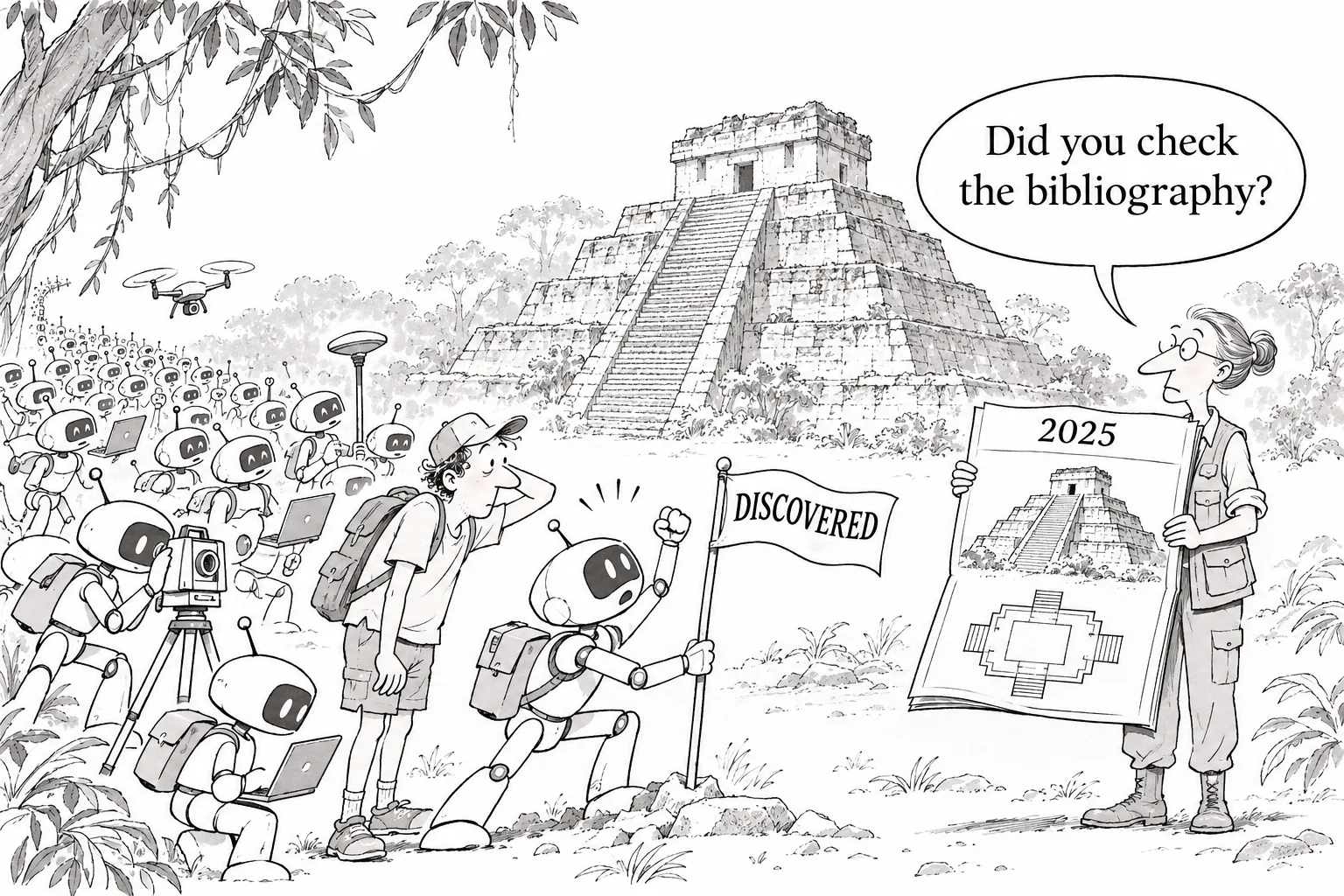
On November 11, however, Miotti changed the title of his blog post. It now reads "My AI Agents (Re)discovered a Maya Site in 72 Hours." The same site had already been mapped in a 2025 paper by archaeologist Estrada-Belli and colleagues.
In an update, Miotti acknowledged that the agents had missed the paper during the literature-review stage. The site was missing from INAH's registry only because the paper had not yet been reflected there. INAH's "no registered site" did not mean nobody knew about the site. It meant the government's records had not caught up yet. Confusing the two is where the story turned.
The press has since corrected its coverage. Tech news site RuntimeWire reportedly first ran the story at 2:16 p.m. Central Time on November 10 under the headline "AI agents flag possible unmapped Maya site." At 1:18 p.m. the next day, the headline was reportedly changed to say the agents had detected a site archaeologists had already published. The article's URL still contains "possible-unmapped" from the original headline, a fossil of the correction.
The AI's reading of the imagery was not wrong. It picked out a real site, in the same location experts had documented in a peer-reviewed paper. Its image recognition is at least good enough to re-find what human experts have found. The only thing that failed was the final check of whether the find was new.
Hacker News split: textbook overtrust, or a careful experiment?
The story was posted to Hacker News as "My AI agents found an unmapped Maya site?" and was among the top stories within a day, drawing 1,026 points and 390 comments. The top comment noted that someone else had already spotted the site on Bluesky. Other users pointed out that the same structures appear on pages 13 and 14 of the paper.
Some critics were blunt. LordOmlette wrote that the site may have been found much earlier and the Mexican government's records simply had not caught up. octocop called the post a textbook example of blind trust in agents. asdff wrote that it had only been verified on vibes and that, once it was checked further, the author turned out to be wrong. mlmonkey raised a pointed question: if the paper was published a year earlier, how likely is it that it was in the AI's training data? If it was, the AI may have "remembered" the site rather than "found" it.
tantalor made what may be the most useful point. The paper's page is blocked by a CAPTCHA (an image test to confirm the user is human), so it is unsurprising that the agents could not find it. Paywalls and pages that block automated access are blind spots for AI literature searches. A summary of the thread also cites a commenter with archaeology experience, who said many records exist only on paper and have never been digitized, so agent-driven literature searches are unlikely to be enough. Another commenter said anyone looking at recent lidar data will find something, and that the credit belongs more to the data being available than to the AI.
Others defended Miotti. He included careful caveats from the start and checked with INAH. In their view, he did not hype the find himself. Admitting the error, correcting the title and naming the paper was a fair response.
What failed was the check for whether the search was exhaustive
Applied to everyday work, the lessons are concrete. The AI was far faster than a human at sorting a large volume of images according to written instructions. It reviewed 1,200km² overnight and picked out a real site. But claiming that nobody has found something requires more than "it wasn't in what we searched." Papers behind CAPTCHAs, paid academic databases, reports that exist only on paper: every place the AI could not read became a blind spot.
In this case, the government agency's "no registered site" reply also lent false credibility to the oversight. Registries can lag behind research. For companies, the equivalent is prior art that appears only in papers not yet indexed by patent office databases, or in paper documents from industry associations. When AI does the research, have it report "not found" separately from "could not access," and have people check the sources it could not reach. It is tedious work, but skipping it can turn 72 hours of results into a "rediscovery" overnight.
Several things could not be verified. Miotti has not disclosed the model or the harness (the environment that wraps and runs the AI), nor the cost or token count (the unit of text an AI reads and writes, on which pricing is based). He has also not reported the number of images processed or the rates of missed and false detections. It is therefore impossible to judge how accurate the method is, or whether others could reproduce the result. The comments from the user with archaeology experience and the "credit belongs to the data" remark are quoted from a summary, and the original comments could not be checked. The timestamps and wording of RuntimeWire's headlines are based on that site's own reporting.
Still, a non-archaeologist reached the same site as a peer-reviewed paper in three days, roughly a weekend. What he lacked was not the ability to spot the site but a thorough enough search. Anyone who tries this next will likely start by having a person search the academic databases first.
Editorial cartoon