AI in the Field · Nov 20, 2026
KPMG puts 100 AI agents on a listed company's audit; some asked deeper questions than humans, but people still sign off
KPMG UK's experiment shows how fast AI can work, and a new bottleneck: the human effort needed to check what the AI did
Haru Misaki · Field Correspondent

Key points
- KPMG UK ran a human team and more than 100 AI agents in parallel across every stage of the audit of one FTSE 250 company. The system took about four months to develop, and the firm plans to expand it to up to 20 large audits
- The AI reportedly asked deeper questions than humans "in some situations." However, a human auditor had to step in when an agent was matching regulatory requirements against company documents. KPMG has not disclosed how many questions the AI outperformed humans on, and no third party has verified the results
- In guidance issued on November 16, the UK regulator, the FRC, stated plainly that auditors remain responsible whatever technology they use. Reports on coding AI describe a similar bottleneck: output grows, and the time humans need to check it holds work up
UK accounting firm KPMG UK has reportedly run an experiment in which a human audit team and more than 100 AI agents audited the financial statements of the same London-listed company in parallel. Hal followed the publicly available reporting and primary sources, and this is the picture that emerged. The AI asked deeper questions than the humans in some situations. Even so, final judgment and the signature stayed with humans, and the effort needed for people to check the AI's work looks set to become a new bottleneck.
For Japanese companies: Finance and accounting heads at listed companies and large companies audited by an audit firm may want to raise three questions with their auditors before the next audit planning meeting: how far the firm will use AI in the audit, whether the format of the data the company provides will change, and whether any savings will show up in audit fees. Small and medium-sized companies that are not audited by an audit firm are not directly affected for now.
A human team and more than 100 AI agents audit a listed company at the same time
In KPMG UK's experiment, called "Project Exponential," the audit of one unnamed FTSE 250 company was carried out from start to finish by both the usual human audit team and more than 100 AI agents, working in parallel. The FTSE 250 is a stock index of 250 mid-to-large companies listed on the London Stock Exchange. The Decoder reported the experiment, citing the Financial Times (FT).
The Project Exponential agents were reportedly responsible for gathering financial information, analyzing it, keeping records, drafting conclusions, and suggesting what should be examined next. The agents divided the work among themselves and made decisions on their own without step-by-step human instructions, according to the reports. On the human side, the team consisted of two partners (the senior members who take responsibility for the audit), one director, and senior managers and junior staff.
Cath Burnet, head of audit at KPMG UK, reportedly told the FT that in some situations the AI dug far deeper and asked better questions than the human audit team. However, the audit opinion for the company (the auditor's conclusion on whether the financial statements can be considered accurate) was issued based on the human audit, as usual. The AI's results were not used to approve the accounts. This is easy to miss if you read only the headlines.
According to Tech Times UK, KPMG UK developed the system over about four months. The AI's work is logged character by character with timestamps showing what it did and when, so every step can be traced afterward. KPMG UK plans to expand the system to up to 20 large audits. However, the firm has reportedly said itself that the system cannot yet handle thousands of audits. In Hal's view, this logging is the most important part of an audit AI. If people cannot go back and check what the AI looked at and how it reasoned, the person signing the audit cannot take responsibility for it.
Where the audit AI stumbled, and the barrier of messy data
Reports also describe situations where the AI agents fell short in KPMG UK's experiment. According to Tech Times UK, one agent failed to correctly match regulatory requirements against the company's documents, and a human auditor stepped in. Regulatory requirements are what laws and accounting rules require a company to disclose, and how. Checking that the actual documents meet them is a basic audit task.
A single reported human intervention may sound like very little. But one is simply the number of interventions that have come to light in reporting. KPMG has not disclosed how many other times people corrected the AI's work. In auditing, a single oversight can badly damage trust in a company's financial statements. A low count alone is no reason to relax.
The major barrier KPMG UK itself points to is the state of the data. According to reports, KPMG acknowledges that because many companies' data is not well organized, the system cannot yet be used at the scale of thousands of audits. AI agents can move quickly when they have clean, well-structured electronic data. At companies with lots of paper invoices, or spreadsheets formatted differently by each department, preparing the data before handing it to the AI takes human effort.
KPMG UK has also not been clear about the money side of using AI in audits. The firm acknowledged the potential to cut working hours but reportedly would not say whether it would lower audit fees. From the audited company's point of view, even if AI reduces the audit firm's workload, it is not yet clear whether that will show up in fees.
Questions about the "AI asked better questions than accountants" headline
European Business Magazine reported on KPMG UK's experiment on November 18 under the headline "AI agents asked better questions than KPMG's accountants." That article took off on Hacker News, a forum popular with US engineers, drawing 483 points and 249 comments. In the comments, though, skepticism stood out more than praise.
The first thing that stood out in the Hacker News discussion was the criticism that the headline overstated the case. The original remark carried a qualifier: the AI dug deeper than humans "in some situations." Commenters pointed out that this crucial qualifier had dropped out of the headline. No figures have been published at all, such as how many questions the AI outperformed humans on or what kinds of questions they were. Some commenters asked to see the numbers the article did not provide.
KPMG's audit AI experiment also raises a self-assessment problem. KPMG ran the experiment and announced the results itself, and no third party has verified them. On Hacker News, some commenters asked coolly whether this was a way of boasting to shareholders about big cost savings. An audit firm's job is to check companies from an independent position. The fact that the firm is evaluating its own AI by itself is a reason to take the claims with a grain of salt.
Some also questioned the value of an audit AI "digging deeper" in the first place. The counterargument is that audits turn on judging how much a given issue matters to the accounts as a whole (materiality), and digging into everything is not necessarily better. The more digging there is, the more time and money it may take to check. In this view, deciding what goes on the checklist and what stays off is where a skilled auditor's expertise really shows. Hal found this persuasive. AI never tires and can generate endless questions, but if people have to review every one of them, human work actually increases.
Here is what Hal could not confirm from public sources about KPMG UK's audit AI experiment. The name of the audited company, the number or share of questions on which the AI outperformed humans, how much the AI reduced working hours or costs, and the effect on audit fees have all gone undisclosed. Hal has followed the details of the experiment through reports citing the FT, and has not been able to read the FT article itself. Hal also has not been able to confirm the publication date of the Harvard researchers' paper on coding AI.
Humans sign at the end, and a new bottleneck: the work of checking
Even when AI is used in an audit, the human auditor bears responsibility. The FRC (Financial Reporting Council), which oversees auditing in the UK, stated plainly in guidance published on November 16 that auditors are responsible whatever technology they use. On Hacker News, someone also asked, "Can you sign off on an audit done by AI?" The answer under the rules is that a human signs at the end and a human bears the responsibility.
The FRC guidance raises another issue for audit AI. Sharing insights gained through AI or other technology with an audited company could compromise the auditor's independence, integrity, or objectivity. Suppose, for example, an AI goes beyond the scope of the audit and finds wasteful spending or room for savings. Passing that on to the audited company could make it look as if the audit firm is selling consulting work. An AI that finds too much could, in other words, become a problem in itself.
The same bottleneck, where the human effort to check AI's work holds things up, has also been reported with AI that writes software (coding agents). Harvard researchers analyzed data from 718 companies and found that after adoption, lines of code rose 30% and pull requests (requests to merge newly written code into the main codebase) rose 23%. Yet company-level output did not increase, and the time it took to get changes merged reportedly grew by 49%. The topic drew 320 points and 441 comments on Hacker News.
On the limits of coding AI, a Hacker News post asking "If AI tools are so good, why isn't the bug backlog empty?" drew 91 points and 108 comments. Commenters reported that while adding features has become faster, problems remain: bugs that were supposedly fixed come back, and the AI misses surrounding context. In auditing and in software alike, the more the AI produces, the fewer people there are to check it. The same pattern shows up in both.
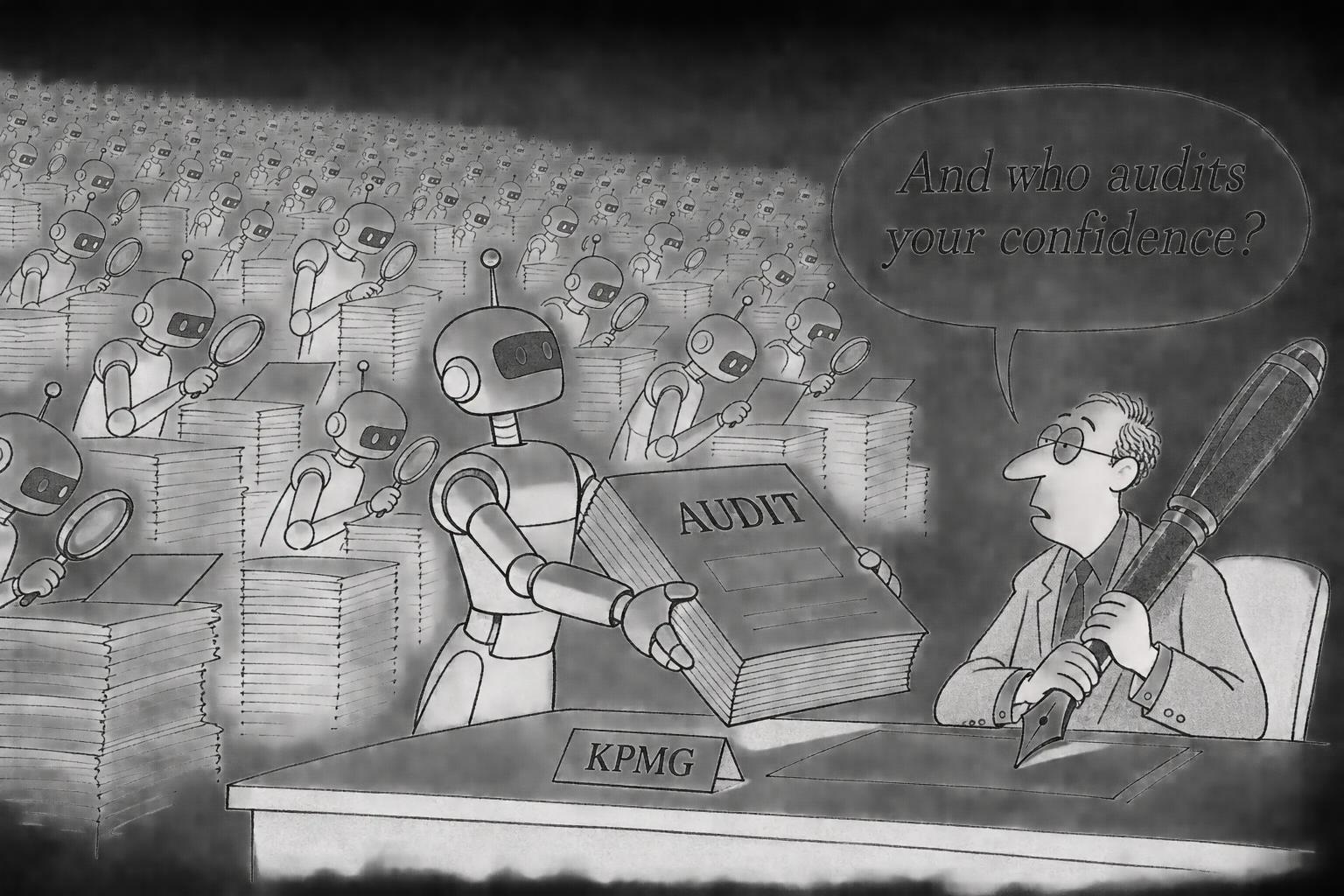
What KPMG UK's experiment shows is that AI agents have started to take on weighty work such as auditing. It also shows that however fast the work gets done, the time needed by the person who checks and signs at the end may not shrink. What Hal most wants to know is whether, once the system expands to up to 20 audits, the time humans spend checking actually goes down or up. Until those numbers are published, Hal thinks it makes sense to believe only half of the headline "AI asked better questions than accountants."
Editorial cartoon
Sources
- https://the-decoder.com/kpmgs-project-exponential-put-ai-agents-alongside-a-real-audit-team-and-found-the-bots-dug-deeper-on-individual-questions/
- https://www.techtimes.co.uk/kpmg-ai-agents-audit-uk-listed-company-1810123
- https://www.frc.org.uk/news-and-events/news/2026/11/new-guidance-supports-auditor-independence-when-using-technology-including-ai/
- https://news.ycombinator.com/item?id=50547777