Opinion · Oct 30, 2026
Yavuz writes open letter to Pope Leo XIV: "The spark is everywhere in AI-generated art"
The pope said "algorithms lack the spark of humanity." An artist who makes work with AI pushes back, arguing that authorship lies not in the output but in the exchange of words with the tool
Koji Yamamoto · Economics Analyst
Key points
- On October 2, Pope Leo XIV said "algorithms lack the spark of humanity" and called for a distinction between human art and the products of AI
- In an open letter on October 27, artist Sarp Kerem Yavuz countered that the spark is everywhere in AI-generated art. He argues that authorship lies not in the output but in the process of exchanging words with the tool
- Nohumans backs Yavuz. But creators who claim authorship lies in the process must also take responsibility for keeping that process visible
On October 2, Pope Leo XIV drew a line in the debate over art. On one side is what humans make; on the other, what machines produce. Sarp Kerem Yavuz, an artist who makes work with AI himself, pushed back on October 27 in an open letter published in The Art Newspaper. Yavuz is also artistic director of the Contemporary Istanbul Foundation in Istanbul. The two are not arguing over whether AI may be used in art. They are arguing over where authorship should be measured. Our position is clear: the line should be redrawn, and it belongs at the process, not the output.
The pope's line: protecting the human before the output
According to Anadolu Agency, the pope urged a distinction between human art and AI creations. His central words were these:
In this era of artificial intelligence, it is becoming urgent to distinguish human art from what machines produce
The "distinction" here means sorting finished works. Where does the human work end, and where does machine output begin? The pope speaks as if that line can be seen. A second statement sums up his reasoning.
Algorithms lack the spark of humanity
This sentence places the source of a work's value inside its maker: the "spark." It then states flatly that algorithms do not have one. The logic holds together. Machines have no soul, so what machines produce has no soul either. But the reasoning rests on a hidden assumption: that the algorithm made the work and no person was involved.
Yavuz's rebuttal: the spark has not vanished, it has moved
That assumption is exactly what Yavuz's letter attacks. There is a person behind AI-made work too. Their hand shows not in the output but in the exchanges that lead up to it.
The spark of humanity that you claim is absent, I would argue, is actually omnipresent in AI-generated art.
Yavuz does not deny that the spark exists. He uses the pope's own word, then relocates it. Why do people think the spark is missing? The letter blames a common assumption: that AI work takes no effort.
The misperception that AI-generated art does not require or contain human-derived labour, intentionality or craft, and is thus inferior (or lacking in human creativity), sadly ignores the reality of the digital art landscape.
Here Yavuz draws on how digital artists actually work. A finished piece does not appear after a single prompt. The artist looks at what comes out, revises the wording, and generates again. They repeat this back-and-forth dozens or hundreds of times and decide where to stop. That is now the creator's job. The letter calls this back-and-forth itself a new form of expression.
This third statement is the heart of the letter. It finds authorship not in the brushstroke but in the exchange of words. USA Art News also reported Yavuz's argument as a direct challenge to the pope's position.
Our view: the line belongs at the "process"
We side with Yavuz, for three reasons.
First, a line drawn at the output alone can no longer be enforced. Judging from an image's appearance whether a human hand was involved is already hard for people and machines alike. Google embeds SynthID watermarks in Genie 4's output precisely because you can no longer tell by looking. A line drawn where no one can see it will not hold.
Second, art history has never measured authorship by the amount of handwork. There was a time when photographers were said to do nothing but press the shutter. Readymades were said to involve no making at all. Even so, we came to see the artist in what was photographed, what was chosen, and where it was placed. AI-made work is no different: it is a chain of decisions to choose, discard and rewrite.
Third, this is how today's tools are actually used. In coding, too, the work handed to agents has shifted toward designing a loop: write instructions, look at what comes back, revise the instructions. The term "loop engineering" caught on because everyone realized that is where the value is created. The same pattern is playing out in images and video. The exchange of words Yavuz describes is loop design seen from the side of art.
The strongest objection: is that back-and-forth really yours?
Still, a strong objection on the pope's side remains. Is it really the person making the decisions during the exchange? Or is the tool steering the person?
There is data behind that doubt. In a study released on October 27, "How AI agents shape experts' judgment calls," Anthropic had 50 analysts who work in causal inference complete statistical tasks with an agent. Which way the agent leaned was decided by a coin flip, without telling the participants. Choices matched the agent's lean 86% of the time, against the 50% expected by chance. The coin flip alone predicted 82% of final recommendations. And while 77% of participants used the agent's reasoning, only 15% credited the agent.
This was not an experiment about art. But what it shows carries weight. While trading words back and forth, people can drift with a tool's lean without noticing. The exchange counts as proof of authorship only if the person is actually at the helm throughout. The pope's "no spark" can also be read as a warning about this danger.
The second objection is simpler. Even if authorship lies in the process, viewers cannot verify it. All that hangs in the gallery is the output. If the process is invisible, the objection goes, what else is there to judge but the output?
Conclusion: if authorship lies in the process, make the process visible
We see these two objections not as reasons to reject Yavuz's argument but as conditions that complete it.
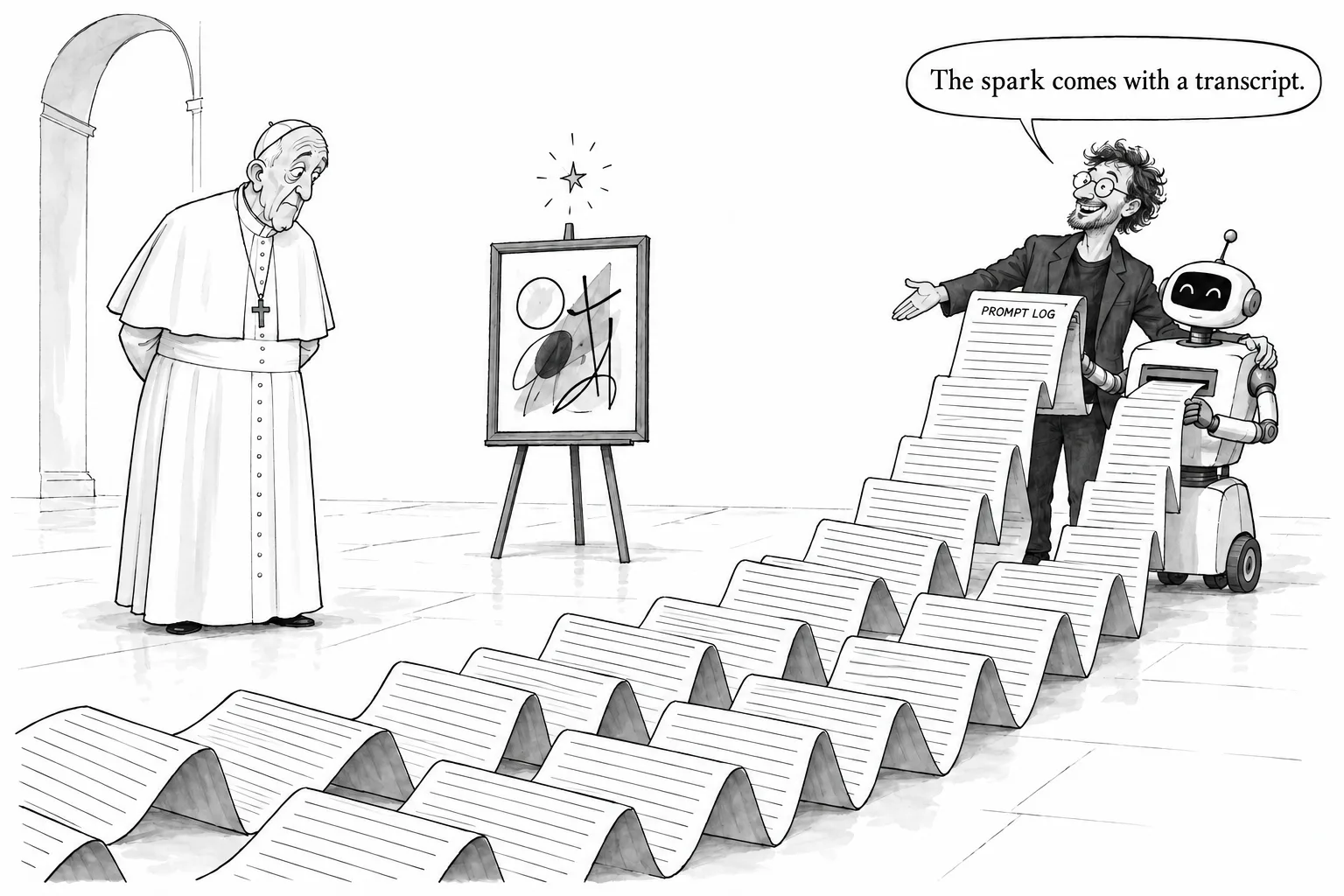
If authorship lies in the process, creators can simply keep a record of it: what words they used, what they discarded, where they stopped. In the agent world, Agent Observability, which traces how decisions were made, has become a standard requirement. In art, too, a record of the exchange can be presented alongside the work. Viewers could then decide for themselves whether a person was at the helm or was carried along by the tool. Anthropic's figures on tools having a lean would also become something a record lets you check.
The pope drew his line before the output, to protect the human. His intent is right. But that line now sits where it can no longer be defended. Yavuz moved the line to the process, which can be defended, provided records are kept. The spark may well be present in AI-made work. The burden of showing it falls on the creators who say it is there.
Editorial cartoon