Products & Models · Nov 25, 2026
Anthropic and OpenAI say their AI models proved the "VP≠VNP" complexity problem, publishing hours apart
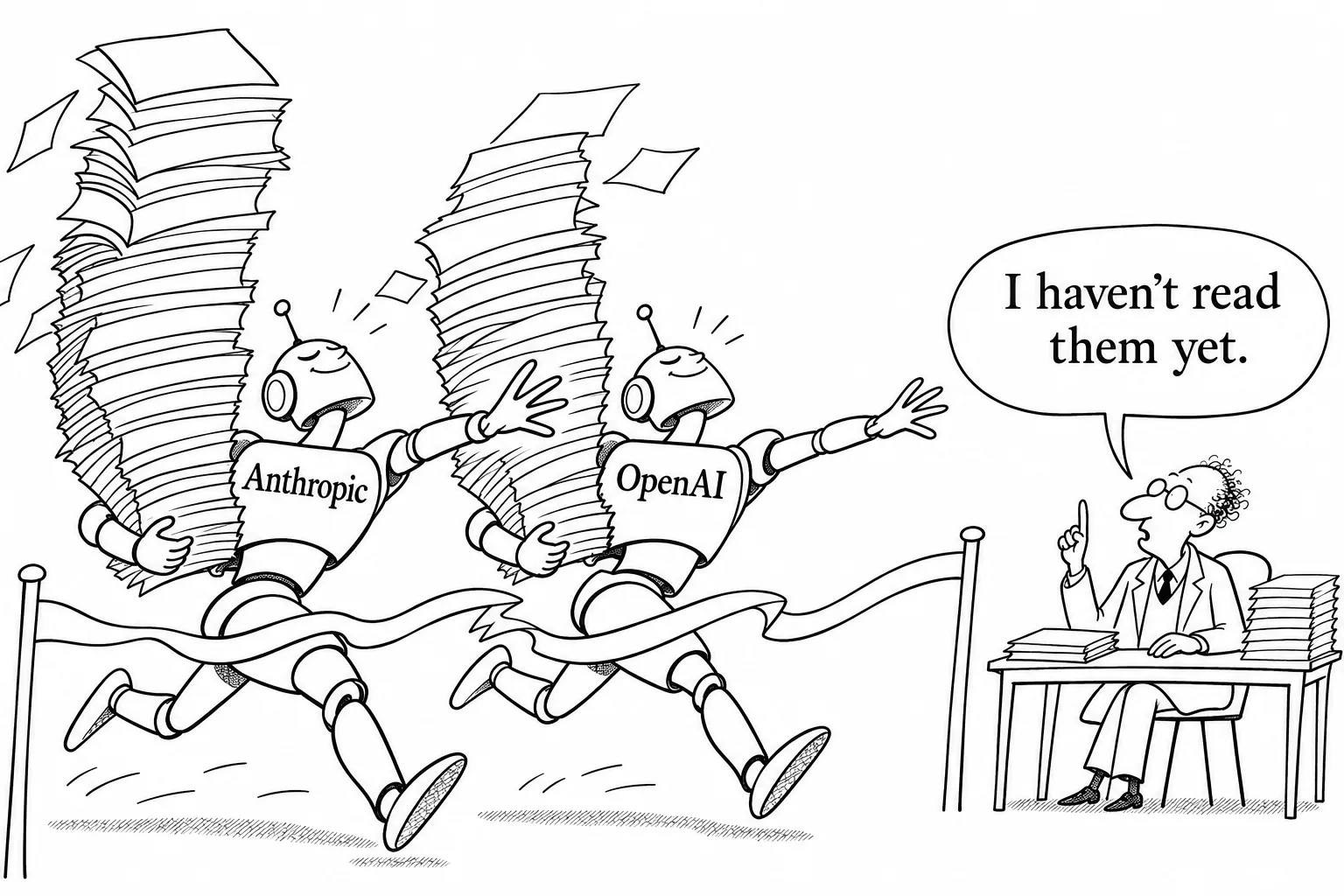
Anthropic and OpenAI released proofs produced by their in-house AI models on November 23–24 (UTC), each with a paper and a formal proof in Lean. No human mathematician has checked them yet, and which company found its proof first has become a point of dispute.
Rie Suzuki · Technology Editor

Key points
- Anthropic and OpenAI released proofs of the complexity problem VP≠VNP hours apart on November 23–24 (UTC). Both said in-house AI models produced the results, and both came with a paper and a formal proof in Lean
- Anthropic claims VP≠VNP holds "over every field." It wrote that no human mathematician has checked the proof. It also acknowledged that Lean verifies only the proof, and that no machine has checked whether the formal statement says what the paper claims
- The result does not resolve P≠NP and has no direct effect on cryptography or everyday business operations. After October's ETH refutations, the two companies have again released results on the same hard problem at nearly the same moment and are disputing who got there first
[Update, November 25, 2026, 5:16] OpenAI's release was a commit made at 01:14 UTC on November 24, so we changed the release date from "November 23" to "November 23–24 (UTC)."
Anthropic and OpenAI released proofs of "VP≠VNP" on November 23–24 (UTC). The problem has gone unsolved in computational complexity theory for more than 40 years, and both companies said their in-house AI models found the proofs. The two releases came only hours apart. Each company included a paper and a proof written in Lean, a proof-assistant language, in a form a machine can check (a formal proof). However, no human mathematician has yet checked either one, and the companies now appear to be competing over who found the result first. Claims that AI has solved hard math problems have become common over the past month. The question now is who will check them.
What it means for companies in Japan: Most companies are not affected. This result does not solve P≠NP, and cryptography and software security are unchanged. Contracts for ChatGPT, Claude, Copilot and similar services are also unaffected. The groups that should pay attention are R&D units in manufacturing, pharmaceuticals and finance that use AI to run calculations, write proofs or check designs. Before using AI-generated results internally, leaders of those units should set up a process, by the end of the year, for a person to confirm what was actually verified, even when a result is described as "machine-verified." That means checking whether only the answer was verified, or the way the question was stated as well.
What VP≠VNP is: an algebraic version of P≠NP
VP≠VNP is a question posed by computer scientist Leslie Valiant in 1979. It is the algebraic counterpart of the famous P≠NP problem. VP is the class of polynomials that can be computed with a small number of additions and multiplications. The determinant, for example, is in VP because it can be computed quickly even as the matrix grows. VNP contains the "permanent," a polynomial that looks very much like the determinant except that every sign is turned into a plus. The permanent is tied to counting combinations, and no fast way to compute it is known. VP≠VNP is the claim that polynomials like the permanent cannot be computed in a small number of steps, however clever the method.
VP≠VNP is considered easier to attack than P≠NP, and researchers have worked on it for decades. If it holds, it would be a major example of computational hardness actually being proved. Still, Anthropic itself writes in its description of the paper that the result "does not settle P vs NP."
Anthropic's claim: true "over every field"
Anthropic placed a paper titled "VP ≠ VNP over every field" in a GitHub repository holding its Lean proofs. The paper and the Lean proof were added together in a single commit on November 23 (primary source). The author is listed as "Claude (Anthropic)," and the company says the result was "found by an internal research version of a Claude model." It does not give the model's name or version.
According to Anthropic's paper, the Hamiltonian cycle polynomial (a polynomial that counts paths in a graph that visit every vertex exactly once and return to the start) cannot be computed over any field (a number system with addition and multiplication) without more than m^(c (log m)^(1/3)) arithmetic gates, where m is its size. The paper says the same lower bound holds for the permanent over every field except those of characteristic 2 (number systems in which 1+1=0). This bound grows faster than any polynomial. Characteristic 2 is excluded because there the permanent equals the determinant and can be computed quickly.
Anthropic's paper says the same lower bound also holds for approximate computation. From this it concludes that VP is strictly contained in VNP, and also that VNP is not contained in the "closure" of VP (the class that also includes everything VP polynomials can approximate arbitrarily closely). If the claim is correct, it would also answer the question posed by the line of research that has sought VP≠VNP through geometric methods.
What the Lean proof guarantees, and what it does not
Anthropic's Lean proof is set up so that the file stating the theorem imports only the Mathlib mathematics library. The company says the proof relies only on the three standard axioms (propext, Classical.choice and Quot.sound). To check it, Anthropic uses the Lean kernel, compares the statements with a tool called Comparator, and re-checks the proof with nanoda, an independent checker written by someone else.
In the same description, Anthropic was clear about the limits. "Lean checks the proof, but no machine checks that this file says what it claims to say," it wrote. An appendix to the paper has a table matching the paper's theorems to the Lean statements, including "where they differ." Anthropic also states plainly that both the paper and the proof were written by an AI model and that "no human mathematician has checked the proof." It describes the repository as "a research artifact, not maintained, and not accepting contributions."
A formal proof in Lean is a machine guarantee that the proof's reasoning contains no errors. Whether the problem is stated in the same way as the VP≠VNP that mathematicians mean is something only a person can judge by reading it. Experts said the same about a proof of the Riemann hypothesis released the same week, which Anthropic mathematician Levent Alpöge produced with Claude: it passed Lean's check, but it will still take time for people to understand what it shows.
OpenAI on the same day: who found it first?
OpenAI placed a manuscript titled "VP and VNP are different," dated November 23, in openai/math, its GitHub repository for mathematical results. The repository also has a history file (history.md) that records the order in which results were produced, and this result is listed there. OpenAI has also not disclosed which model produced its results so far.
This is not the first time Anthropic and OpenAI have released results on the same hard problem at nearly the same time. On October 26–27, the two companies released results hours apart claiming to refute ETH, another complexity hypothesis (the hypothesis that problems such as 3-SAT unavoidably take close to brute-force time). Both companies wrote then that their in-house models had found the result on October 16. A month later, human experts have still not finished verifying it. With VP≠VNP, the release times are again only hours apart, which is why who found it first is being disputed.
Outsiders have few ways to confirm the order of discovery. Each company simply records and publishes its own account of "when" its in-house model found the result. In mathematics, priority has traditionally been decided by the date a paper was made public and by human verification. In the race between AI companies, internal timestamps are being put forward before either of those.
What to watch next
The next step for the VP≠VNP proofs is whether experts in complexity theory can read the two papers and confirm the reasoning. In particular, someone needs to check whether the Lean statements really match what the papers claim. Anthropic's own table of differences between its paper and its Lean code is a starting point. It is also not yet known whether the two companies' proofs use the same idea or different approaches.
What we could not confirm: For this article, we were unable to read the text of OpenAI's manuscript or the contents of history.md. As a result, we have not confirmed the exact scope of OpenAI's claim (which fields it covers and its lower-bound formula), the Lean version and checking method it used, or how OpenAI describes the timing of its discovery. We have also not independently confirmed the exact release times of the two companies or which came first. On Anthropic's side, we do not know the Lean version, the number of files, the model version used or the amount of compute required.
Editorial cartoon