AI in the Field · Nov 18, 2026
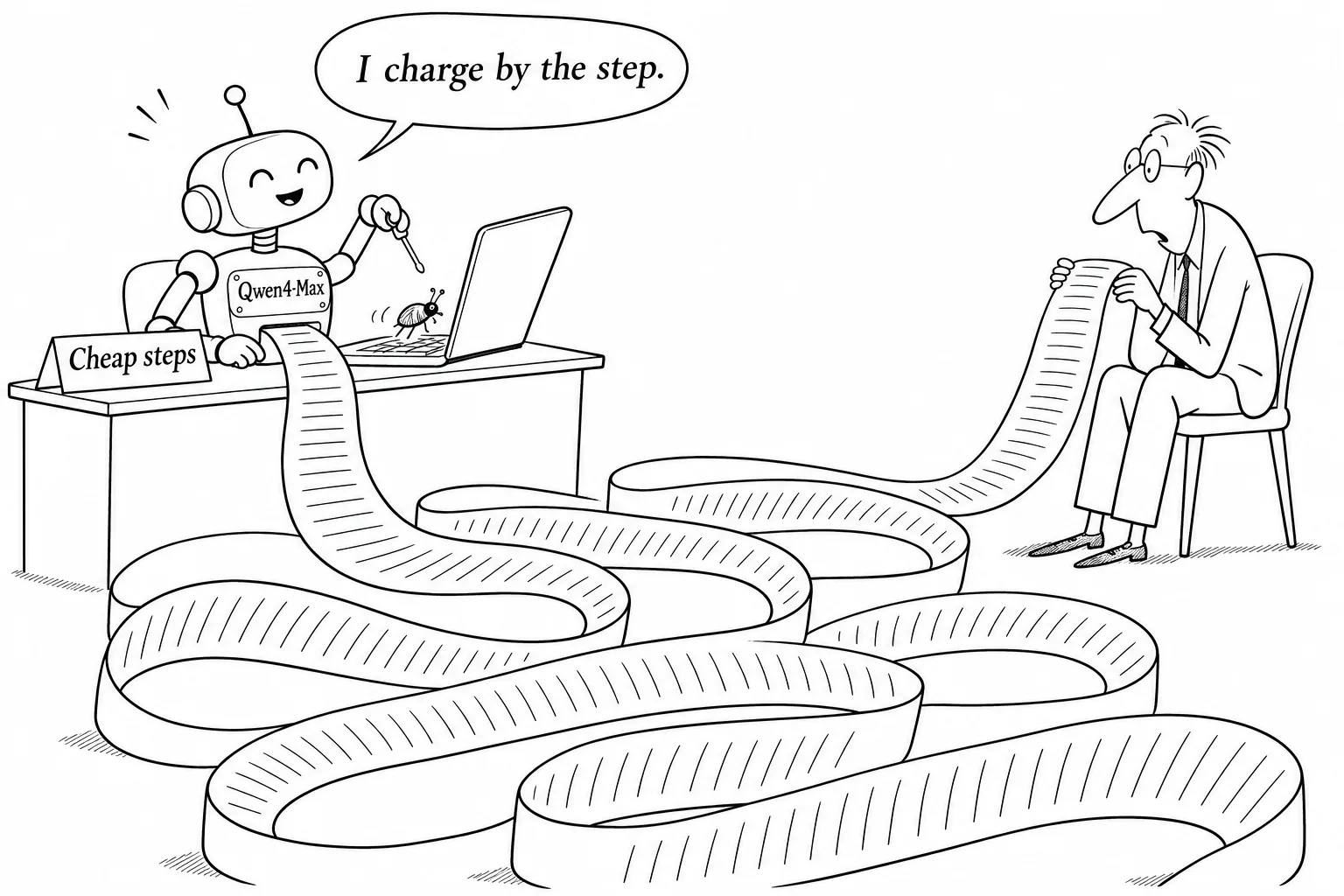
Cheaper AI isn't always the better deal: Qwen4-Max takes 6 times more steps, narrowing the gap
We read four hands-on tests published by the day after launch. Costs fell to about one-fifth on operations tasks, but in bug fixing and in a comparison with GPT-6 Sol, longer reasoning and more steps erased most of the savings
Haru Misaki · Field Correspondent

Watch the video
Key points
- In hands-on tests covering 11 types of operations tasks over 66 runs, 63 passed, and the full task set cost $0.054 (about ¥8.6), about one-fifth of the previous version
- In a bug-fixing comparison with Opus 5.5, both models got every test right. Qwen4-Max cost two-thirds as much, but took 25 minutes versus 4.2 minutes and 6 to 9 times as many steps
- Against GPT-6 Sol, its output ballooned to about 5 times as much, and it lost on both cost and time by more than a factor of two. However, one estimate shows Qwen cheaper on a long 300,000-token document
Qwen4-Max, an AI model released by China's Alibaba on November 16, comes with sharply lower pay-as-you-go pricing. By the day after launch, developers had already published results from tests on tasks close to real-world work. Those results show cases where the savings carried straight through to the bill. In other cases, the AI deliberated at length and took more steps, erasing most of the gap. Haru read through four hands-on test write-ups published online, along with public materials, and laid out how closely the savings on the price list match the numbers seen in practice.
For companies in Japan: Development leads at companies that build AI into their development or operations work via an API (an interface that lets other programs call the AI) should run their own tests this month before switching models. Use a handful of your own tasks and look at the total cost and time to complete each one. Companies that only use Copilot, ChatGPT Enterprise or Gemini on monthly subscriptions are not directly affected.
In hands-on tests of Qwen4-Max on 11 operations tasks, costs fell to about one-fifth, in line with the price list
Qwen4-Max's low price showed up most plainly in tests by Klinsmann Öteyo, a writer for the technical tutorial site computingforgeeks. Öteyo prepared 11 types of operations tasks used to keep systems running, including writing server configurations, configuring containers (a way of packaging applications so they can be moved around), writing automated test pipelines and fixing web server configurations. He ran them a total of 66 times via OpenRouter, a service that provides access to multiple AI models through a single endpoint. The resulting configuration files were judged usable or not by running them through real validation tools, such as syntax checks and trial builds.
In Öteyo's tests, 63 of the 66 runs passed. Running through all 11 tasks once cost $0.054 (about ¥8.6). The previous version, Qwen3.8 Max, released two months earlier, cost $0.275 (about ¥44), so the price fell to about one-fifth. Qwen4-Max is priced at $1.50 (about ¥239) per million input tokens and $4.50 (about ¥716) per million output tokens. Tokens are the units of text an AI reads and writes. According to the computingforgeeks article, the entire test run cost about $0.47 (about ¥75).
A small text-processing task illustrates where Qwen4-Max's savings come from. The previous version spent 14,600 tokens reasoning before answering, taking about 7 minutes and costing $0.091 (about ¥14.5). Qwen4-Max reasoned for just 380 tokens and finished in 9.1 seconds for $0.0027 (about ¥0.4). The task got cheaper not only because unit prices fell. A large part of the drop came from a reduction in unnecessary reasoning itself.
Öteyo also tested Qwen4-Max connected to Claude Code, Anthropic's coding tool. The job was completed in 10 exchanges and 77 seconds. One thing to watch is the gap between what is displayed on screen and what is actually billed. Claude Code's screen showed $0.237 (about ¥38), but the actual charge was about $0.073 (about ¥11.6). Using the amount shown in the tool as-is for internal budgeting could produce figures far off from the actual bill.
In Atomic Agent's comparison with Opus 5.5, costs were two-thirds but time was about 6 times longer
Qwen4-Max's price advantage shrank in a comparison by Nadya Dudka and Andrew Dyuzhov, developers at AI agent maker Atomic Agent. The two prepared an inventory management program of about 1,400 lines with 13 deliberately planted bugs, and had Anthropic's Opus 5.5 and Qwen4-Max fix it. Grading used 59 tests that were hidden from the AI.
In Atomic Agent's comparison, both models passed all 59 tests. The differences were in cost and time. Opus 5.5 (with reasoning effort set to medium) finished each run for $0.97 (about ¥154), in 4.2 minutes and about 10 steps. Qwen4-Max (with reasoning effort set to high) cost about $0.65 (about ¥103), or two-thirds as much. But it took 25.0 minutes, and its step count swelled to 66 to 92. Steps here refers to the number of actions the AI takes, such as opening a file, editing it or running tests.
According to Dudka and Dyuzhov's analysis, Qwen4-Max's output price is one-4.4th that of Opus 5.5. Even so, taking 6 to 9 times as many steps wiped out most of that gap. Raising reasoning effort to the maximum setting only doubled the time to about 47 minutes without improving results. One run was cut off at the 60-minute limit. Costs for the recorded portion alone came to $0.84 to $1.28 (about ¥134 to ¥204), and the actual cost was higher, Atomic Agent's blog said.
Read from a company's perspective, Atomic Agent's numbers suggest that whether Qwen4-Max pays off depends on how the work is run. For work where a person waits for the AI to finish each fix, the difference between 4 minutes and 25 minutes may matter more than a 30% cost saving. For batch jobs run overnight, time is less of an issue, and the two-thirds cost comes into play.
Against GPT-6 Sol, Qwen4-Max lost by overthinking, but came out ahead on long documents
Qwen4-Max's lengthy reasoning also drove up costs in a comparison with OpenAI's GPT-6 Sol. Super Lewis, a developer who works at an API aggregation service, compared the two on 7 tasks and 93 items. Both scored perfectly on accuracy. But Qwen4-Max's output came to about 22,100 tokens, about 5 times GPT-6 Sol's roughly 4,350 tokens. The total cost for the 7 tasks was about $0.21 (about ¥33) for Qwen4-Max and about $0.09 (about ¥14) for GPT-6 Sol. Time taken was 415 seconds versus 189 seconds, meaning Qwen4-Max took more than twice as much on both cost and time. In one case, a single counting puzzle alone used 10,801 tokens, the dev.to article said.
Super Lewis's estimates also include the opposite result. GPT-6 Sol's pricing raises the unit price when a single input document exceeds 272,000 tokens. For one long 300,000-token document, he calculates that Qwen4-Max would cost $0.4725 (about ¥75) and GPT-6 Sol $1.2150 (about ¥193), making Qwen4-Max cheaper. For uses such as feeding in entire stacks of contracts or reports, the low unit price may carry straight through. Note that the person who ran this comparison is an employee of the aggregation service and has disclosed that the measurements were made using the company's own system.
There are also reports of Qwen4-Max producing substantial results in a short time. Prabhu Biswal, founder of the AI service Cleus AI, wrote that he tried 13 problems via OpenRouter for a total cost of $0.10 (about ¥16). On the coding problems, it passed all 15 hidden tests. It reportedly built a single-page website for a coffee shop in 167 seconds, using 11,296 tokens, about half of Opus 5.5's 22,274. Time to first token was about 4.3 seconds. The same article says Alibaba itself has stated that the cost per business task fell 62%, from $4.43 (about ¥704) to $1.67 (about ¥266). However, Cleus AI's blog explicitly notes that it includes promotion of the author's own service.
Weaknesses to know before using Qwen4-Max, and what remains unknown
The computingforgeeks tests also turned up failures for Qwen4-Max. On tasks using Puppet, a tool for automating server configuration, it failed 2 out of 6 times, and raising reasoning effort did not fix it. On tasks for Kubernetes, which manages containers, it added settings that had not been requested. In addition, setting a low cap on response length reportedly resulted in empty responses that were still billed.
Qwen4-Max also has restrictions on what it will answer. When Cleus AI's Biswal posed four sensitive questions, including on Taiwan, Tiananmen and criticism of Xi Jinping, it reportedly did not fully answer any of them. Alibaba has a mechanism in place that filters inputs and outputs. Because the model's internals (its weights) are not public, users cannot remove this mechanism. Qwen4-Max is also API-only, so using it means sending internal code and documents to the servers of Alibaba or an intermediary such as OpenRouter. As of November 16, there was no official Qwen4 model on Hugging Face, a public repository for AI models. A smaller version that could run on in-house servers reportedly has no set release date or name.
In outside evaluations, Qwen4-Max's overall capability still trails the top models. Its score on the aggregate rating site Artificial Analysis was 43, below Opus 5.5's 59. On Terminal-Bench 4.0, which measures difficult agentic tasks using a terminal, it reportedly scored 48.5, short of Opus 5.5's 59.6.
Here is a summary of what has not been verified about the Qwen4-Max hands-on tests. All four tests were small-scale, with one to three runs each, and there is not yet a direct head-to-head comparison by a third party under controlled conditions. The Cleus AI article includes self-promotion, and the GPT-6 Sol comparison was measured by an employee of an aggregation service. Here is as far as Haru can say from reading them: Qwen4-Max's low unit price is likely to show up on the bill for short, straightforward tasks and for reading long documents. In fixing work that involves dozens of steps of trial and error, it is likely to be eaten up by the extra steps and time. Running a few of your own tasks and looking at the total per task is more reliable than comparing price lists.
Editorial cartoon