Work & Society · Oct 21, 2026
OpenAI lawyer reportedly tells US judicial panel there will be no scientific way to detect AI images, shifting debate to who bears the burden of proof, though only 15 of 931 judges have seen evidence challenged as fake
A company that builds image generators has reportedly given up on detection. The question for courts is shifting from telling real from fake to deciding who must show that evidence is authentic
Koji Yamamoto · Economics Analyst

Key points
- OpenAI's Shira Anderson reportedly told a US federal judiciary committee on rules of evidence on October 15 that no scientific method for detecting AI images will emerge. Meta reportedly took a similar position
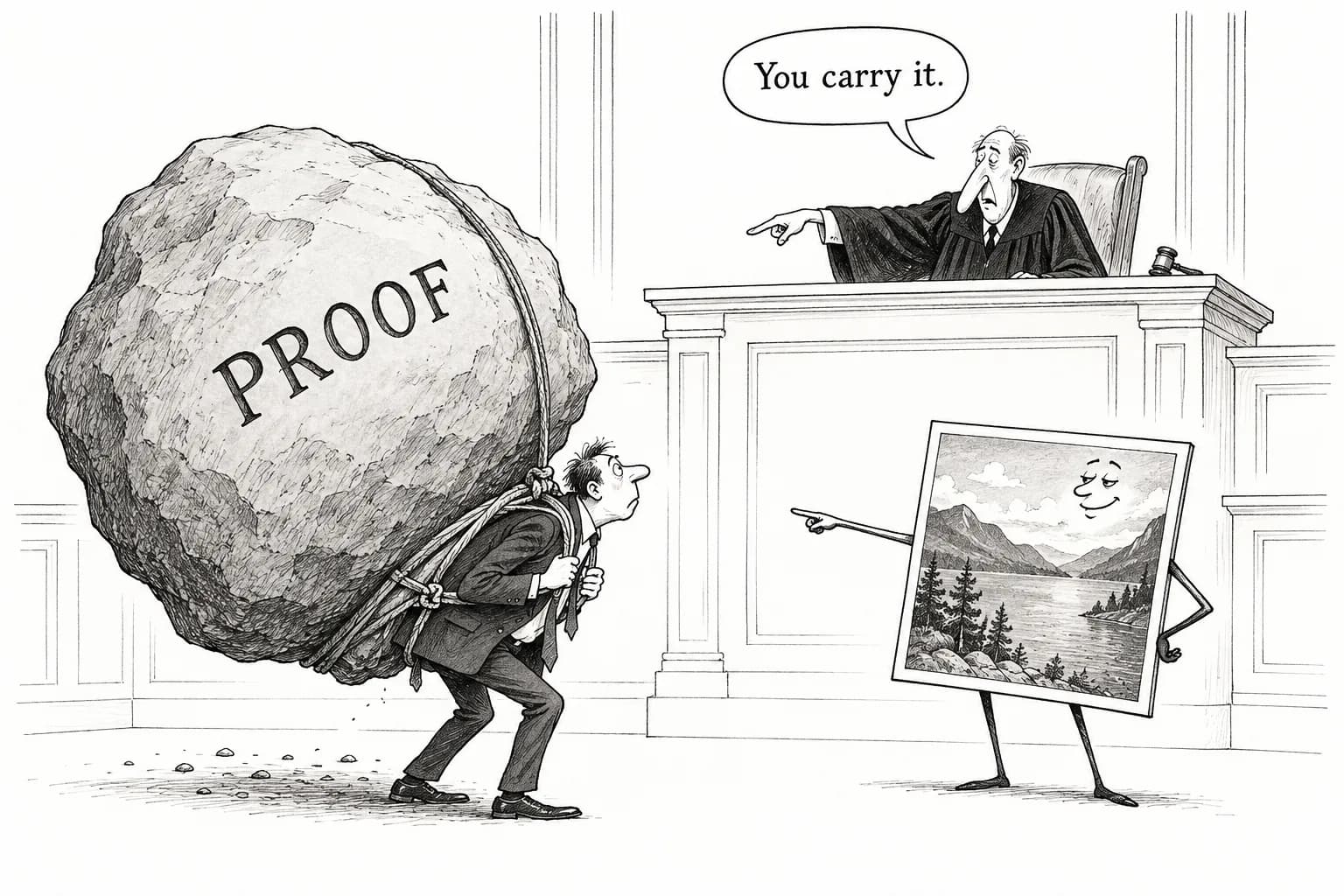
- With detection no longer something courts can count on, the rules debate has moved from working out "is it real?" to deciding "who must show it is real" when evidence is suspected of being fake
- A survey of judges, however, reportedly found that only 15 of 931 had dealt with evidence challenged as fake. With no consensus, the proposed rule on AI evidence was reportedly deferred
At a meeting of the committee that writes the rules of evidence for US federal courts, a company that builds generative AI acknowledged that it will become impossible to catch fake images with technology, according to reports. Several outlets reported that Shira Anderson, a policy counsel at OpenAI, made the remark at the committee's October 15 meeting.
AI images are only getting better, and I do not think that there will be a scientific way going forward to detect them.
In effect, a lawyer for a company that releases image-generation models told the judiciary, in an official forum, not to count on detection technology. Meta, which also took part in the meeting, reportedly took a similar position that detection has its limits. Anderson also reportedly said this about detection systems:
I do not think it'll ever be bulletproof
Taken together, the two remarks do not say that detection technology is not good enough yet. They say it will never be decisive. If courts accept that, their job changes. Instead of using technology to rule on whether evidence is authentic, they have to decide who bears the burden of proving that suspect evidence is genuine. Reports suggest this meeting was where that change came clearly into view.
Why would the makers say it can't be detected?
There are two broad ways to identify AI-generated images. One is to look for statistical anomalies in the image itself. The other relies on the maker embedding a watermark or provenance information in the output. The first approach gets weaker as generative models improve, because there are fewer telltale signs to find. Anderson's remark that "AI images are only getting better" refers to this arms race, which detectors cannot win.
Watermarking has a different weakness: it only works if the maker cooperates. Google applies SynthID to audio and video avatars, and Meta applies Video Seal to real-time avatars. But images made with models that don't add watermarks, especially open-weight models running on local machines, have nothing to detect in the first place. OpenAI's own figures for text watermarking show the same weakness. OpenAI has said that textGrain, which it introduced in the EU, catches about 92% of unedited text, but that this drops to about 17% when 25% of the words are replaced with synonyms. Text watermarks work differently from image watermarks, but both can be removed by editing.
Meanwhile, three unannounced model IDs named "aurora" appeared in OpenAI's API in mid-October. Testers comparing them reported that all three produced images, and some see them as a sign that a new image model is coming (OpenAI has not confirmed this). So while the company keeps improving its image quality, its own lawyer has acknowledged the limits of detection.
From "is it real?" to "who has to show it?"
Under the US Federal Rules of Evidence, the authenticity requirement is met when the party offering the evidence shows that the item is what the party claims it is. The bar is low. For a photograph, it is often enough for a witness who was there to testify that the photo accurately shows what they saw. Whether the item is fake has traditionally been left to the jury, as a question of how much weight to give it.
Deepfakes open holes in this system from two directions. First, a convincing fake can simply clear the low bar. Second, in the reverse case, a party can cast doubt on genuine evidence by insisting it is an AI fake. This second problem is known as the "liar's dividend."
According to reports, the committee has spent several years debating a proposed rule that would change how evidence challenged as fake is handled. Its core is about allocating the burden: if the opposing party shows some basis for believing the evidence may be fake, the party offering it would have to prove its authenticity to a higher standard. If detection technology could settle the question, there would be little need to spell out that allocation in such detail, because a forensic examination would be enough. With the makers acknowledging that fakes will remain undetectable, the debate now centers on how to design the procedure: at what stage, and on how much suspicion, the burden of proof should fall on which side.
15 of 931 judges: what's missing is cases, not technology
Still, figures were also presented that support a more cautious view of how urgent the problem is in court, according to reports. In a survey of judges submitted to the committee, only 15 of the 931 who responded had actually dealt with a claim that evidence was an AI-generated fake. That is less than 2%.
Bloomberg Law reported that the proposed rule on AI evidence was deferred for lack of consensus. The reports point to this picture. On the technology side, it is now more or less taken for granted that fakes cannot be told apart. In the courts, though, few cases have yet been derailed by them. Changing the rules now could make procedures for all evidence more burdensome to address a problem that hasn't happened yet. Waiting could mean acting too late once cases pile up. This time, the committee chose to wait.
It would be premature, however, to read 15 out of 931 as a sign that the problem is small. For evidence to be challenged as fake, someone first has to notice or suspect that it is fake. If the makers themselves say it will become scientifically impossible to tell, the small number of challenges may mean that fakes are getting through unnoticed rather than that there are few of them. The survey figures cannot settle this.
Where does the burden of proof go?
When detection can't be relied on, the way to show that evidence is genuine moves to provenance outside the image itself: who took it, when, on what device, how it was stored, and whose hands it passed through. Provenance data signed by the capturing device, storage records and the photographer's testimony carry more weight than the image's pixels. That favors whoever can keep provenance in order. Companies and law enforcement can assemble records easily, while a bystander who happened to capture an incident on a phone may find it harder to prove that a genuine photo is real. Deciding how to allocate the burden is a question of procedure, but also a question of fairness: who pays the cost of proof.
The other issue is the responsibility of the companies that generate the content. The remarks can also be read as a statement that the makers will not take on responsibility for detection. How much watermarking to apply, and how to attach provenance information to outputs, is currently left to each company. In the EU, Article 50 of the AI Act actually forced changes to text watermarking, but the US federal rules of evidence are not a tool for imposing obligations on the companies that generate content. Whatever courts decide about the burden of proof, it will not change how those who make fakes behave.
What we have not been able to confirm
This article is based on media reports. We have not reviewed the committee's minutes or a record of the meeting itself. We have not been able to confirm Meta's exact remarks, the text and number of the proposed rule, the details of who conducted the survey of judges and when, or when the committee will take up the issue again. Anderson's remarks are also as quoted in media reports.
Even so, the direction is clear. A company that builds generative AI has reportedly told the judiciary not to count on detection technology. What courts must now decide is not whether an image was made by AI. It is who must show that evidence is genuine once it has been called into question, and how far they must go. Writing that rule has reportedly been put off for now.
Editorial cartoon