Products & Models · Nov 26, 2026
OpenAI says AI cracked a series of hard math problems; only 4 in 10 results machine-checked
Nine papers, including the matrix multiplication exponent 9/4 and Smale's 9th problem. The work came from an unnamed internal model, and no named experts have reviewed it yet
Rie Suzuki · Technology Editor

Key points
- OpenAI released nine papers claiming to solve problems that had stood open for decades, including showing that the matrix multiplication exponent ω is exactly 9/4 and that linear programming can be solved in strongly polynomial time (Smale's 9th problem)
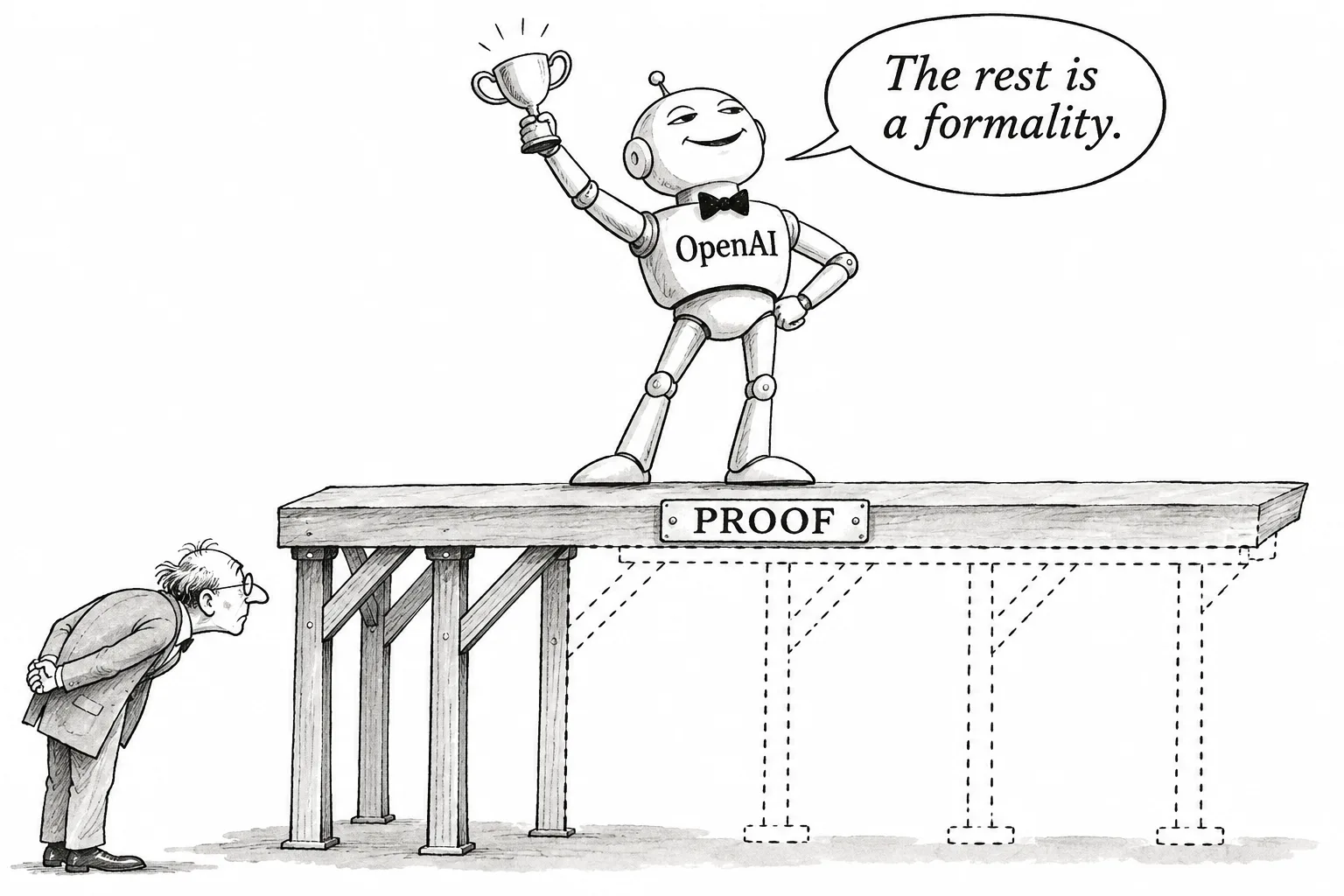
- Only about 42% of the main results have been checked in Lean, a language for machine-checking proofs. Neither humans nor machines have checked the rest yet
- The problems were solved by an unnamed internal model, and there is no record of named outside experts checking the work. The papers have been checked less thoroughly than the VP≠VNP and Riemann hypothesis proofs released the same week
OpenAI has posted nine papers, dated November 24, to its own repository on GitHub, claiming to solve mathematical problems that had stood open for decades. The claims include showing that ω (omega), the number that sets the limit on how fast matrices can be multiplied, is exactly 9/4, and that linear programming can be solved in strongly polynomial time (the "9th problem" posed by the mathematician Steve Smale). According to the company, the problems were solved by an unnamed internal model. However, only about 42% of the main results have been checked in Lean, a language in which a machine checks a proof step by step. No named experts have reviewed the papers yet.
For Japanese companies: Most companies will see no immediate impact. Logistics and manufacturing companies that use mathematical optimization software for delivery or production planning have no need to rush to replace it, because the papers' results will not quickly make those tools faster. R&D teams that use AI-generated proofs or analyses in their decisions should first check, item by item, which parts have passed machine or human checks.
The problems OpenAI claims to have solved: matrix multiplication and linear programming
The matrix multiplication exponent ω describes how quickly the work of multiplying two large tables of numbers grows as the tables get bigger. Matrix multiplication sits at the core of the computations behind AI. With the naive method the work grows with the cube of the size, and it is known that ω cannot be smaller than 2. As of the mid-2020s, the best upper bound shown by human researchers was about 2.37. Many researchers have suspected that ω goes all the way down to 2.
OpenAI's matrix multiplication paper claims that ω is exactly 9/4 (2.25). Pinning down the exact value means showing both that multiplication can be done as fast as 2.25 and that it cannot be done any faster. If the result holds, it would also overturn the long-held view that ω goes down to 2.
Linear programming finds the allocation that maximizes profit or minimizes cost given limited materials, labor and money, and it is used every day in logistics, production planning and finance. Today's methods are fast enough in practice. In theory, though, their running time depends not only on the size of the problem but also on how many digits the numbers in it have. Whether linear programming can be solved in a time that depends only on the number of variables and constraints, regardless of the digits (strongly polynomial time), was the 9th problem on the list of problems Smale put forward in 1998 for the 21st century, and it had remained unsolved. OpenAI's linear programming paper claims to solve it.
OpenAI's nine papers also include results on other hard problems. The news site Snape Report reported that they include a paper disproving the "polynomial Hirsch conjecture," which concerns how long a path along the edges of a polyhedron from one vertex to another can be (secondary source). The conjecture bears on the speed of the simplex method, the classic algorithm for linear programming.
About 42% of OpenAI's main results passed Lean
Lean is a system in which a machine checks whether each step of a proof is correct, sparing people the burden of reading proofs hundreds of pages long. About 42% of the main results in OpenAI's nine papers have been checked in Lean. The remaining 58% or so have passed neither a machine check nor a check by a named human.
The new papers have been checked less thoroughly than other AI math claims released the same week. Anthropic's proof of VP≠VNP by Claude, released on November 23, came with a 70-page paper and a Lean formalization. OpenAI itself attached a Lean proof to the VP≠VNP proof it released a few hours later. The proof of the Riemann hypothesis that Anthropic mathematician Levent Alpöge produced with Claude is being checked by MIT's Andrew Sutherland, who is testing whether it passes multiple independent checkers.
Passing Lean is not the end of the story. The machine guarantees only that the statement as written has been proved. Whether that statement actually says what the paper claims needs to be checked separately by people. For its VP≠VNP proof as well, Anthropic itself has cautioned that whether the statement matches the claim was not machine-checked.
No named experts have reviewed OpenAI's nine papers yet
There is no record of named outside experts checking OpenAI's new papers. In October, when OpenAI and Anthropic claimed to have disproved the ETH (Exponential Time Hypothesis), long treated as a basic assumption about computational hardness, a group of complexity researchers including Russell Impagliazzo, Ramamohan Paturi and Ryan Williams were named as taking on the verification. No such arrangement is visible yet for the nine new papers.
The model OpenAI used for the papers is an unnamed internal model. In a November 22 essay, OpenAI chief scientist Jakub Pachocki wrote that unnamed internal models had begun producing results on open math problems. Results from models that have not been released are piling up in a form that is hard for outsiders to check. On November 24, Axios reported that some employees at Anthropic and OpenAI fear whether unreleased internal models can be released safely (secondary source).
What we could not confirm about OpenAI's math papers
We have not confirmed the titles of all nine papers. Nor have we confirmed how the figure of about 42% was counted (what was counted as a main result, or the breakdown by paper). This article also does not cover when the results were obtained, how much computing they took, or how outside researchers have responded. The information on the polynomial Hirsch conjecture paper comes from a secondary source.
What to watch next in OpenAI's claims
There are three things to watch next for OpenAI's nine papers: whether named experts read the papers and give their judgment; whether the remaining 58% or so of the main results are filled in with Lean; and whether other researchers can verify for themselves the result that ω is 9/4. Matrix multiplication and linear programming have both been attacked by many researchers for decades, so if the results are correct, they would rank among AI's biggest achievements in mathematics, and if there are errors, they should be found quickly.
Editorial cartoon
Sources
- https://github.com/openai/math/blob/main/history.md
- https://github.com/openai/math/commits/main
- https://github.com/openai/math/blob/main/preprints/The-matrix-multiplication-exponent-is-nine-fourths-November-24-2026/paper.pdf
- https://github.com/openai/math/tree/main/preprints/Strongly-polynomial-linear-programming-November-24-2026
- https://github.com/openai/math/blob/main/preprints/The-matrix-multiplication-exponent-is-nine-fourths-November-24-2026/README.md
- https://dev.to/axrisi/openais-claim-that-the-matrix-multiplication-exponent-is-exactly-94-and-what-has-been-checked-398j
- https://snapereport.com/s/openai-preprints-claim-strongly-polynomial-lp-and-polynomial-hirsch-disproof
- https://scottaaronson.blog/?p=10379