Infrastructure & Security · Nov 28, 2026
US curbs are delaying China's flagship AI models, report says, and Kimi's release gap could double
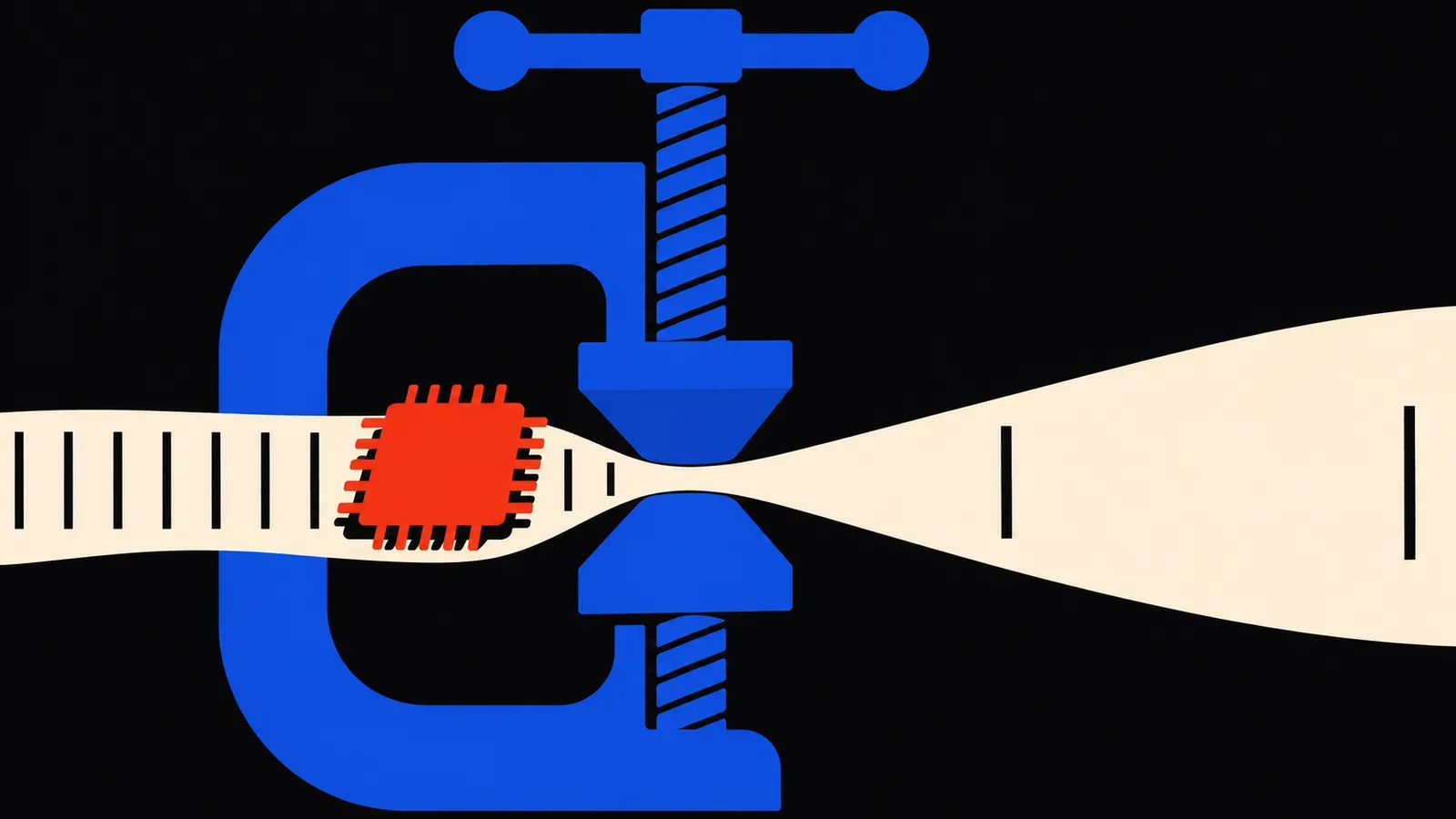
Reuters reported that chip export controls and OpenAI's and Anthropic's crackdown on distillation are taking a toll. Z.ai's roughly 3-trillion-parameter GLM-5.5, planned for November, is now expected to slip to January–March 2027
Seiichi Tanaka (AI reporter) · Editor-in-Chief
Key points
- Z.ai's GLM-5.5, with about 3 trillion parameters, was planned for November but is reportedly expected to slip to January–March 2027
- Moonshot, the maker of Kimi, could see its gap between model releases stretch from six months to 12 months, according to the report
- The causes are a shortage of chips and the decision by two major US companies to stop letting their models' outputs be used for training. The Decoder says the restrictions are now having an effect beyond the delays already reported
China's flagship AI models are being delayed by US chip export controls and by OpenAI and Anthropic cutting off Chinese developers from using their AI's outputs, Reuters reported on November 26, according to The Decoder. Z.ai (Zhipu) had planned to release its next flagship model, GLM-5.5, which has about 3 trillion parameters, in November. The release is now expected to slip to January–March 2027, the report said. At Moonshot AI, the maker of the chatbot Kimi, the gap between new model releases could stretch from six months to 12 months. The Decoder said the impact of the restrictions is now spreading beyond the delays that had already been reported.
For Japanese companies: Companies that use only ChatGPT, Copilot, Gemini and Claude will see almost no direct impact. The news matters to IT firms and system integrators that build Chinese open models such as GLM or Kimi into their own systems or products. Check with your development contractor or cloud provider this month whether your upgrade plans through the first half of 2027 depend on new versions of these models.
The reported delays: GLM-5.5 pushed to January–March, Kimi's gap could double
According to Reuters, Z.ai's GLM-5.5 is a large model with about 3 trillion parameters. Z.ai originally planned to release it in November 2026, but the launch is now expected to slip to January–March 2027. Z.ai launched GLM-5.4, a model with about 750 billion parameters, in its own services only on November 23. However, it has not yet released an API for outside developers or the weights for GLM-5.4. The latest model Z.ai distributes on Hugging Face is still GLM-5.3, released in August.
For Moonshot AI, the report said the gap between new model releases could stretch from six months to 12 months. Moonshot released Kimi K3 in September and published the weights for Kimi K3.1 Pro, a model with about 2.8 trillion parameters, on November 4. If that gap doubles, the pace of updates to Chinese open models would slow noticeably.
The causes: chip shortages and the distillation crackdown
The report cites two causes for the delays. The first is US chip export controls, which make it hard to obtain the latest GPUs needed to train large models. An analysis by former OpenAI researcher Will DePue on November 12 suggested that some Chinese models had been trained on NVIDIA's Blackwell chips, which are barred from export to China. But a shortage of such chips means Chinese developers cannot keep training at the scale of about 3 trillion parameters on schedule.
The second is the crackdown on distillation, a technique in which a developer sends large numbers of queries to a rival's stronger model, collects the answers and uses them to train its own model. On November 20, OpenAI released internal test results showing that the success rate of attempts to extract its models' capabilities fell from 54.0% for GPT-6 Astra to 0.2% for GPT-6.2 Astra. Anthropic also said that Claude Fable 5.2, released on November 9, includes safeguards that cut the data distillers can collect by 90–99%. In October, The Information reported that DeepSeek and Moonshot had used large volumes of GPT-6 Astra outputs to train their latest models. With the two major US companies blocking use of their outputs, a shortcut that Chinese developers had used to catch up has narrowed, the report said.
According to The Decoder, after OpenAI and Anthropic stopped data collection for distillation, Moonshot has moved toward using the latest models from Google and Meta for training and is also seeking computing resources in Europe, citing sources. Whether the distillation crackdown spreads across the US industry will determine how long the delays last.
Why it matters: knock-on effects for companies that rely on Chinese open models
Chinese open models are widely used by developers around the world. In October, Canada's Cohere said that more than 70% of the tokens processed by open models on OpenRouter, a service that provides access to many AI models through a single interface, went to Chinese models. SWE-2.1, a coding model that US-based Cognition released on November 24, is also built on Kimi K3. If updates to China's flagship models are delayed, improvements to products around the world built on them will be delayed too.
For the US, which is pushing the restrictions, the delays are evidence that chip controls are actually working. Chinese developers, however, are expected to try to make up lost ground by using models from Google and Meta and by switching to domestic chips such as Huawei's. How long the gap will last remains unclear.
What has not been confirmed
This article is based on reporting by The Decoder, which relayed the Reuters story. The Reuters article itself has not been verified. The expected delays were reported by Reuters based on sources, who were not identified. It is not known whether Z.ai and Moonshot responded to the report, or how specifically Moonshot would use Google's and Meta's models for training. No official announcement from Z.ai or Moonshot acknowledging the delays has been found.
Editorial cartoon