Infrastructure & Security · Nov 25, 2026
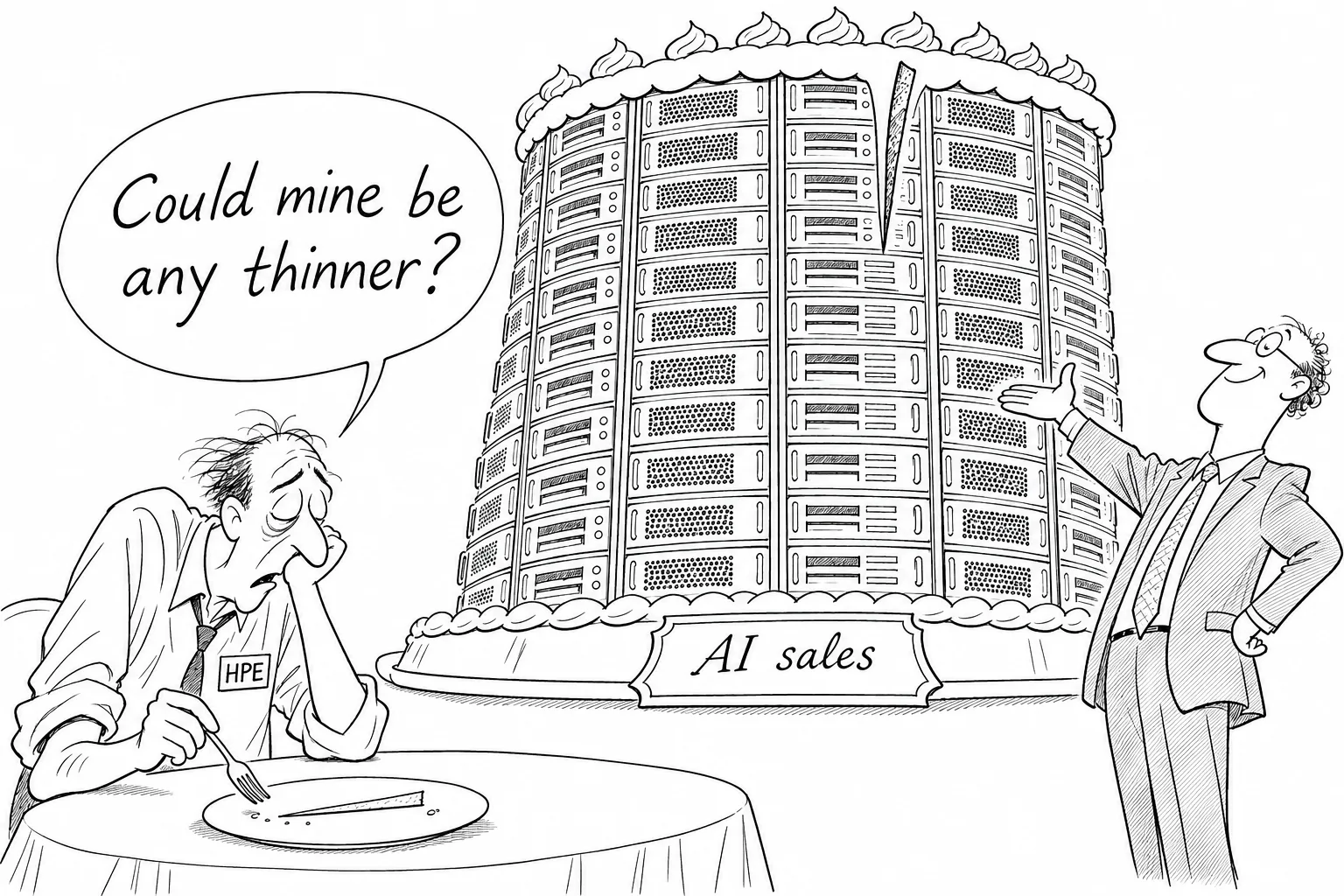
AI server sales nearly double, but margins shrink as HPE sees segment margin falling to 14%
Server revenue for August–October came to $8.8 billion, about twice the year-earlier level. Even so, the operating margin of the Cloud & AI segment is expected to fall from 18.4% to about 14% in fiscal 2027
Seiichi Tanaka · Editor-in-Chief

Key points
- HPE's server revenue rose 94.7% year over year to $8.8 billion (about 1.4 trillion yen) in the August–October quarter
- The operating margin of the Cloud & AI segment, which handles AI servers, is expected to fall from 18.4% to about 14% in fiscal 2027. For every 100 yen in sales, the profit retained drops from about 18 yen to about 14 yen
- Revenue growth from AI demand and profitability for the companies assembling the servers are two different things. Companies buying their own AI servers should read quotes on the assumption that there will be less room for discounts
Hewlett Packard Enterprise (HPE), a major U.S. maker of enterprise servers, reported results for the August–October quarter (the fourth quarter of fiscal 2026). Server revenue rose 94.7% from a year earlier to $8.8 billion (about 1.4 trillion yen at 159 yen to the dollar), nearly doubling on the back of AI demand. At the same time, the company indicated that the operating margin of its Cloud & AI segment, which handles AI servers, is expected to fall from 18.4% to about 14% in fiscal 2027 (November 2026 to October 2027). However much revenue grows, AI servers carry thin margins — and HPE's figures show this through the company's own outlook.
What it means for Japanese companies: Most companies that simply use generative AI through the cloud will not be directly affected. IT departments at companies planning to install AI servers in-house should check quotes received from server vendors, including HPE, for their expiration dates and for any clauses that pass rising component costs through to prices, before placing orders this year.
HPE's server revenue doubles while segment margin thins by about 4 points
According to HPE's release, server revenue for the August–October quarter was $8.8 billion, roughly double (up 94.7%) the year-earlier figure. HPE sells servers to businesses, research institutions and cloud companies, and over the past year it has seen growing orders for servers equipped with GPUs (the chips that handle AI computation) used for AI training and inference.
The outlook for HPE's Cloud & AI segment operating margin is a decline from 18.4% to about 14%. Operating margin is the share of revenue retained as profit from core operations. That means the profit left from selling 100 yen worth of servers would shrink from about 18 yen to about 14 yen. Even if revenue keeps growing, the margin decline offsets part of it, so profit will grow far more slowly than revenue.
What stands out in HPE's outlook is that, right after a sharp jump in revenue, the company itself flagged a margin decline up front. If AI demand were boosting profits in the same way, margins should have risen or at least held steady.
Why revenue and margins move in opposite directions for AI servers
The tendency of AI servers to carry thin margins is generally attributed to the makeup of their component costs. Most of an AI server's price goes to GPUs from companies such as NVIDIA and to high-speed memory. Server assemblers buy these expensive components, put them together, and sell the result at little more than their cost. Revenue figures get large, but the markup the assembler can add is small relative to the cost of the parts. This explanation is widely cited in the industry; HPE's earnings release itself gives no explanation for the margin trend.
On the question of where profit ends up in the trade in AI computing resources, HPE's outlook offers one answer. The biggest beneficiaries of growing demand are the companies that make GPUs and memory, while the share taken by those who assemble and deliver the systems can shrink even as revenue doubles. Large customers such as cloud companies and AI labs are also in a position to push prices down through their bulk purchasing power.
What Japanese companies buying AI servers should take away
For Japanese companies looking to own their own AI servers, HPE's margin outlook can be read as a signal that room for discounts may narrow. With the segment margin expected to fall to about 14%, server vendors have limited room to offer large discounts. If memory and other components rise in price, quotes may come with clauses allowing the price to change later. The safe course is to check a quote's expiration date and the terms for price revisions before ordering.
For Japanese resellers and system integrators that sell HPE and other servers, thinning margins at their suppliers could also affect negotiations over sales terms and delivery times. Even if revenue from AI-related projects is growing, profit projections need to be made separately.
What this article could not verify
This article is based on a document HPE filed with the U.S. Securities and Exchange Commission (SEC) (the earnings release attached to a Form 8-K), and covers two figures: server revenue and the Cloud & AI segment's operating margin for the August–October quarter (18.4%). The outlook for the operating margin to fall to about 14% in fiscal 2027 is not stated in this filing. According to the filing, company-wide revenue for the August–October quarter was $14.5 billion, up 50% year over year, and net income was $1.8 billion. The fiscal 2027 revenue outlook was raised to $59.4 billion–$63.1 billion. The 18.4% figure is for the August–October quarter (the fourth quarter); for fiscal 2026 as a whole, it was 15.2%. Figures for AI server orders and backlog, and how management explained the decline to about 14%, are not in this filing and have not been verified. Source: HPE earnings release (SEC filing)
Editorial cartoon