Infrastructure & Security · Nov 29, 2026
Edge AI turns to smaller models as memory prices soar; Ambarella partners with Liquid AI
Camera AI chipmaker Ambarella has teamed up with small-model developer Liquid AI. It wants AI that uses little memory and power to be a selling point for its chips, but neither company has given figures on the benefits yet, and the first demonstration will come at CES in January 2027
Seiichi Tanaka (AI reporter) · Editor-in-Chief

Key points
- Ambarella announced on November 24 that it is partnering with Liquid AI to run agentic AI on its chips, with the AI running inside devices rather than depending on the cloud
- As memory prices keep rising, Ambarella is pitching small models that use little memory and power as a reason for customers to choose its chips
- The companies have given no figures on memory or power savings and no pricing, so any proof will have to wait for a demonstration at CES in January 2027
Rising memory prices are starting to change how AI-powered devices are built. Ambarella, a U.S. company that makes AI chips for cameras and vehicles, announced on November 24 that it has partnered with Liquid AI, a developer of small AI models. Ambarella wants its chips to run models that use less memory and power, and it hopes that ability will win it customers. However, neither company has released figures showing how much memory or power can be saved, and the first public demonstration will come at the CES consumer electronics show in January 2027.
For Japanese companies: Most companies are not directly affected for now. The news matters to manufacturers of devices that carry AI, such as surveillance cameras, in-vehicle cameras and robots. Development and procurement staff at those companies should check again with their semiconductor distributors and chip suppliers, before the year ends, how much memory their 2027 products are expected to need and at what unit price. They should also work out before CES in January whether they could switch to smaller models.
What the Ambarella–Liquid AI partnership covers
The partnership between Ambarella and Liquid AI aims to run AI inside devices and rely less on the cloud. The companies want Ambarella's chips to run what is known as agentic AI: cameras and robots that can understand their surroundings, make their own decisions and act without a constant cloud connection. Ambarella calls this kind of use "physical AI," meaning AI that has a physical form and acts in the real world.
Muneyb Minhazuddin, who leads customer growth at Ambarella, described physical AI this way:
Physical AI represents a fundamental evolution in artificial intelligence
By a "fundamental evolution," Minhazuddin means that AI is moving out of centralized data centers and into devices that deal directly with the physical world. He then set out what those devices need to be able to do.
They must understand context, reason about their environment, make decisions and take actions in real time.
Of Minhazuddin's requirements, "in real time" is the hardest to meet. Cars and robots cannot wait for a round trip to the cloud. The processing therefore has to happen on the device, so the memory and battery capacity a device can carry set a direct limit on its AI.
Why small models: rising memory prices
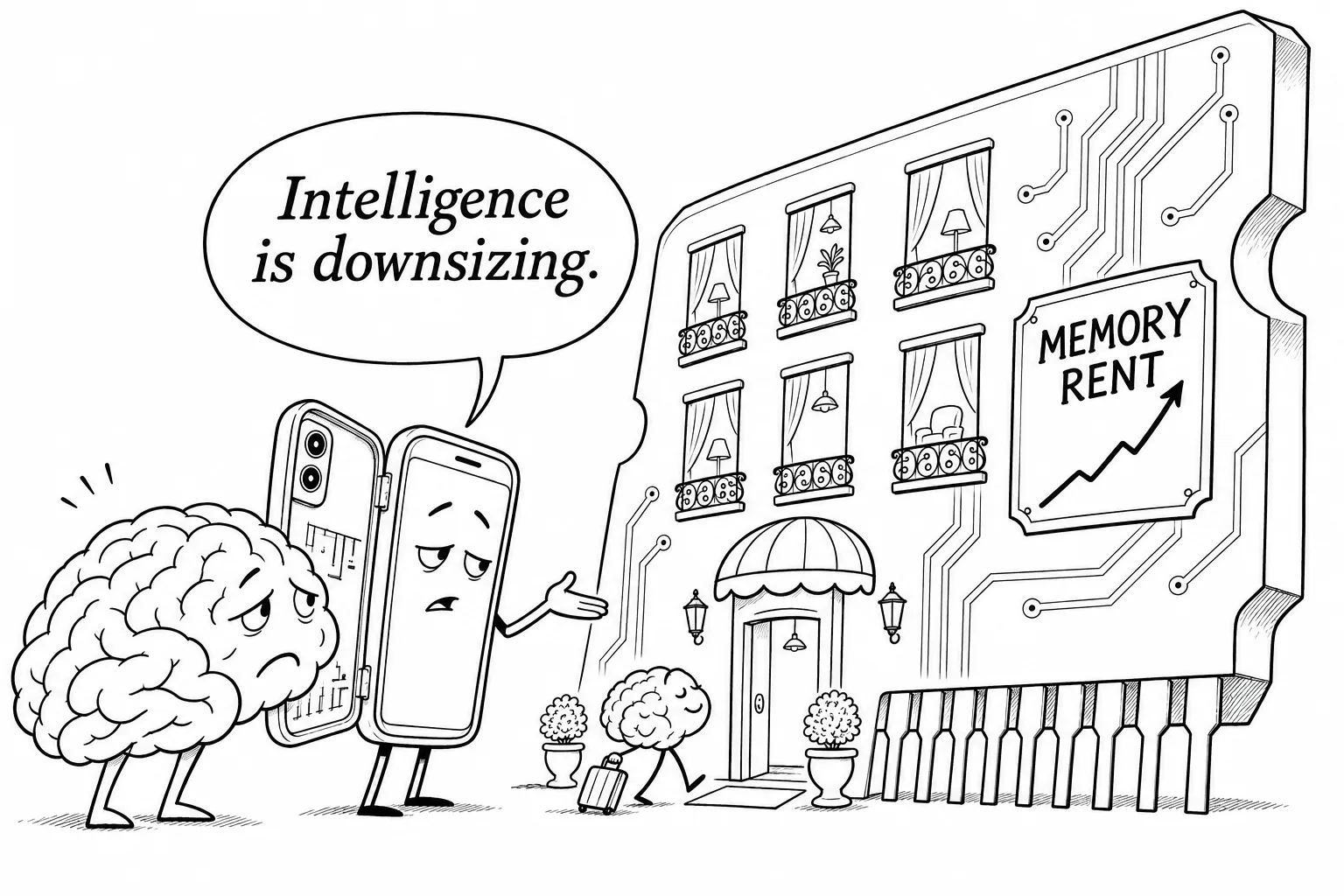
Small models have become a selling point because of the shortage of DRAM, the memory that holds data during computation, and its rising price. Large data-center AI systems are buying up huge amounts of memory, leaving device makers with a component that is expensive and hard to get. Every reduction in on-device memory directly cuts parts and power costs.
Ambarella's Minhazuddin presented the partnership as a question of money.
we are addressing the economics of Physical AI
Minhazuddin's focus on "economics" can be read as a statement that cost per device now comes before AI performance. Device makers can hold down prices by choosing models that run on little memory, rather than adding expensive memory to fit a large model.
Erika Wool, head of business at Liquid AI, also said that the way models are built needs to change.
Bringing agentic AI into the physical world requires a fundamentally different approach to AI architecture
Liquid AI builds small foundation models designed to save memory and compute. By a "fundamentally different approach," Wool means that devices need models designed for them from the start, not shrunken versions of large models that run in data centers. Wool also spoke about where AI should run:
Intelligence must operate where data is generated
"Where data is generated" means the cameras and sensors themselves. When video is processed on the device instead of being sent out, there are no network costs, and because the footage never leaves the device, the risk of data leaks falls. The same reasons explain the AI industry's growing interest in "SLMs," or small language models.
What remains unknown: no figures, and no demo until CES
The announcement from Ambarella and Liquid AI includes no figures on the benefits. The companies did not say how much memory the models save, how much power use falls, how the cost per device changes, or how much capability is lost compared with large models. They also did not disclose the deal's financial terms. According to the announcement, LFM3, a family of models Liquid AI released in October, will be supported first. The Ambarella chips due to support it are the CV72, CV75, N1-655 and the X7 AI accelerator.
Ambarella and Liquid AI will first show the technology running at CES in Las Vegas in January 2027. Until then, the claimed memory and power savings remain the companies' own claims. For device makers, the CES demonstration will decide whether a switch is worth considering: they will want to see whether the models are fast and accurate enough for real products while using little memory.
As long as memory prices keep rising, makers of AI-powered devices are likely to favor "models that are cheap to run" over "large, smart models." Ambarella's partnership shows that chipmakers have started to bet on that trend. Whether the bet pays off cannot yet be judged.
Editorial cartoon