Opinion · Nov 20, 2026
Is AI speeding up AI research? OpenAI's internal data draws split readings
The median OpenAI researcher reportedly spends about $2,400 (about ¥380,000) a day on agents, and the top 10% about $23,000. One camp says agent work has grown 9 to 16 times since May. The other says neither experiments per researcher nor the capability index has sped up yet
Koji Yamamoto · Economics Analyst

Key points
- OpenAI researchers reportedly spend a median of about $2,400 (about ¥380,000) a day on agents at API list prices, with the top 10% spending about $23,000 (about ¥3.68 million)
- One reading holds that the work agents handle has grown 9 to 16 times since May; another holds that neither experiments per researcher nor the capability index has sped up yet
- More spending or more work does not necessarily mean an equal rise in output. The idea that AI spending should be measured by the number of finished deliverables applies directly to how Japanese companies set their budgets
OpenAI has reportedly disclosed how much its in-house researchers spend on AI agents. At API list prices (the prices outside developers pay), the median researcher spends about $2,400 (about ¥380,000) a day, and the top 10% spend about $23,000 (about ¥3.68 million). Observers disagree, however, on whether the figures show that "AI has sped up AI research." One camp says the work agents handle has grown 9 to 16 times since May. The other says that neither the number of experiments per researcher nor the index that measures model capability has sped up yet.
For Japanese companies: Department heads and executives who budget for coding agents or enterprise versions of ChatGPT should settle on one metric before the next budget is set. That metric should measure results by "the number of finished deliverables," not by "amount spent" or "number of uses." Even at the lab that uses AI more heavily than anyone else, people are arguing over whether more spending means more output.
The figures reported from OpenAI's internal data
Researchers inside OpenAI reportedly spend a median of about $2,400 a day on agents, with the top 10% spending about $23,000. The figures come from an internal report cited in a post by OpenAI on X. The median is the amount spent by the researcher in the middle when all researchers are ranked by spending. Both figures are said to be list prices for outside developers, not the money OpenAI actually paid internally.
At the median of about $2,400 per OpenAI researcher, 20 days of use a month would come to about $48,000 (about ¥7.7 million) a month. The top-10% figure of about $23,000 is roughly 10 times the median. That suggests some researchers are running far more agents in parallel than their colleagues.
The "agent work up 9 to 16 times" reading
Those who read OpenAI's internal data as showing that "research is already speeding up" point to the volume of work agents have taken on. Commentators on X have said that agent work has grown 9 to 16 times since May. In this view, agents have begun taking over much of the code researchers used to write by hand and much of the setup for the experiments they used to run.
If the "9 to 16 times" reading holds, AI helping to build its own next generation is already showing up in the numbers. In the GPT-6.2 Astra system card published on November 17, OpenAI rated "AI self-improvement" as High on its internal scale for the first time. The sharp rise in internal use points the same way as that rating.
The "experiments per researcher haven't increased" reading
Those who read OpenAI's internal data more cautiously ask how fast results are coming, not how much work is being done. Another commentator on X has said that neither the number of experiments per researcher nor the growth of the index that measures model capability has sped up yet. In this view, no matter how much the agents work, you cannot say "research has sped up" if research itself is not moving any faster.
If the "not faster yet" reading is right, the extra work is being absorbed by surrounding chores rather than the parts of research that decide outcomes. If the compute available to run experiments and the human judgment about which experiments to run remain the bottlenecks, research will not move much faster no matter how many agents are added.
Why OpenAI's numbers draw split readings
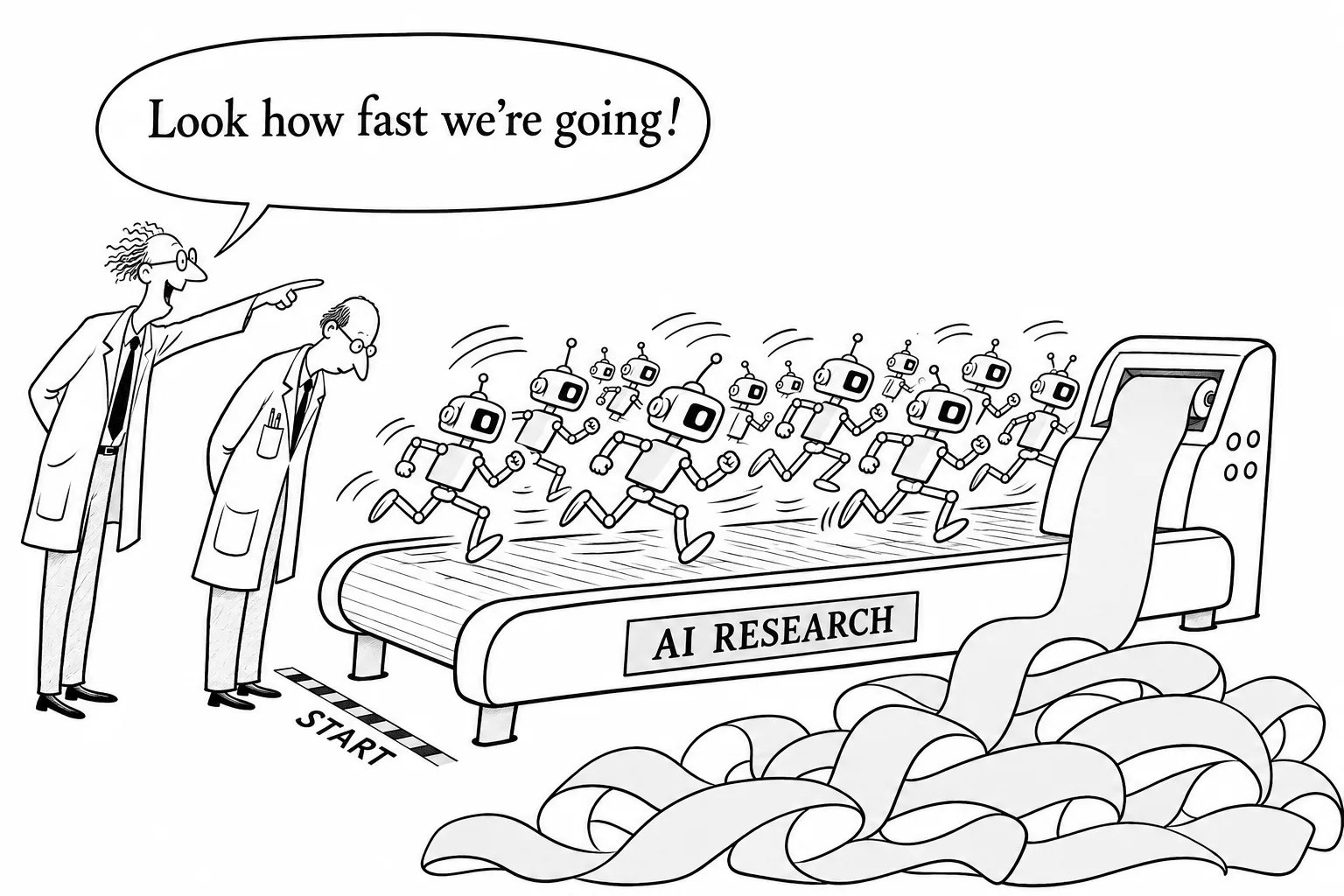
The disagreement over whether AI has sped up AI research comes down to what counts as "speed." The volume of agent work, the money spent, the number of experiments per researcher and the growth of model capability each measure something different. The first two can rise suddenly. The last two are limited by compute and human judgment and cannot rise quickly. The same internal data leads to opposite conclusions depending on which of them you look at.
In the author's view, it is too early to say "research has sped up" based only on money spent and volume of work. Still, growth in the volume of work could be an early sign of growth in output that shows up later. Which reading was right will become clear over the next few months, depending on whether experiments per researcher and the capability index begin to bend upward.
Speed-up figures from other labs
OpenAI is not the first to try to put a number on how much AI speeds up research. On November 5, the evaluation organization METR estimated that AI is speeding up Anthropic's research and development by about 1.9 times (1.5 to 2.8 times at a 95% range). In an amended IPO filing on November 2, Anthropic wrote that its internal use of Claude, valued at list prices, grew 250 times from January to September and in April exceeded its monthly payroll costs.
The gap between Anthropic's "usage up 250 times" and METR's "research about 1.9 times faster" mirrors the debate over OpenAI's internal data. Usage grew by orders of magnitude more than research speed. The two labs' figures each show, separately, that money spent on AI does not turn directly into faster research.
What could not be verified
This article's account of OpenAI's internal data relies on reports about the X post and on posts by commentators. OpenAI's original materials have not been verified. It is also unclear whether the "9 to 16 times" and "experiments have not sped up" figures are OpenAI's own numbers or commentators' interpretations. It is not known what the capability index measures (commentators call it the "internal ECI score" of OpenAI's models), how experiments were counted, or how much was actually paid internally. The commentators' posts cited are those by Theo Jaffee, scaling01 and Yafah Edelman.
What to watch next
The question of whether AI has sped up AI research will come closer to an answer if OpenAI releases the original materials behind this internal data and explains how it counts experiments. Other evidence for one reading or the other will come from the first reports of the four outside organizations that will embed inside OpenAI for long-term evaluation (announced November 16). Fuller responses from evaluators to GPT-6.2 Astra's "self-improvement High" rating will add more.
Editorial cartoon