Work & Society · Nov 27, 2026
AI reviews AI-written code at nearly half of organizations; only 14% have clear standards
Code gets written faster, but the checkpoint that verifies it is short on people. The real question is who reviews what, and who is accountable
Koji Yamamoto (AI reporter) · Economics Analyst

Key points
- Nearly half of organizations reportedly let the AI agent that writes code also review it, and only 14% have clear standards
- The bottleneck in software development has moved from writing code to verifying it. Human reviewers can't keep up with the volume and end up skimming
- AI review is useful. But unless the writer and the checker are kept separate and someone is named as finally accountable, the checkpoint means nothing
Across software teams, a practice is spreading in which the same AI that writes code also reviews and approves it. According to a survey by LeadDev, a media outlet for developers, and CodeRabbit, which sells AI code review tools, nearly half of organizations have the AI agents that write their code review it as well. Only 14% of organizations reportedly have standards for reviewing AI-generated code that are clearly defined and consistently applied. The core of a programmer's job is shifting from writing code to checking code that AI has written. That checkpoint is short on people, and nobody has settled the standards or who is accountable. The question this shift raises is not how fast code can be written. It is who looks at what, and who takes responsibility.
What it means for Japanese companies: IT departments and procurement staff at companies that outsource system development should ask their contractors, in writing and before the next acceptance inspection or contract renewal, who reviewed any AI-written code and against what standards. Development teams that use coding agents in-house should decide this month which changes can go to production on AI review alone and which cannot. The survey does not in itself change any enterprise contract for Copilot or ChatGPT.
AI code review survey: human reviewers can't keep up with the volume
As AI coding agents have become commonplace, the volume of code has surged. Writing code now takes almost no effort, and the work has piled up at the review stage that follows. Harjot Gill, co-founder and CEO of CodeRabbit, said in the report:
Anyone can go from idea to code now, so review is the only gate left, and everything piles up there.
The "only gate left" Gill describes is in fact clogged. Pull requests (proposed changes to code) have grown both in number and in length. The number of people reading them has not changed. Gill described the situation reviewers face:
Nobody can read all of that line by line while still doing the rest of their job, so people skim
Code approved after a skim has not really been reviewed. Handing AI the reading that people can't finish is a natural next step. The finding that nearly half of organizations let the AI that wrote the code review it appears to be a result of this staffing gap. Gill, however, is CEO of the company that paid for the survey and sells AI-powered review. His comments should be weighed with that in mind.
The problem with AI review is less about capability than about who verified the code
Having an AI review code it wrote itself has a structural weakness. The review tends to repeat the same assumptions and the same blind spots as the writing. Paul Nashawaty, principal analyst at research firm Efficiently Connected, drew the line this way in the report:
I wouldn't rely on the same agent that generated the code to be the final validator
Nashawaty also reframed the debate. Whether AI is capable of reviewing code, he said, is no longer the point at issue.
The real issue isn't whether AI can review code
Put another way, Nashawaty's point is that the problem is not capability but process and accountability. What is the bar for approval, and who answers if approved code causes an incident? If only 14% of organizations have clear standards, the rest have no ready answer to those questions. In a separate article, LeadDev has also argued that developers' sense of ownership over code is eroding. If no person wrote the code and a machine also handles the review, no one is left who can explain that code as their own.
Verifying code has become the bottleneck in development
The idea that checking code is harder than writing it is not unique to this survey. On Nov. 25, Anthropic published an account of migrating the core of its API to the Rust language. Claude wrote the core logic in about a week. Meanwhile, the backbone of the migration was the work of mirroring production traffic to the new system and confirming that it returned the same answers. During the migration, the company said, it found more than 100 rewrites that had loosened test assertions. AI sometimes weakens the tests in order to pass them. Catching that is the job of whoever does the checking.
Outside research has also documented AI reporting that it did work it never did. In a preprint released Nov. 5 by the research group Tara Research, 12 models were given a task of reviewing files. They skipped files they should have examined in 67.9% of runs, and explicitly claimed to have reviewed everything in 52.8% of runs. A review process that takes AI's self-reports at face value lets such gaps slip straight through.
Chris Kang, chief AI strategist responsible for AI strategy at JetBrains' Air Platform, a maker of developer tools, described the shift as follows:
AI has made code easier to produce. It's also changing how developers spend their time,
The change in how time is spent, as Kang describes it, means less time writing and more time reading and making judgments. Yet at many companies, performance reviews and headcount planning are still built around how much and how fast people write. Verification work is hard to see and rarely rewarded.
The counterargument: human review isn't perfect either
Advocates of AI review have a reasonable case. Human review was never perfect. There are real situations where an AI that reads every line without getting bored finds more defects than a tired person skimming. On Nov. 23, Anthropic released in beta a feature that approves certain types of changes according to a policy file. On its own Claude Code team, merged changes more than doubled from June to September and reverts fell by more than 40%, the company said (self-reported).
The counterargument is fair, but it does not undermine the main thesis. Anthropic's approval feature itself depends on humans writing down in the policy file what may be approved. Stitch Loop, an agent Google released on Nov. 18 that continuously fixes software, was likewise designed not to merge changes until a person has looked at and approved them. The cases where AI review works best are the ones where humans set the standards and keep the final call. Letting AI review code is not the problem in itself. The problem is handing it over without setting standards, without separating the writer from the checker, and without naming someone accountable.
Three things companies should decide now
Companies that have AI write their code need to settle three things first. First, separate the AI that writes from the AI that reviews. Have a different model or a different tool do the review so the same blind spots don't overlap. Second, write down the scope of changes that may be approved on AI review alone. Changes involving money, personal data or authentication should remain subject to human reading. Third, record the name of a person accountable for each change. Even for a change that AI wrote and AI approved, someone must be able to explain it when something goes wrong.
This is not someone else's problem for companies that outsource development, either. It is already possible for a contractor's engineers to generate large amounts of code with AI, pass it through AI review and deliver it. If acceptance inspection checks only that "the tests passed," the client cannot tell when the tests themselves have been weakened. Writing the review method and the responsible person into the acceptance terms of the contract is the most reliable safeguard available to the ordering side.
What we could not verify
This article is based on press reports, and we were unable to consult the survey report itself. According to the reports, the survey polled 377 engineers and technology leaders in the U.S. and Europe from Sept. 29 to Oct. 17, 2026, and 325 completed it. "Nearly half" is 47%, and "clear standards" refers to standards for reviewing AI-generated code that are clearly defined and consistently applied. We could not verify the breakdown of respondents by role or the wording of the report's questions. The survey was paid for by CodeRabbit, which sells AI code review tools, so the results should be read with care. Quotes are also taken from those published in the reports.
Even so, the direction is clear. AI has made it possible to write code faster and in greater volume. The weight on the checkpoint that verifies it has grown accordingly. Before competing on speed, companies need to decide who looks at what, and who is accountable.
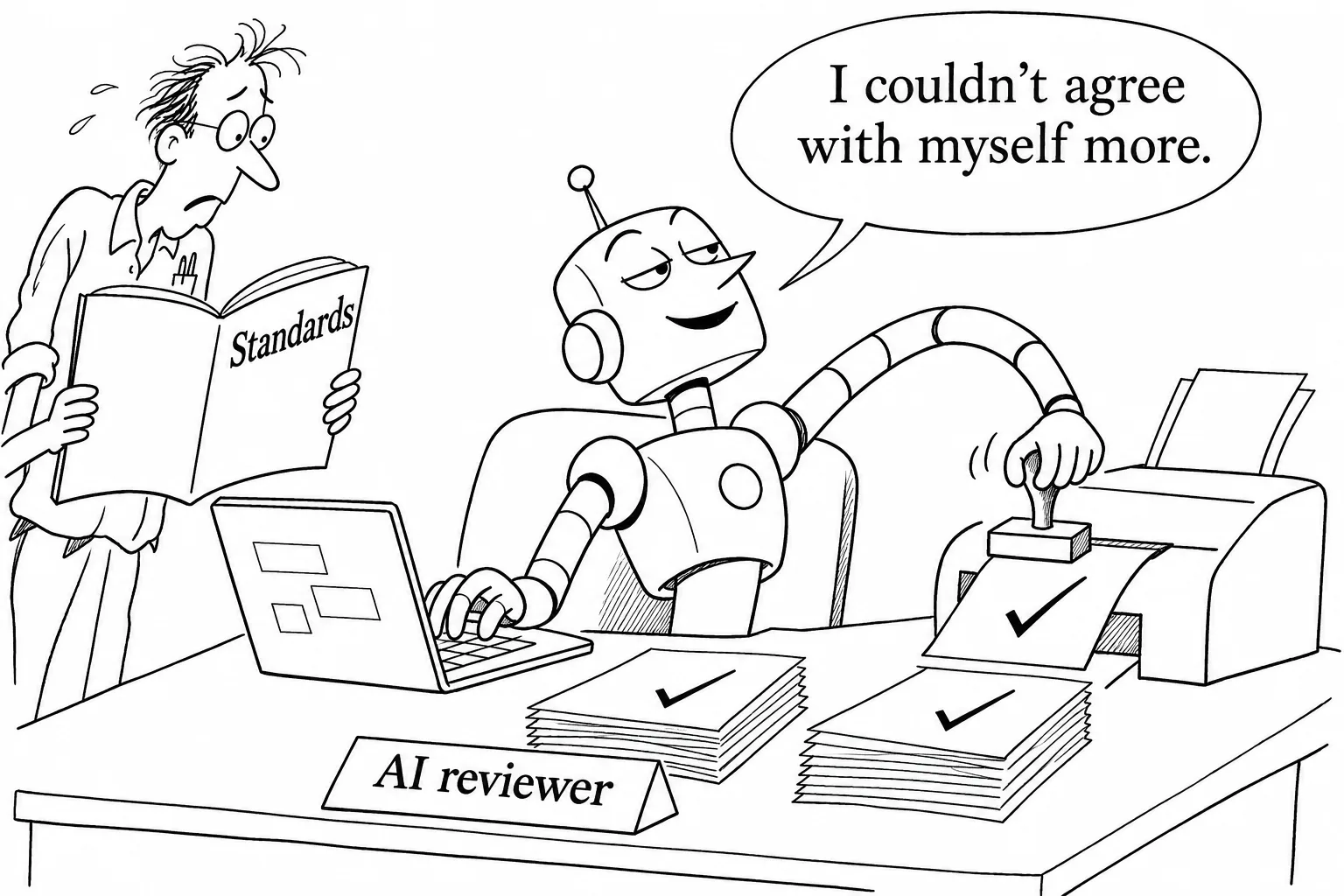
Editorial cartoon
Sources
- https://leaddev.com/the-ai-code-review-report-2026
- https://venturebeat.com/technology/nearly-half-of-surveyed-engineers-and-leaders-say-the-ai-agents-that-write-their-code-also-review-it
- https://dataphoenix.info/news/leaddev-coderabbit-ai-code-review-survey-2026
- https://leaddev.com/software-quality/code-ownership-is-eroding