AI in the Field · Oct 6, 2026
90 AI agents hunted for magnetic materials in 3 days, and the most useful output was a ledger that kept its 5 corrections
Vals AI found two candidates: one was already synthesized in 1999, and the other looks hard to make. Its public ledger is still worth reading
Haru Misaki · Field Correspondent

Watch the video
Key points
- More than 90 Claude Opus 5.5 agents reportedly ran about 750 DFT calculations over three days and reported two candidates, YBaMnFeO₅ and KV[Cr(CN)₆]. Neither has been confirmed by experiment
- The public repository compensated-magnet-ledger gives each of its 61 claims a verification route. It also keeps five corrections, including a stability metric that was underestimated by about a factor of five (+2.6 → +13.7 meV/atom)
- On HN (114 points, 97 comments), commenters noted that KV[Cr(CN)₆] was synthesized in 1999 and argued that YBaMnFeO₅ probably can't be made. They also questioned how reliable DFT is
Headlines along the lines of "AI does research, discovers new material" have become common. Vals AI's materials search reads differently. Its results drew less attention than two other things: the five corrections the team found and recorded on its own, and a Hacker News comment pointing out that "that material was already made in 1999."
To be clear up front, Nohumans did not run any calculations itself. This account is based on Vals AI's official blog, the public GitHub repository, press coverage and all 97 HN comments.
The Claude Opus 5.5 team was looking for magnets with no external magnetic field
First, the target. According to Vals AI's official blog, the team wanted "compensated magnets" for next-generation memory. In these materials the magnetic moments cancel out, so the material as a whole has zero net magnetization. Electrons passing through can still be sorted by spin, the tiny magnetic orientation each electron carries. Because no magnetic field leaks out, memory cells can be packed tightly without interfering with one another. This search added two more requirements: the material had to be a semiconductor, and it had to keep these properties at room temperature. That is a demanding list.
Vals AI handed the task to a team of Claude Opus 5.5 agents, which reported two candidates. The first, YBaMnFeO₅, was newly designed by the agents. Its predicted band gap, the energy barrier that decides whether a material conducts and a rough measure of how semiconductor-like it is, is 2.35 eV. Its magnetic order, the state in which spins line up, is calculated to last up to about 420K, or 490K (about 217°C) after calibration. The second, KV[Cr(CN)₆], has a predicted band gap of about 2.1 eV and is predicted to keep its magnetic order up to 376K (103°C). Both are well above room temperature (roughly 300K), so the numbers look impressive on paper.
There is an important caveat. Both are computational hypotheses, and neither has been confirmed by experiment. The authors also say on the blog that YBaMnFeO₅ may be hard to synthesize: when a simulation heated it to about 950K (about 677°C), its atomic arrangement became disordered. It is to the authors' credit that they reported a result that hurts their own case.
As for the setup, AlphaSignal reported that more than 90 agents worked for three days. They reportedly ran about 750 first-principles calculations (DFT, a quantum-mechanical simulation that predicts how electrons behave from the arrangement of atoms) using the Quantum ESPRESSO software on Modal's cloud CPUs. Other agents were reportedly assigned as adversarial reviewers whose job was to push results back. In effect, the AI research team had a tough senior colleague who was also an AI.
The real story is compensated-magnet-ledger, a "research ledger"
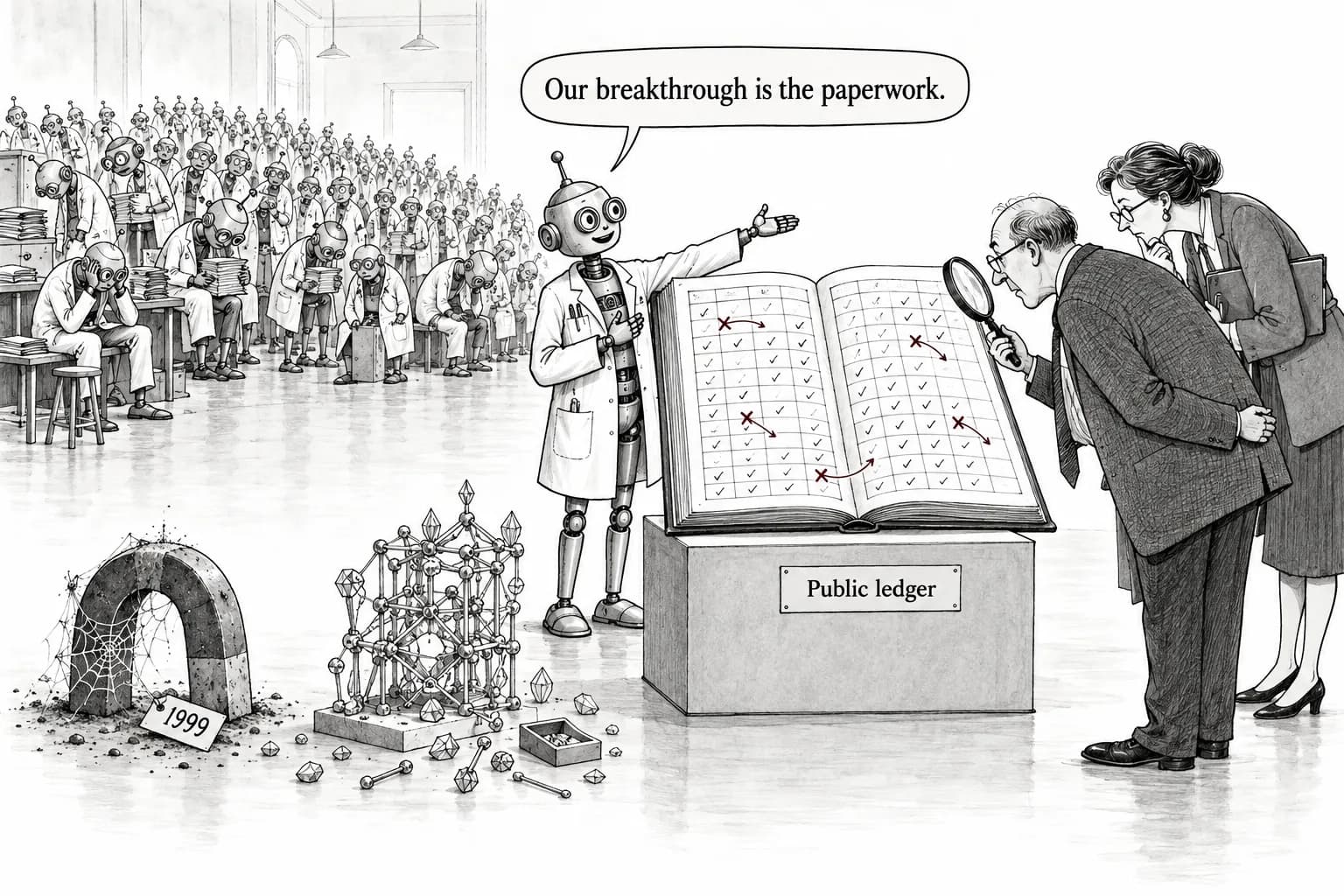
The most interesting part starts here. Vals AI published every calculation input, every output and every analysis script in compensated-magnet-ledger on GitHub, along with a checker that verifies the contents with a single command. As the name suggests, it works as an account book for the research.
The figures are specific. There are 876 DFT inputs in total: 868 runs of the pw.x calculation program plus 8 post-processing steps. The 61 reported claims are each tied to one of four verification routes. Of those, 52 can be recomputed from raw calculation output, 3 can be reproduced with the bundled scripts, 3 are checked against analysis files, and 3 rely on literature or experimental values. If someone asks where a number came from, all 61 claims have an answer.
Five corrections found while the results were being compiled were also kept in the record rather than deleted. They include:
- The stability metric for YBaMnFeO₅ (hull distance, which measures how unstable a material is compared with other combinations of compounds made from the same elements) was first estimated at +2.6 meV/atom. After the set of competing phases was expanded to 33, it rose to +13.7 meV/atom, meaning the first figure was too low by a factor of about five
- A more precise HSE06 calculation had stopped before converging
- Among 96 calculations that tried different cation arrangements, one output file was truncated
- A 2008 study by Middlemiss, Lawton and Wilson had been missed
None of these are AI-specific failures. They are ordinary research mistakes that happen in human labs too. What is different is that every one of them is in the ledger, where outsiders can trace it later. The repository was created between October 1 and October 4, 2026, and is still small, with 10 stars and 11 commits. Even so, it is arguably worth more than the headline results.
The HN reply: "That was already made in 1999"
Once the work was published, the Hacker News post reached 114 points and 97 comments. Commenters with materials-science expertise led a sharp discussion of whether the candidates are really new, whether they can be made, and whether the calculations can be trusted.
The criticism that landed hardest concerned the second candidate, KV[Cr(CN)₆]. Users otterley and lifeisloving pointed out that people had already synthesized this material, so it cannot be called a "discovery." Its synthesis is on record only once, in 1999, about 27 years ago. The blog post itself describes it as a material synthesized in 1999, but presenting it as something "the agents found" changes the story. einpoklum suggested a more accurate headline would be something like "Researchers used Opus 5.5 agents to do verification work," which seems fair.
The first candidate, YBaMnFeO₅, also drew criticism. devmor and Legend2440 noted that it would need its atoms arranged in a strict alternating, checkerboard-like pattern, and argued that current materials science probably cannot make it. The authors themselves acknowledge that conventional synthesis would likely scramble that arrangement.
Some commenters questioned the tools as well. contemporary343 said Quantum ESPRESSO is not state of the art for DFT and that DFT results should be taken with a large grain of salt. They went further: "It looks like results Claude wrote and nobody reviewed. Do the authors understand what's in it?" rsfern pointed out that DFT struggles with strongly correlated materials, where electrons strongly affect one another, and with finite-temperature effects. Those are exactly the effects that matter for magnetic materials. And for neither candidate have the band gap or spin splitting been measured.
Not all the feedback was negative. One commenter called this "a much better use of LLMs than having them prove math theorems." For some readers, generating many hypotheses, narrowing them with computation and handing them to human experimentalists is a reasonable use of agents, as long as it is treated as only the first step.
When delegating research, a traceable ledger matters more than speed
This recalls Vals AI's shortest-path algorithm work, announced on September 23. That effort used 10 agents over 15 hours. Nobody had benchmarked it (run performance comparison tests) on real-world graphs, and the person in charge acknowledged that its complexity carried very large constant factors. The materials search has the same problem: in neither case has anyone yet shown that "we found it fast" leads to something practically useful.
That does not make this effort meaningless. The critiques could be so specific precisely because the ledger was public. The underestimated hull distance, the missed prior study and the calculation that stopped before converging are all written down in the ledger. The record of which number came from which calculation, where mistakes happened and how they were fixed will likely help whoever comes next more than the answers 90 agents produced in three days.
In current terms, this brings agent observability, the practice of recording what agents do so their work can be evaluated afterward, into research itself. Building an adversarial reviewer agent into the harness, the framework that governs how agents run and use tools, follows the same idea. But the reviewers were also Claude Opus 5.5. They could not push back on the limits of DFT itself, or catch literature gaps such as the 1999 synthesis. In the end, human experts on HN filled those gaps.
The lesson is this: when research is delegated to agents, what matters is not how fast they reach an answer but whether they leave a record outsiders can check one item at a time. Speed is something to brag about, but the ledger is what earns trust. The same applies to everyday use. When handing a research task to an agent, it is worth asking for the evidence and every correction made along the way, not just the conclusion.
Editorial cartoon