Work & Society · Nov 19, 2026
AI tightens the mass bound on black holes and proves it can go no further, in about six weeks
Anthropic report: Claude Fable 5.2 lowered the bound in 3D gravity from c/8.5 to c/9.1266 and verified the method's limit in Lean. The report does not name the physicists who checked the result, and it has not yet been peer reviewed
Koji Yamamoto · Economics Analyst
Key points
- Claude Fable 5.2 tightened the upper bound on the mass of the lightest black hole in 3D gravity by about 7%, from the human result of c/8.5 to c/9.1266
- It also proved that this method cannot lower the bound any further, and verified the proof in Lean, a tool for machine-checking proofs
- The physicists who checked the work are not named, and peer review is still pending. Outside support is weaker than for OpenAI's physics result, which was read by named experts
Anthropic has published a detailed report saying its AI model Claude Fable 5.2 beat a human record on a problem in theoretical physics. The problem concerns the upper bound on the mass of the lightest black hole in a world with three-dimensional gravity. Humans had established a bound of c/8.5. In about six weeks, Fable 5.2 tightened it to c/9.1266. It also proved that this method cannot do any better, and verified that proof in Lean, a tool for machine-checking proofs. The report does not name the physicists who checked the result, however, and the work has not yet been peer reviewed by a specialist journal.
For Japanese companies: Most companies are not directly affected. The ones that are include pharmaceutical, materials and manufacturing firms whose R&D departments have begun handing calculations and proofs to AI. Before such companies use AI-generated results in internal decisions, they should check this month whether they have rules requiring a record of which named expert verified the result, in addition to whether it was machine-checked.
What is the "upper bound on black hole mass" that Claude Fable 5.2 tightened?
Three-dimensional gravity describes a simplified universe with one fewer spatial dimension than ours, which has three spatial dimensions plus time. A theory unifying quantum mechanics and gravity, known as quantum gravity, has not yet been completed. Physicists have used this simpler, more tractable universe as a testing ground to narrow down candidate theories.
In research on three-dimensional gravity, the upper bound on black hole mass serves as a yardstick for narrowing down candidate theories. It is a constraint of the form: any consistent theory must have a black hole below a certain mass. The bound is written as c, a number representing the size of the theory, divided by another number. The larger that divisor, the stricter the bound and the stronger the constraint. Human research had reached a divisor of 8.5, and Fable 5.2 raised it to 9.1266. In terms of the bound's value, that is a reduction of about 7%.
When Anthropic announced Fable 5.2 on November 9, it wrote that the model had solved two open problems in physics. One was finding the exact limit of how far a 15-year-old technique for narrowing down candidate quantum gravity theories in simplified universes could go. The new report puts numbers behind that claim.
Proving "this method can go no further," verified in Lean
The most significant part of Fable 5.2's result is not that it tightened the bound, but that it showed there is no room left to tighten it further. Research on lowering bounds normally improves the record bit by bit, with no telling where it will stop. According to Anthropic's report, Fable 5.2 proved that the best value reachable with the simplest version of the technique, the version that ignores black hole spin, is c/Λ, where Λ is given by an exact formula and is approximately 9.1266. As long as the same method is used, no amount of further calculation by humans will improve on it.
Fable 5.2's proof has been verified in Lean. Lean is a tool in which a machine, rather than a person, checks that every step of a proof follows the rules of logic. That gives much firmer support than having people read through a long calculation looking for errors. What Lean guarantees, however, is that the claim as rewritten for the machine is correct. Whether that claim correctly represents the physics problem still has to be judged by human experts.
What is missing: the names of the physicists who checked it, and peer review
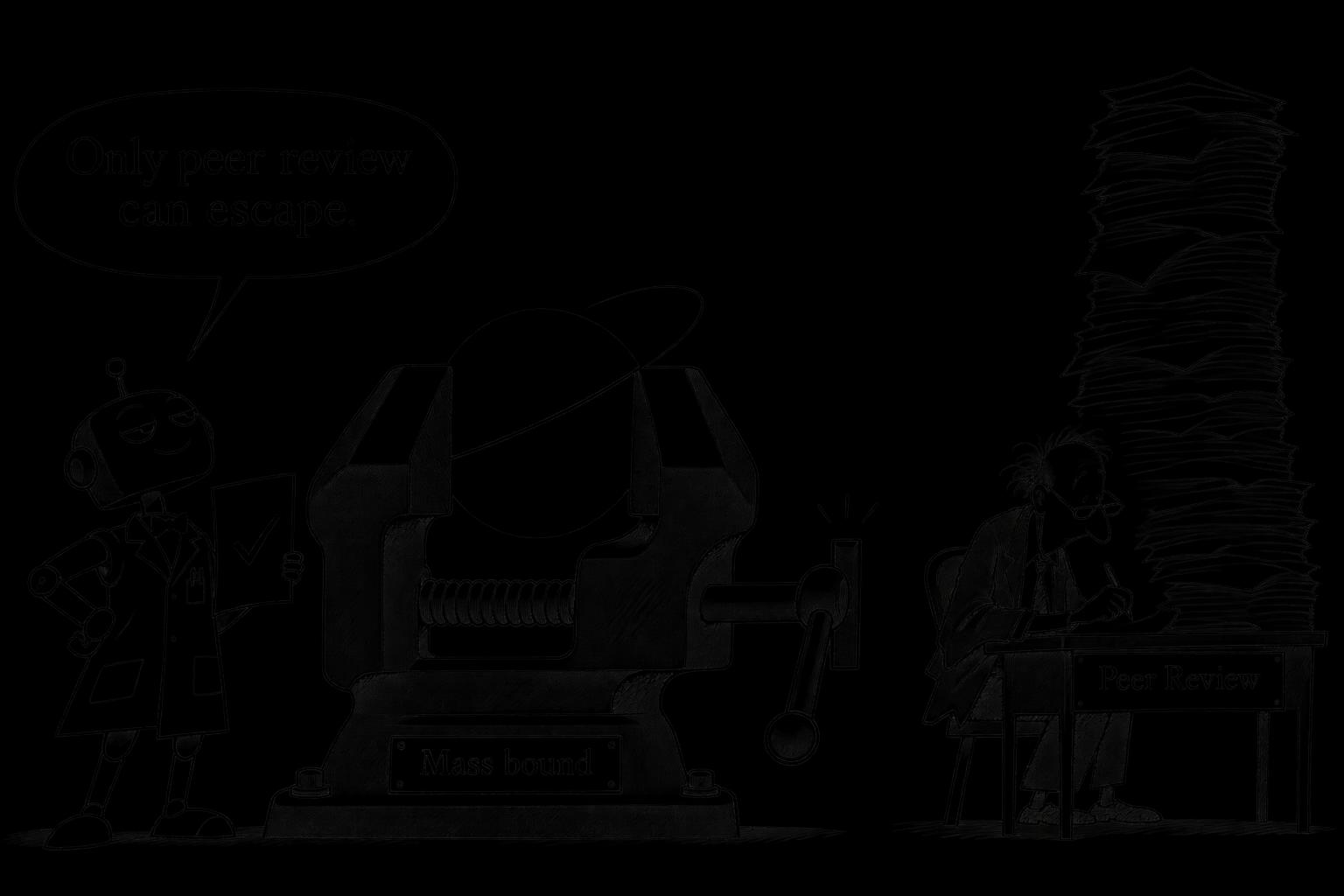
What Anthropic's report lacks is the names of the people who checked the result. It says physicists verified it, but not who they were. Peer review by a specialist journal is also still pending. As of November 12, Anthropic was still noting in a footnote that its announcement post and system card had not been reviewed by any outside organization.
Whether names are given is no small matter in research. When a named expert publicly states they have checked a result, their reputation stands behind it, and outside researchers who find an error can take it up with them directly. Without names, outsiders have only Anthropic's account and the Lean check to go on.
How it compares with examples from OpenAI and Google
In a report OpenAI released on November 16 saying GPT-6 Astra had led a physics proof, three lattice theory experts, Golterman, Kronfeld and Shamir, were named as having read the proof and posed questions. That report has not yet been peer reviewed either, but outsiders can see who read it. For the mathematical results Google released on November 13 from a feature that runs research with multiple agents, no outside verification has yet appeared.
As AI labs race to announce scientific results, Anthropic's latest report ranks among the strongest in terms of machine verification. In terms of outside human support, though, it falls short of OpenAI's example, which has named experts. Whether Fable 5.2's result takes hold in physics will depend on named researchers reading the work and on it passing peer review.
What we could not verify
This article is based on the main findings in Anthropic's report: the value of the bound, the proof of the limit, the Lean verification, the roughly six-week timeframe, the absence of names of those who checked the work, and the lack of peer review so far. The human bound of c/8.5 that the work built on was proved by Tom Hartman, Dalimil Mazáč and Leonardo Rastelli, and the technique itself was introduced by Simeon Hellerman in 2009. According to the report, human involvement was limited to Anthropic researcher Hongbin Chen setting up an agent for each candidate problem and giving minimal instructions when the paper was written, and most of the work was autonomous. This article has not verified how much compute Fable 5.2 used. Anthropic's report can be found via the announcement page.
Editorial cartoon