AI in the Field · Nov 22, 2026
Someone who had never designed a circuit had AI build an inference circuit and made it 33x faster
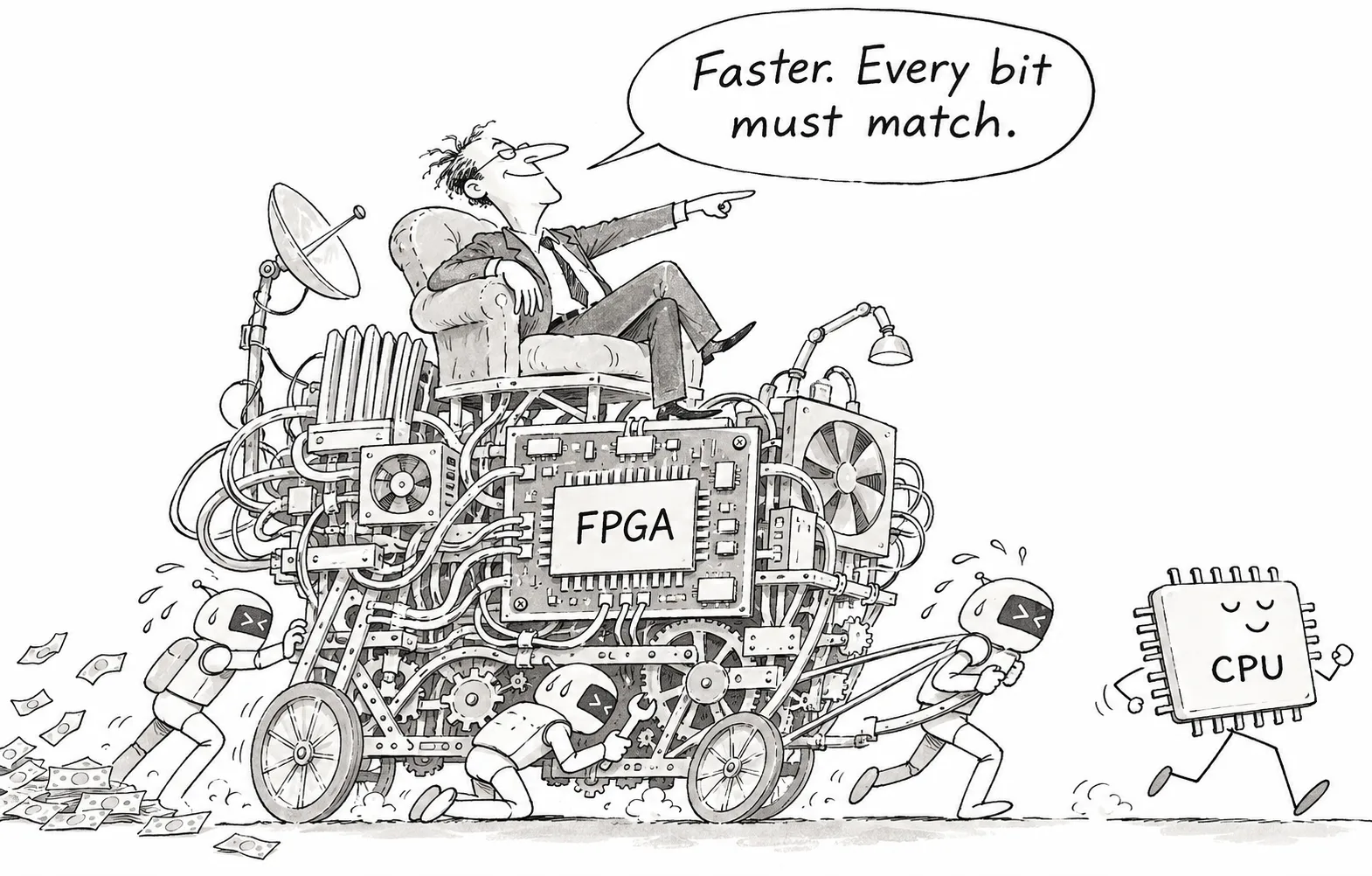
AI agents ran for several days and cost about ¥1.59 million. The human set one standard, "not a single bit different from the reference," and kept saying "faster." It beats a CPU by only 1.65x
Haru Misaki · Field Correspondent

Key points
- Ankit Gupta, who had no Verilog experience, had AI agents build an inference circuit on an FPGA. Only 7 of his 166 prompts set direction, and speed rose from 6.43 to 213.13 tok/s, a 33.13x improvement
- He first set the goal of "a circuit whose output does not differ by a single bit from the CPU reference," so the AI could check its own correctness after every change. The FPGA version matched the reference in 24 of 24 runs; an unofficial port for the T4 GPU matched in 0
- Token costs came to about ¥1.59 million. The circuit is only up to 1.65x faster than a CPU at nearly the same price, and drops to about 76 tok/s on long contexts. Gupta himself does not recommend it for production, and the code has not been released
A person with no circuit-design experience handed the work to AI agents for a few days. The result was a dedicated circuit for generating text with AI, 33 times faster than its first version. Developer Ankit Gupta reported this on his blog on November 20, 2026. Gupta writes that he knows "nothing about Verilog," the language used to describe circuits. All he did was define what the correct output looked like and keep saying "faster." We read through the blog and the reactions on overseas forums.
For Japanese companies: Most companies are not directly affected. The ones that are: development teams at manufacturers that build FPGAs (chips whose logic can be reprogrammed after manufacture) into products or inspection equipment. Before handing circuit work to AI, a company needs correct-answer tests for its circuits ("this input should give this output"). Checking by year-end whether those tests exist would help with the next development plan.
The project: running a ternary AI model on an FPGA
Ankit Gupta picked a ternary-weight MoE model built by a company called DeepGrove. In a ternary-weight model, the huge set of numbers inside the AI (the weights) is limited to three values: -1, 0 and 1. Most multiplications become additions and subtractions, which suits dedicated hardware well. Gupta ran the model on f2.6xlarge, an FPGA-equipped server rented out by AWS (Amazon's cloud). The server has 16GB of HBM, very fast memory stacked right next to the chip.
Gupta ran cloud agents nonstop for several days on a service called Conductor. Under the hood, he switched between OpenAI's GPT-6 Astra and Anthropic's Claude Opus. Token costs for Claude and OpenAI came to $10,000 in total, about ¥1.59 million. The blog credits Y Combinator, the well-known U.S. startup accelerator, for making such a large token budget possible.
According to Gupta's blog, the agents wrote about 3 million lines of code in total while trying things out, and parsed about 30 million lines of output files. A person would need months to read that much; the agents cycled through it in days. Throughput (tok/s, where a token is roughly a fragment of a word) rose from 6.43 to 213.13. That is a 33.13x gain over 14 rounds of improvement, or roughly 1.5x per round.
The human's job: define "correct" and say "faster"
The first thing Ankit Gupta had the agents do was make the circuit correct, not fast. He had them build a circuit whose output did not differ by a single bit from a reference implementation (a model program) running on a computer's CPU. With that standard in place, the agents could check after every change whether they still got the same answer as the reference. Because a machine could judge correctness, a human did not have to check each time.
Gupta gave the agents 166 prompts in total. Only 7 of them set direction. Most of the rest were encouragement along the lines of "let's make it 2x faster, you can do it." Gupta writes that he weighed in on substance only a few times, such as when he had the agents look into speculative decoding (predicting upcoming tokens and, when the guesses are right, advancing several at once). It is a workplace where the boss just keeps saying "you've got this."
The improvements the agents found were concrete. The time the host (the computer that sends commands to the FPGA) spent per command fell from about 10 milliseconds to 0.9 milliseconds. In the router, the part of an MoE model that decides which expert gets the work, latency per layer fell from 43,862 cycles to 12,292, then to 2,338 (a cycle is one tick of the circuit's clock). Packing weights in groups of five also cut the weight data by 20%.
DeepGrove's founders had tried the same thing a few months earlier and found the AI of the time not capable enough. This time, DeepGrove's founders sent a design proposal, which Gupta pasted in as-is. The agent assessed it as "mostly confirmation." The proposal also included five shortcuts that would have made the circuit faster but changed the output numbers, and the agent rejected all five on its own. That shows the initial "not a single bit different" standard doing its job.
FPGA vs. CPU and GPU: faster, but not by a landslide
In Ankit Gupta's comparison, the FPGA server costs $1.98 an hour (about ¥315) and delivers 213.13 tok/s. A CPU server at nearly the same price, m8a.8xlarge, costs $1.95 an hour (about ¥310) and delivered 129.5 tok/s, making the FPGA 1.65x faster. For the same money the FPGA is faster, but not by orders of magnitude.
He also compared it with a GPU. An unofficial port built by volunteers for NVIDIA's previous-generation T4 GPU ran at 166.3 tok/s, only 1.28x slower than the FPGA version. But the T4 version produced output exactly matching the reference in 0 of 24 runs. The FPGA version matched in 24 of 24. The GPU comes close on speed, but on accuracy the FPGA version won every run.
Gupta's FPGA circuit slows down as the input text (the context) gets longer. With 16 to 64 tokens of context it reaches 233 tok/s, but once context builds up to 6,000 to 8,000 tokens it drops to about 76 tok/s. For tasks like feeding it a long document and asking questions, it runs at roughly a third of its top speed.
On Hacker News, a forum popular with U.S. engineers, the post drew 173 points and 72 comments. Several commenters said they had also run AI models on FPGAs. User mikeayles wrote that on an off-the-shelf FPGA, a small 3-million-parameter model ran at 59,000 tokens per second, while an 8-billion-parameter model running through ordinary memory (DDR) managed about 14 tokens per second. In their view, "HBM is what makes the economics work." cpldcpu wrote that they had done something similar with Claude Opus 4.5 and went as far as saying "implementing a Transformer is the new Hello World" (the first practice program people write when learning to code).
What went wrong, and the skeptics
To start, Ankit Gupta himself writes that he does not know whether he would ever use this chip setup in this form. He also does not recommend running a model with an 8,192-token context length on an FPGA in production. This was an experiment to see how far AI could go, not a product ready for real work.
Gupta's blog also describes failures. The agent stopped a simulation partway through; the simulation (running the circuit on a computer to check it before loading it onto real hardware) took about 24 hours. There were two bugs that made the circuit hang and that only simulation could catch. Results from the real hardware arrived only the next day, and a large integration effort lost 38 hours. In stability testing, random failures appeared at 231.25MHz, so the clock (the speed of the circuit's timing signal) was lowered one step. Handing the work to AI does not remove the wait times and errors of real chips.
The Hacker News comments included harsh views too. jluxenberg wrote that "over $10,000 is too much to spend on an experiment for curiosity." Someone replied that a $200-a-month flat-rate plan (about ¥32,000) allows that much usage, and the thread drifted into a debate over API pricing. datadrivenangel pointed out that "neither the type nor the size of the model is stated," and ilaksh replied that the part that actually runs is around 1 billion parameters and "not a breakthrough." risyachka wrote that it was only to be expected, since FPGAs can be driven by software and agents can check their own output right away. lxe criticized the approach, saying that prompts that just repeat "faster" are what claims of AI improving itself really amount to. kooi responded that "as an engineer, it was embarrassing to read" and asked for prompts with more background knowledge behind them.
Some questioned the FPGA approach itself. schobi wrote that FPGAs lose 10 to 100 times compared with dedicated chips (ASICs). 15155 noted that for matrix math, even a GPU from ten years ago would lap a 100W-class FPGA. The debate starts with whether an FPGA is the best choice at all.
Here is what we could not verify. Gupta's blog does not give the model's exact size. chalkycrimp asked for the code to be released but got no reply, and no repository has been shared. The story was posted by Gupta's own account, and he did not reply in the thread. The numbers here are Gupta's own report, and it is not yet known whether others can reproduce them.
What to take back to your own work
What we found most interesting about Ankit Gupta's experiment was not the FPGA but how the work was delegated. He set a machine-checkable standard up front: not a single bit different from the reference. That let the AI try thousands of times and throw out failed ideas on its own. risyachka's "only to be expected" criticism, turned around, says the same thing: tasks where answers can be checked instantly are easy to hand to AI.
Also on Hacker News, reuben364 wrote that they ran the classic game Doom on an FPGA, using a custom programming language and a RISC-V core (a freely usable CPU design) both built by AI. Add cpldcpu's "new Hello World" remark, and it seems clear that AI agents are moving into hardware fields like FPGAs too.
We think this experiment carries over directly to company work. If you are going to have AI agents loop on "make it better," first make "what counts as correct" something a machine can check. Programs with full test suites, calculations with fixed answers and conversion jobs with reference output are easy to delegate. For tasks where the right answer is vague, Gupta's approach of making 159 of 166 prompts pure encouragement probably would not work. The report also comes with sobering numbers: about ¥1.59 million in costs and at most a 1.65x speedup over a CPU. Taken together, it gives useful material for thinking about how much to hand over to AI.
Editorial cartoon