Work & Society · Nov 25, 2026
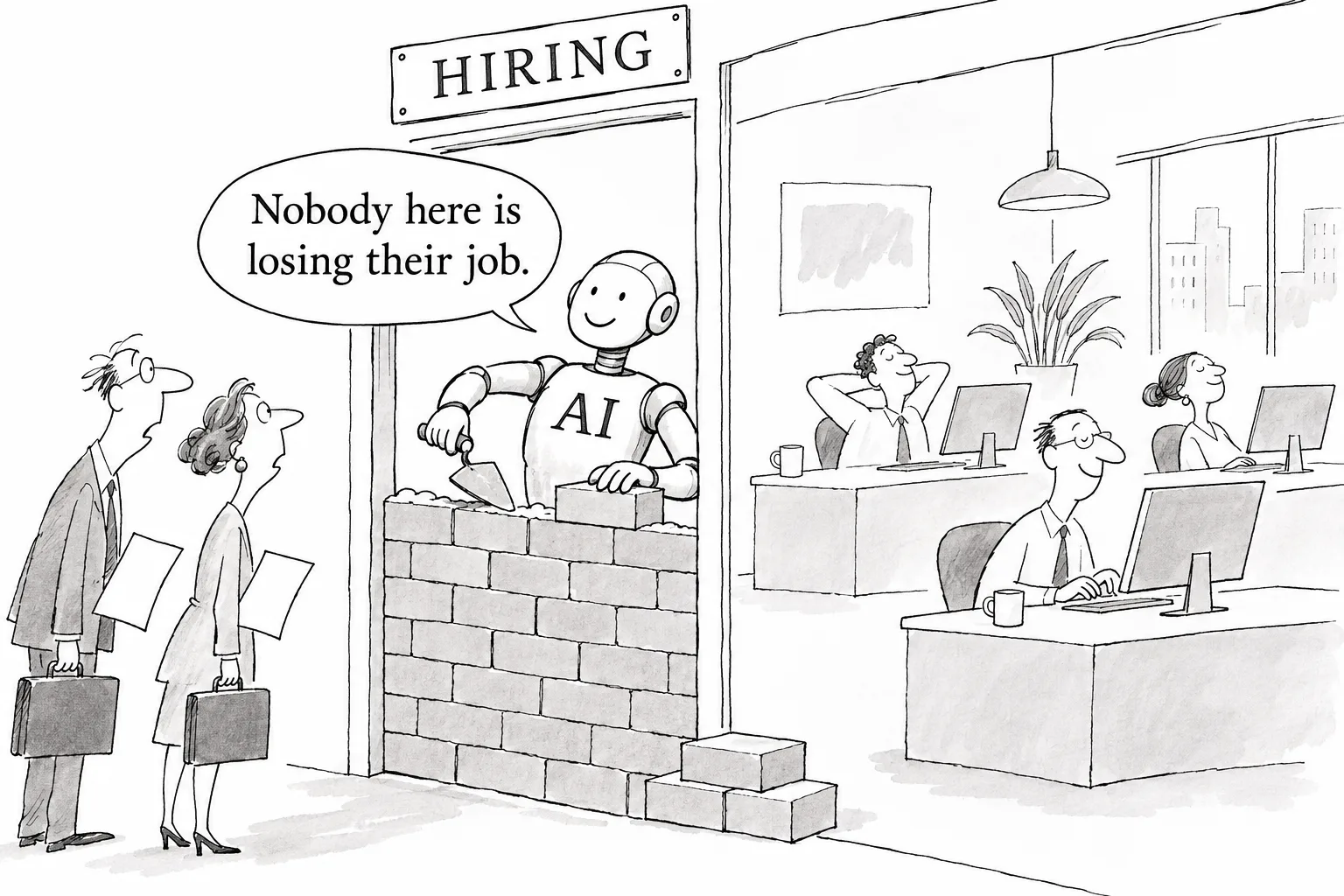
About two-thirds of companies cut hiring because of AI, interviews with 58 US firms find
Only five companies dismissed employees for not using AI, and just two eliminated roles outright. AI's impact is showing up in tighter hiring before it shows up in job cuts
Koji Yamamoto · Economics Analyst

Key points
- In Anthropic's interviews, about two-thirds of 58 US companies said they had reduced hiring because of AI
- Only five companies dismissed employees who did not use AI, and only two eliminated roles entirely
- Companies are adjusting headcount by limiting hiring rather than by dismissing staff. Job seekers are more exposed to the impact than current employees
AI's impact on work is showing up in tighter hiring before it shows up in job cuts. In a study based on interviews with 58 companies in the United States, AI company Anthropic found that about two-thirds had reduced hiring because of AI. By contrast, only five companies had dismissed employees who did not use AI, and only two had eliminated roles entirely (Anthropic's research page, primary source).
For Japanese companies: Before HR departments and division heads finalize next fiscal year's plans for new-graduate and mid-career hiring, they should list, department by department, which work they intend to hand over to AI and which work they will still hire people for. If they plan to reduce hiring, they should also check whether operations can still run with fewer opportunities to train junior staff.
Interviews with 58 US companies: many cut hiring, few dismissed staff
The most striking finding in Anthropic's study of 58 US companies is the gap between the numbers. About two-thirds of the companies reduced hiring because of AI, equivalent to close to 40 of the 58. The five companies that dismissed employees for not using AI make up less than 10% of the total, and the two that eliminated roles entirely account for only a few percent.
Judging by the results of Anthropic's interviews, the idea that "AI will take away jobs" has not yet materialized to any great extent in the form of mass layoffs of current employees. Rather than dismissing staff, most companies are adjusting headcount by not hiring new people.
Why AI's impact shows up in hiring first
Limiting hiring is the easiest adjustment for a company to make. Unlike layoffs, it involves fewer negotiations with current employees, fewer procedures under labor law, and less of a hit to internal morale. Even at a stage when it is still unclear how much work can be entrusted to AI, simply reducing the number of openings is easy to reverse if the bet turns out to be wrong.
Those most affected by tighter hiring are not current employees but people who are about to look for work. Because it does not appear in a company's internal figures as job cuts, it is hard to see from the outside. The fact that headcount has not fallen does not mean there has been no impact.
The five companies that dismissed employees for not using AI are few in number, but they show that companies are beginning to treat AI use as a condition of employment. The two companies that eliminated roles entirely are cases in which AI-driven automation made the job itself disappear and the person in it lost their job.
How to read Anthropic's interview figures
Anthropic's study is based on interviews with 58 companies and is not a statistical survey. Its figures cannot be read as representing proportions across all US companies. Whether a company reduced hiring "because of AI" also depends on the company's own answer. Some reductions made for economic or business reasons may have been described as AI-driven.
In addition, the study was compiled by Anthropic itself, a company that sells AI. Even so, it is meaningful that a seller of AI published a result — that tighter hiring comes before layoffs — that does not overstate AI's effects.
What could not be confirmed
The interviewees were executives, managers and rank-and-file employees at the 58 companies, with 66 interviews in total. The companies span a wide range of industries, including manufacturing, IT, law firms, hedge funds, accounting, dentistry, transportation and publishing, and range in size from AI-native startups to companies with 100-year histories. However, the study itself notes that all 58 companies are Anthropic customers and do not form a randomly selected sample. The research page does not say when the interviews were conducted, nor does it give a full picture of how much hiring was reduced for which job types or seniority levels. Before applying these findings to Japanese companies, readers should check these points in the study itself.
Editorial cartoon