Rules & Policy · Oct 17, 2026
China proposes adding 23 AI technologies to its export control catalogue, with model weights and agents expected to be covered; Taiwan says the same day it will curb AI chip exports to China
The proposal from the Ministry of Commerce and the Ministry of Science and Technology lists AI as a separate category in the catalogue. Secondary sources say unreleased model weights could also be covered. Taiwan reportedly plans to restrict chips bound for China as part of a trade deal with the U.S. On a single day, controls on AI exports tightened from both the U.S. and Chinese sides
Koji Yamamoto · Economics Analyst

Key points
- China's Ministry of Commerce and Ministry of Science and Technology proposed adding 23 AI technologies to the catalogue of technologies whose export is prohibited or restricted (primary source). This would be the first time AI enters the catalogue as a category of its own
- Secondary sources say model weights that have not yet been released, along with agents, could also be covered. How already-released weights would be treated, and what each of the 23 items contains, has not been confirmed
- On the same day, Bloomberg reported that Taiwan said it would curb AI chip exports to China as part of a trade deal with the U.S. The list of parties restricting AI flows now includes China itself and Taiwan, not just the U.S.
China's Ministry of Commerce and Ministry of Science and Technology on October 16 published a proposal to revise the catalogue of technologies whose export is prohibited or restricted. The proposal adds 23 AI technologies to the catalogue. This is the first time AI has been included as a category of its own. Bloomberg reported that models, chips and agents would be covered. According to secondary sources, model weights that have not yet been released could also fall under the rules.
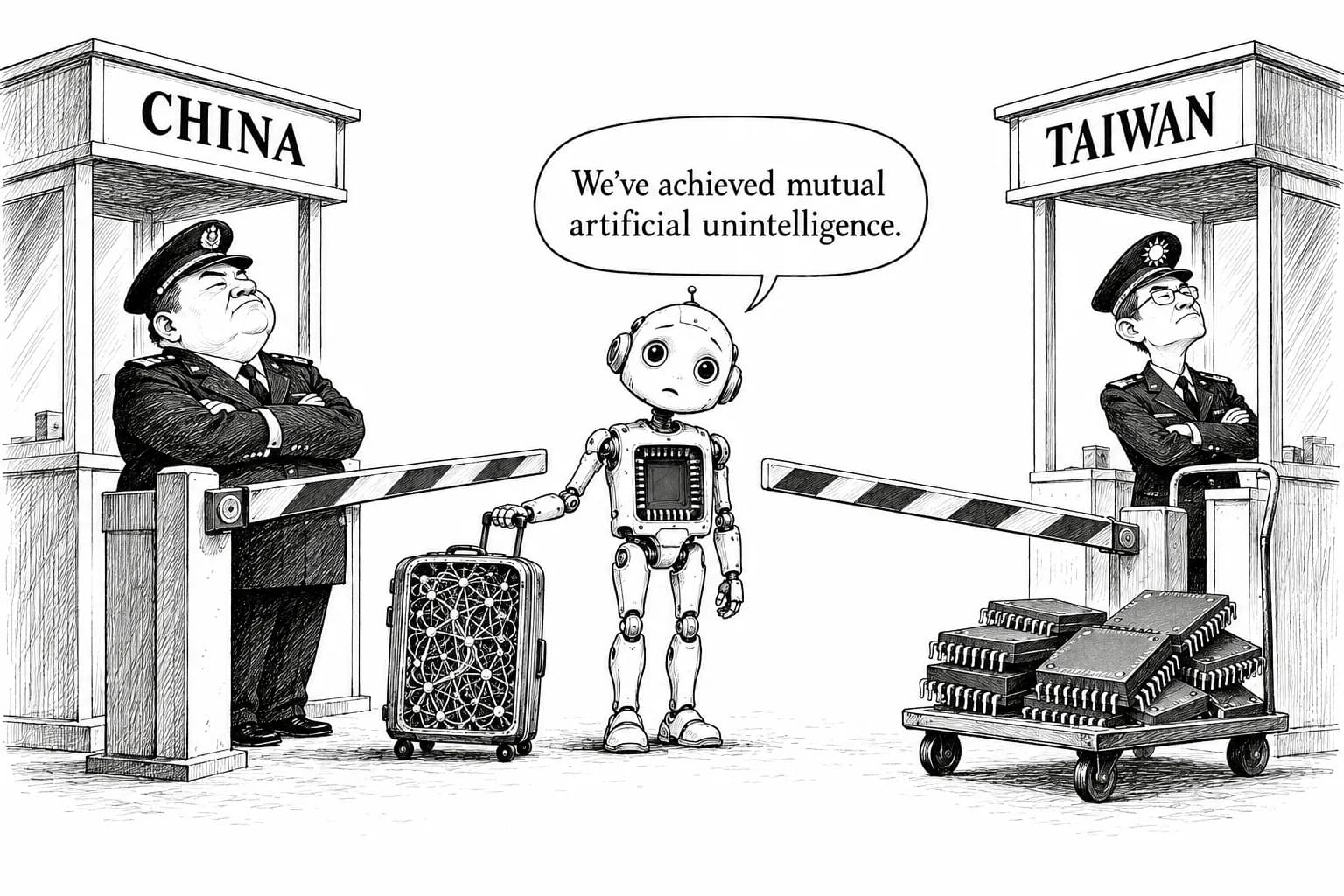
On the same day, Bloomberg reported that Taiwan said it would restrict exports of AI chips to China, reportedly as part of a trade deal with the U.S. Until now, AI export controls were something the U.S. imposed on China. On this day, China moved to keep its own AI from leaving the country, and Taiwan joined the effort to limit chips going to China. Controls are tightening from both the U.S. and Chinese sides at once.
China's proposal: treating models and agents as "technology exports"
Under China's technology export catalogue, transferring a listed technology abroad requires a government licence or registration. The new proposal creates AI as a separate category with 23 items. Bloomberg's headline names three of them: models, chips and agents.
Chinese state media outlet Global Times also reported the proposal the same day. Geopolitechs, which publishes analysis of U.S.-China technology issues, analysed the move under a headline describing it as imposing "temporary export registration." The arrangement appears to require notification when AI technology is sent abroad until the catalogue revision is formally adopted, but its scope and duration have not been confirmed.
The key issue is how weights are treated. Secondary sources say model weights that have not yet been released could be covered by the controls. If model weights are treated as "technology exports," Chinese labs would need government approval to hand weights to overseas offices or partners. If agents are included, controls could extend beyond standalone models to the harnesses and tool combinations that run them.
The impact on Chinese open-weight models is not yet clear
Chinese labs have kept releasing weights over the past month. StepFun on October 15 released the weights for Step 5 Preview (600B total, 27B active) on Hugging Face as it had announced. Xiaomi released MiMo-V2.6 under the MIT license in September, and Z.ai released GLM-5.3. OpenRouter's weekly token counts continue to show Chinese models well ahead of U.S. models. Released weights have been the main way Chinese AI has spread around the world.
If the proposal covers "unreleased" weights, the question becomes whether releases themselves will have to pass a government review. If sending pre-release weights abroad requires approval, joint evaluations with overseas researchers and companies, as well as pre-release testing on foreign clouds, would become subject to formal procedures. However, the secondary sources do not make clear how weights already on Hugging Face, or future decisions to release, would be handled. It remains to be seen whether the proposal will affect how rumoured models such as DeepSeek V4.1 Pro, Kimi K3.1 and GLM 5.5, expected between late October and November, are released.
Taiwan's announcement: more parties imposing restrictions
According to Bloomberg, Taiwan will curb AI chip exports to China as part of a trade deal with the U.S. The performance thresholds for covered chips and the timing of the rules have not been confirmed. Taiwan manufactures advanced AI chips. U.S. export controls have so far stopped chips from flowing to China mainly through U.S. companies and U.S. technology. If Taiwan itself starts imposing restrictions, routes for getting around the controls to reach China will narrow.
Seen alongside China's proposal, the picture becomes clearer. The U.S. and Taiwan are blocking the flow of compute (chips) into China. China is moving to control the outward flow of models and agents. The scope of what is being restricted has widened from hardware to weights, the core of the software, and the U.S. is no longer the only party doing the restricting.
What has not been confirmed
The available information does not confirm the following: what each of the 23 items contains, and which items are "prohibited" and which are "restricted"; the deadline for public comment and when the catalogue revision will be formally adopted; whether already-released weights and future release decisions are covered; and, for Taiwan's rules, the threshold for covered chips, the timing, and which provision of the trade deal with the U.S. they fall under.
Upcoming milestones include China's fifth plenum (October 26–29) and a U.S.-China dialogue on superintelligence scheduled to take place by November. While the U.S. and China are setting up a forum to discuss AI safety, both sides are also pressing ahead with procedures to restrict AI exports.
Editorial cartoon
Sources
- https://www.mofcom.gov.cn/zwgk/zcfb/art/2026/art_0a31a3c9ac404f7a9b0e917ce3412997.html
- https://www.globaltimes.cn/page/202610/1372418.shtml
- https://www.geopolitechs.org/p/china-imposes-temporary-export-registration
- https://www.bloomberg.com/news/articles/2026-10-16/china-proposes-export-controls-on-ai-models-chips-and-agents
- https://www.bloomberg.com/news/articles/2026-10-16/taiwan-to-curb-ai-chip-exports-to-china-as-part-of-us-trade-deal